This website uses cookies to enhance your browsing experience and ensure the functionality of our site. For more detailed information about the types of cookies we use and how we protect your privacy, please visit our Privacy Information page.
×
Cookie Settings
This website uses different types of cookies to enhance your experience. Please select your preferences below:
> Gobiiformes (Gobies) > Gobiidae (Gobies) > Gobiinae
Etymology: Cryptocentrus:Greek, kryptos = hidden + Greek, kentron = sting (Ref. 45335); cyanospilotus:Name from Greek word meaning blue-spotted; referring to the diagnostic feature colour pattern. The scientific name also refers to the previously published common name for this species, Bluespot Shrimpgoby.
Môi trường: môi trường / vùng khí hậu / Mức độ sâu / phạm vi phân phối Sinh thái học
biển cùng sống ở rạn san hô; mức độ sâu 2 - 18 m (Ref. 92356). Tropical
Western Pacific: Caroline Islands, Solomon Islands, Papua New Guinea, Indonesia, Malaysia, Philippines and Ryukyu Is.
Bộ gần gũi / Khối lượng (Trọng lượng) / Tuổi
Chín muồi sinh dục: Lm? range ? - ? cm Max length : 4.1 cm SL con đực/không giới tính; (Ref. 92356); 4.1 cm SL (female)
Mô tả ngắn gọn Khóa để định loại | Hình thái học | Sinh trắc học
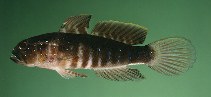
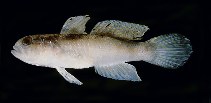
Các tia vây lưng cứng (tổng cộng) : 6 - 7; Các vây lưng mềm (tổng cộng) : 10; Tia cứng vây hậu môn: 1; Tia mềm vây hậu môn: 9. Characterized by the following: dorsal rays VI-I,10; anal rays I,9; pectoral rays usually 16; scales in longitudinal series 49-54; predorsal scales 10-13; scales ctenoid posteriorly on upper two-thirds of side anterior to level of about fifth or sixth soft dorsal ray; cycloid on lower side, including abdomen, prepelvic region, and pectoralfin base; head naked except side of nape and predorsal region, scales extending anteriorly to level of rear margin of preopercle; body depth at pelvic-fin origin 3.8-4.3 in SL; gill opening extending forward nearly to a vertical at posterior edge of preopercle; dorsal spines progressively longer to fourth, longest 1.1-1.4 in HL; rounded caudal fin, longer than head, 2.7-3.2 in SL; pectoral fins reaching to level of second dorsal-fin origin, 3.4-4.0 in SL; pelvic fins reaching posteriorly to about anus, 3.7-4.1 in SL; colour variable, generally pale to dark brown; male with about eight narrow pale bars on body and oblique brown bandson basal portion of dorsal fins; both sexes with small blue spots scattered on cheek and operculum, and similar spots on body more or less arranged in vertical rows with 2-4 spots per row; female often whitish or pale grey dorsally on head, sometimes with several dark brown and pale grey saddles along back, and elliptical orange spots on second dorsal fin; pelvic fins of both sexes frequently pale yellowish, sometimes white (Ref. 92356).
A relatively common species, observed in many occasions, and it occurs singly or in pairs. It is invariably associated with unidentified snapping shrimps of the genus Alpheus that share the same burrows, consisting of silty-sand bottoms in sheltered waters (Ref. 92356).
Vòng đời và hành vi giao phối Chín muồi sinh dục | Sự tái sinh sản | Đẻ trứng | Các trứng | Sự sinh sản | Ấu trùng
Allen, G.R. and J.E. Randall, 2011. Two new species of shrimp-associated gobies (Gobiidae: Cryptocentrus) from the Western Pacific. Marine Biology Research 7(6):554-564. (Ref. 92356)
Tình trạng Sách đỏ IUCN (Ref. 130435: Version 2025-2 (Global))
Sinh thái dinh dưỡng Thức ăn (con mồi) Thành phần thức ăn Thành phần thức ăn Khẩu phần ăn Các động vật ăn mồi
Sinh thái học Sinh thái học
Biến động dân số Các thông số tăng trưởng Độ tuổi / kích thước tối đa Chiều dài-trọng lượng tương đối Chiều dài-chiều dài tương đối. Chiều dài-tần số Chuyển đổi khối lượng Bổ xung Sự phong phú
Vòng đời Sự tái sinh sản Chín muồi sinh dục Độ trưởng thành/Mang liên quan Sự sinh sản Đẻ trứng Tập hợp sinh sản Các trứng Sự phát triển của trứng Ấu trùng Sự biến động ấu trùng
Chỉ số đa dạng phát sinh loài (Tài liệu tham khảo 82804): PD50 = 0.5000 [Uniqueness, from 0.5 = low to 2.0 = high].
Bayesian length-weight: a=0.00741 (0.00347 - 0.01582), b=3.09 (2.91 - 3.27), in cm total length, based on LWR estimates for this (Sub)family-body shape (Ref. 93245).
Mức dinh dưỡng (Tài liệu tham khảo 69278): 3.2 ±0.3 se; based on size and trophs of closest relatives
Thích nghi nhanh (Tài liệu tham khảo 120179): Chiêù cao, thời gian nhân đôi của chủng quần tối thiểu là dưới 15 tháng (Preliminary K or Fecundity.).
Sự dễ bị tổn thương của nghề đánh cá (Ref. 59153): Low vulnerability (10 of 100). 🛈