This website uses cookies to enhance your browsing experience and ensure the functionality of our site. For more detailed information about the types of cookies we use and how we protect your privacy, please visit our Privacy Information page.
×
Cookie Settings
This website uses different types of cookies to enhance your experience. Please select your preferences below:
> Gobiiformes (Gobies) > Gobiidae (Gobies) > Gobiinae
Etymology: Cryptocentrus:Greek, kryptos = hidden + Greek, kentron = sting (Ref. 45335); cyanospilotus:Name from Greek word meaning blue-spotted; referring to the diagnostic feature colour pattern. The scientific name also refers to the previously published common name for this species, Bluespot Shrimpgoby.
Environnement : milieu / zone climatique / profondeur / gamme de distribution Écologie
marin récifal; profondeur 2 - 18 m (Ref. 92356). Tropical
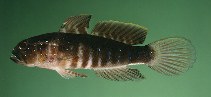
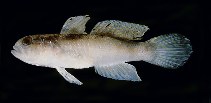
Épines dorsales (Total) : 6 - 7; Rayons mous dorsaux (Total) : 10; Épines anales: 1; Rayons mous anaux: 9. Characterized by the following: dorsal rays VI-I,10; anal rays I,9; pectoral rays usually 16; scales in longitudinal series 49-54; predorsal scales 10-13; scales ctenoid posteriorly on upper two-thirds of side anterior to level of about fifth or sixth soft dorsal ray; cycloid on lower side, including abdomen, prepelvic region, and pectoralfin base; head naked except side of nape and predorsal region, scales extending anteriorly to level of rear margin of preopercle; body depth at pelvic-fin origin 3.8-4.3 in SL; gill opening extending forward nearly to a vertical at posterior edge of preopercle; dorsal spines progressively longer to fourth, longest 1.1-1.4 in HL; rounded caudal fin, longer than head, 2.7-3.2 in SL; pectoral fins reaching to level of second dorsal-fin origin, 3.4-4.0 in SL; pelvic fins reaching posteriorly to about anus, 3.7-4.1 in SL; colour variable, generally pale to dark brown; male with about eight narrow pale bars on body and oblique brown bandson basal portion of dorsal fins; both sexes with small blue spots scattered on cheek and operculum, and similar spots on body more or less arranged in vertical rows with 2-4 spots per row; female often whitish or pale grey dorsally on head, sometimes with several dark brown and pale grey saddles along back, and elliptical orange spots on second dorsal fin; pelvic fins of both sexes frequently pale yellowish, sometimes white (Ref. 92356).
A relatively common species, observed in many occasions, and it occurs singly or in pairs. It is invariably associated with unidentified snapping shrimps of the genus Alpheus that share the same burrows, consisting of silty-sand bottoms in sheltered waters (Ref. 92356).
Cycle de vie et comportement reproducteur Maturité | Reproduction | Frai | Œufs | Fécondité | Larves
Allen, G.R. and J.E. Randall, 2011. Two new species of shrimp-associated gobies (Gobiidae: Cryptocentrus) from the Western Pacific. Marine Biology Research 7(6):554-564. (Ref. 92356)
Statut dans la liste rouge de l'IUCN (Ref. 130435: Version 2025-2 (Global))
Dynamique des populations Paramètres de croissance Âges / tailles maximales Longueur-poids rel. Rel. longueur-longueur. Fréquences de longueurs Conversion de masse Recrutement Abondance
Cycle de vie Reproduction Maturité Maturité/épines rel. Fécondité Frai Agrégats de frai Œufs Développement de l'œuf Larves Dynamique des populations larvaires
Physiologie Composition corporelle Nutriments Consommation d'oxygène Type de natation Vitesse de nage Pigments visuels Son de poisson Maladies et parasites Toxicité (CL50)
Indice de diversité phylogénétique (Réf. 82804): PD50 = 0.5000 [Uniqueness, from 0.5 = low to 2.0 = high].
Bayesian length-weight: a=0.00741 (0.00347 - 0.01582), b=3.09 (2.91 - 3.27), in cm total length, based on LWR estimates for this (Sub)family-body shape (Ref. 93245).
Niveau trophique (Réf. 69278): 3.2 ±0.3 se; based on size and trophs of closest relatives
Résilience (Réf. 120179): Haut, temps minimum de doublement de population inférieur à 15 mois (Preliminary K or Fecundity.).
Vulnérabilité de la pêche (Ref. 59153): Low vulnerability (10 of 100). 🛈