



Hypostomus arecuta Cardoso, Almirón, Casciotta, Aichino, Lizarralde & Montoya-Burgos, 2012
Hochladen Photos und videos
Bilder | Google Bild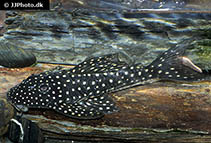 Hypostomus arecuta
Photo von JJPhoto
Bilder | Google Bild
Photo von JJPhoto
Klassifizierung / Names Namen | Synonyme | Catalog of Fishes(Gattung, Arten) | ITIS | CoL | WoRMS | Cloffa
> Siluriformes (Catfishes) > Loricariidae (Armored catfishes) > Hypostominae
Etymology: Hypostomus: Greek, hypo = under + Greek, stoma = mouth (Ref. 45335); arecuta: Named from a Guaraní word arecutá, meaning loricariid fish.
Etymology: Hypostomus: Greek, hypo = under + Greek, stoma = mouth (Ref. 45335); arecuta: Named from a Guaraní word arecutá, meaning loricariid fish.
Umwelt: Milieu / Klimazone / Tiefenbereich / Verbreitungsgebiet Ökologie
; süßwasser demersal; pH range: 6.8 - 7.1. Subtropical
Verbreitung Territorien | FAO Gebiete | Ökosysteme | Vorkommen | Punkt Karte | Einführungen | Faunafri
South America: Paraná river in Argentina.
Größe / Gewicht / Alter
Kurzbeschreibung Bestimmungsschlüssel | Morphologie | Morphometrie
Rückenflossenstacheln (insgesamt) : 2; Rückenflossenweichstrahlen (insgesamt) : 7; Afterflossenstacheln: 1; Afterflossenweichstrahlen: 4. Differs from its congeners by the following combination of characters: dorsum of head and body and all fins dark grey covered by numerous rounded cream dots; ventral surface of head and belly a plain cream color; 66-85 premaxillary/dentary teeth; cleithral width 3.0-3.4 in SL; abdominal length 3.9-4.5 in SL; eye diameter 5.2-6.2 in HL; pelvic fin-spine length 3.9-4.5 in SL; caudal peduncle depth 8.3-9.6 in SL; upper caudal-ray length 2.8-3.6 in SL; lower caudal-ray length 2.4-3.5 in SL; right mandibular ramus 3.9-4.6 in HL; dorsal spine length with mean 31.6 % SL; length of right mandibular ramus 3.9-4.6 in HL; abdominal length 3.9-4.5 in SL; head depth 1.6-1.7 in HL;, interorbital width 2.6-3.0 in HL; predorsal length 2.3-2.6 in SL; pectoral-fin spine length 2.8-3.3 in SL; caudal peduncle length 3.0-3.6 in SL; scutes along lateral line 26-28 (mode 27); scutes between end of dorsal fin to adipose fin 5-6 (mode 6) ; scutes from adipose to caudal fins 3-5 (mode 5), and scutes from anal to caudal fins 12-14 (mode 14) (Ref. 91776).
Body shape (shape guide): elongated.
Body shape (shape guide): elongated.
Facultative air-breathing in the genus (Ref. 126274); Found in coastal areas of main river channel with bottom composed mostly by large boulders of sandstone with patches of sand and pebbles. Occurs in well oxygenated waters having moderate current speed, about 0.60 m s-1, water transparency of 1.5-2.40 m and conductivity of 50.9-59.6 μS cm-1 . Sympatric with Hypostomus commersoni, H. cochliodon,, H. uruguayensis, H. latifrons, H. ternetzi, H. luteomaculatus, H. microstomus, and H. boulengeri (Ref. 91776).
Lebenszyklus und Paarungsverhalten Geschlechtsreife | Fortpflanzung | Ablaichen | Eier | Fruchtbarkeit | Larven
Hauptreferenz
Laden Sie Ihre Referenzen hoch | Referenzen | Koordinator : Fisch-Muller, Sonia | Partner
Cardoso, Y.P., A. Almirón, J. Casciotta, D. Aichino, M.S. Lizarralde and J.I. Montoya-Burgos, 2012. Origin of species diversity in the catfish genus Hypostomus (Siluriformes: Loricariidae) inhabiting the Paraná river basin, with the description of a new species. Zootaxa 3453:69-83. (Ref. 91776)
CITES
Not Evaluated
Bedrohung für Menschen
Harmless
Nutzung durch Menschen
Fischereien: nicht kommerziell
FAO - Publication: search | FishSource |
Mehr Information
Trophische Ökologie
Lebensmittel (Beutetiere)
Nahrungszusammensetzung
Nahrungsaufnahme
Lebensmittelrationen
Räuber
Lebensmittel (Beutetiere)
Nahrungszusammensetzung
Nahrungsaufnahme
Lebensmittelrationen
Räuber
Ökologie
Ökologie
Ökologie
Populationsdynamik
Wachstumsparameter
Max. Alter/Größen
Länge-Gewicht-Rel.
Länge-Länge-Verhältnis.
Längenhäufigkeiten
Massenkonvertierung
Rekrutierung
Dichte
Wachstumsparameter
Max. Alter/Größen
Länge-Gewicht-Rel.
Länge-Länge-Verhältnis.
Längenhäufigkeiten
Massenkonvertierung
Rekrutierung
Dichte
Lebenszyklus
Fortpflanzung
Geschlechtsreife
Reifung/Kiemen rel.
Fruchtbarkeit
Ablaichen
Laichaggregationen
Eier
Eientwicklung
Larven
Larven Pop.Dyn.
Fortpflanzung
Geschlechtsreife
Reifung/Kiemen rel.
Fruchtbarkeit
Ablaichen
Laichaggregationen
Eier
Eientwicklung
Larven
Larven Pop.Dyn.
Anatomie
Kiemenoberfläche
Gehirn
Otolith
Kiemenoberfläche
Gehirn
Otolith
Physiologie
Körperliche Zusammensetzung
Nährstoffe
Sauerstoffverbrauch
Schwimmart
Schwimmgeschwindigkeit
Visuelle Pigmente
Fischgeräusche
Krankheiten und Parasiten
Toxizität (LC50s)
Körperliche Zusammensetzung
Nährstoffe
Sauerstoffverbrauch
Schwimmart
Schwimmgeschwindigkeit
Visuelle Pigmente
Fischgeräusche
Krankheiten und Parasiten
Toxizität (LC50s)
Genetik
Genom
Genetik
Heterozygotie
Vererbbarkeit
Genetische Vielfalt
Genom
Genetik
Heterozygotie
Vererbbarkeit
Genetische Vielfalt
Menschenbezogen
Aquakultur-Systeme
Aquakultur Profile
Zuchtlinien
Ciguatera-Fälle
Briefmarken, Münzen, Verschiedenes.
Aquakultur-Systeme
Aquakultur Profile
Zuchtlinien
Ciguatera-Fälle
Briefmarken, Münzen, Verschiedenes.
Tools
Zusatzinformationen
Download XML
Zusammenfassung | Punktdaten | Namen | Photos
Internet Quellen
AFORO (otoliths) | Aquatic Commons | BHL | Cloffa | Websites from users | FishWatcher Einträge suchen | CISTI | Catalog of Fishes: Gattung, Arten | DiscoverLife | ECOTOX | FAO - Publication: search | Faunafri | Fishipedia | Fishtrace | GloBI | Google Books | Google Scholar | Google | IGFA World Record | OneZoom | Open Tree of Life | Otolith Atlas of Taiwan Fishes | PubMed | Reef Life Survey | Socotra Atlas | TreeBase | Tree of Life | Wikipedia: Gehe zu, Suchen | World Records Freshwater Fishing | Zoobank | Zoologischer Rekord
Schätzungen auf der Grundlage von Modellen
Phylogenetischer Diversitätsindex (Ref. 82804): PD50 = 0.5000 [Uniqueness, from 0.5 = low to 2.0 = high].
Bayesian length-weight: a=0.01585 (0.00726 - 0.03460), b=2.95 (2.78 - 3.12), in cm total length, based on LWR estimates for this Genus-body shape (Ref. 93245).
Widerstandsfähigkeit (Ref. 120179): mittel, Verdopplung der Population dauert 1,4 - 4,4 Jahre. (Preliminary K or Fecundity.).