



Photonectes paxtoni Flynn & Klepadlo, 2012
Carica il tuo foto e Video
Google image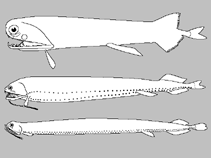 No image available for this species;
drawing shows typical species in Stomiidae.
Google image
drawing shows typical species in Stomiidae.
Classificazione / Nomi Nomi Comuni | Sinonimi | Catalog of Fishes(Genere, Specie) | ITIS | CoL | WoRMS | Cloffa
> Stomiiformes (Lightfishes and dragonfishes) > Stomiidae (Barbeled dragonfishes) > Melanostomiinae
Etymology: Photonectes: Greek, photos = light + Greek, nekton = swimmer (Ref. 45335); paxtoni: Named for Dr. John Paxton for his many contributions to the study of mesopelagic fishes and his encouragement to the authors.
Eponymy: Dr John Richard Paxton (d: 1938) is an American-born Australian ichthyologist. [...] (Ref. 128868), visit book page.
Etymology: Photonectes: Greek, photos = light + Greek, nekton = swimmer (Ref. 45335); paxtoni: Named for Dr. John Paxton for his many contributions to the study of mesopelagic fishes and his encouragement to the authors.
Eponymy: Dr John Richard Paxton (d: 1938) is an American-born Australian ichthyologist. [...] (Ref. 128868), visit book page.
Ambiente: milieu / zona climatica / distribuzione batimetrica / gamma di distribuzione Ecologia
marino pelagic-oceanic; distribuzione batimetrica 130 - 135 m (Ref. 92891). Tropical
Distribuzione Territories | Aree FAO | Ecosistemi | Presenze | Mappa dei ritrovamenti | Introduzioni | Faunafri
Western Pacific Ocean; Papua New Guinea.
Dimensione / Peso / Età
Breve descrizione Chiavi di identificazione | Morfologia | Morfometria
Raggi dorsali molli (totale) : 16 - 18; Raggi anali molli: 18. This species is distinguished from other members of the subgenus Photonectes in the following set of characters: short barbel with a very enlarged ovoid terminal bulb without terminal appendages; no blue luminous tissue; reduced length of gill filaments on first branchial arch, less than arch depth; VAV photophores 15-16 (vs. 0-15), AC photophores 13 (vs. 9-12), IV photophores 29 (vs. 30-46); bulb is plain (without filaments) and remarkably large. This species is similar to P. ovibarba (synonym of P. braueri) in having an enlarged bulb but is without pectoral fins (vs. present, with 2 rays each), IV photophores 29 (vs. 32-33), AC photophores 13 (vs. 10-12), the bulb has no terminal appendage (vs. bearing a small ovoid appendage); from another species with a large bulb, P. fimbria (synonym of P. parvimanus), IV photophores 29 (vs. 43-49), IP photophores insert halfway along the isthmus, or with gap (vs. insert near mandibular symphysis or no gap), no thick skin (vs. thick skin over dorsal- and anal-fin rays), no flap or terminal appendage; growth change unknown (vs. bulb with terminal flap increasing with growth) (Ref. 92891).
Body shape (shape guide): elongated.
Body shape (shape guide): elongated.
Ciclo vitale e comportamento di accoppiamento Maturità | Riproduzione | Deposizione | Uova | Fecondità | Larve
Riferimento principale
Caricare le referenze | Bibliografia | Coordinatore | Collaboratori
Flynn, A.J. and C. Klepadlo, 2012. Two new species of Photonectes (Teleostei: Stomiidae) from the Indo-Pacific, and a re-examination of P. achirus. Memoirs of Museum Victoria 69: 259-267. (Ref. 92891)
Stato della Lista Rossa IUCN (Ref. 130435: Version 2025-2 (Global))
Data deficient (DD) ; Date assessed: 15 August 2019
CITES
Not Evaluated
Minaccia per l'uomo
Harmless
Usi umani
FAO - Publication: search | FishSource |
Informazioni ulteriori
Ecologia trofica
Articoli alimentari (prede)
Alimentazione
Consumo di cibo
Razioni alimentari
Predatori
Articoli alimentari (prede)
Alimentazione
Consumo di cibo
Razioni alimentari
Predatori
Ecologia
Ecologia
Ecologia
Dinamica della popolazione
Parametri di crescita
Età massima / dimensioni massime
Rapporto lunghezza-peso.
Lunghezza-lunghezza rel.
Lunghezza-frequenze
Conversione di massa
Reclutamento
Abbondanza
Parametri di crescita
Età massima / dimensioni massime
Rapporto lunghezza-peso.
Lunghezza-lunghezza rel.
Lunghezza-frequenze
Conversione di massa
Reclutamento
Abbondanza
Ciclo di vita
Riproduzione
Maturità
Maturità/Gli occhielli sono relativi.
Fecondità
Deposizione
Aggregazioni riproduttive
Uova
Sviluppo delle uova
Larve
Dinamica popolazioni larvali
Riproduzione
Maturità
Maturità/Gli occhielli sono relativi.
Fecondità
Deposizione
Aggregazioni riproduttive
Uova
Sviluppo delle uova
Larve
Dinamica popolazioni larvali
Anatomia
Area branchiale
Cervello
Otolite
Area branchiale
Cervello
Otolite
Fisiologia
Composizione corporea
Nutrienti
Consumo di ossigeno
Tipo di nuoto
Velocità di nuoto
Pigmenti visivi
Suono del pesce
Malattie e parassiti
Tossicità (LC50)
Composizione corporea
Nutrienti
Consumo di ossigeno
Tipo di nuoto
Velocità di nuoto
Pigmenti visivi
Suono del pesce
Malattie e parassiti
Tossicità (LC50)
Genetica
Genome
Genetica
Eterozigosi
Ereditarietà
Diversità genetica
Genome
Genetica
Eterozigosi
Ereditarietà
Diversità genetica
Legato all'uomo
Sistemi di acquacoltura
Profili di acquacoltura
Varietà
Casi di Ciguatera
Francobolli, monete, materiale vario.
Sistemi di acquacoltura
Profili di acquacoltura
Varietà
Casi di Ciguatera
Francobolli, monete, materiale vario.
Strumenti
Libro elettronico | Giuda pratica | Generatore frequenze di lunghezza | Strumento Parametri Biologici | Mappa dei ritrovamenti |
Cattura-MSY |
Rapporti speciali
Controllo della manutenzione dell'acquario | Verificare la presenza di schede informative sulle specie | Verifica delle schede informative sull'acquacoltura
Scarica XML
Fonti Internet
AFORO (otoliths) | Aquatic Commons | BHL | Cloffa | Websites from users | Check FishWatcher | CISTI | Catalog of Fishes: Genere, Specie | DiscoverLife | ECOTOX | FAO - Publication: search | Faunafri | Fishipedia | Fishtrace | GloBI | Google Books | Google Scholar | Google | IGFA World Record | OneZoom | Open Tree of Life | Otolith Atlas of Taiwan Fishes | PubMed | Reef Life Survey | Socotra Atlas | TreeBase | Tree of Life | Wikipedia: Go, ricerca | World Records Freshwater Fishing | Zoobank | Record zoologico
Stime basate su modelli
Indice di diversità filogenetica (Fonte Biblio. 82804): PD50 = 0.5000 [Uniqueness, from 0.5 = low to 2.0 = high].
Bayesian length-weight: a=0.00302 (0.00115 - 0.00790), b=3.11 (2.88 - 3.34), in cm total length, based on LWR estimates for this (Sub)family-body shape (Ref. 93245).
Livello trofico (Fonte Biblio. 69278): 3.1 ±0.5 se; based on size and trophs of closest relatives