



Photonectes paxtoni Flynn & Klepadlo, 2012
Uploaden van uw Foto's en video's
Google afbeelding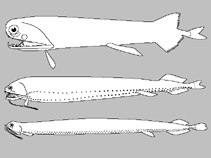 No image available for this species;
drawing shows typical species in Stomiidae.
Google afbeelding
drawing shows typical species in Stomiidae.
Classificatie / Namen Lokale namen | Synoniemen | Catalog of Fishes(Genus, Soort(en)) | ITIS | CoL | WoRMS | Cloffa
> Stomiiformes (Lightfishes and dragonfishes) > Stomiidae (Barbeled dragonfishes) > Melanostomiinae
Etymology: Photonectes: Greek, photos = light + Greek, nekton = swimmer (Ref. 45335); paxtoni: Named for Dr. John Paxton for his many contributions to the study of mesopelagic fishes and his encouragement to the authors.
Eponymy: Dr John Richard Paxton (d: 1938) is an American-born Australian ichthyologist. [...] (Ref. 128868), visit book page.
Etymology: Photonectes: Greek, photos = light + Greek, nekton = swimmer (Ref. 45335); paxtoni: Named for Dr. John Paxton for his many contributions to the study of mesopelagic fishes and his encouragement to the authors.
Eponymy: Dr John Richard Paxton (d: 1938) is an American-born Australian ichthyologist. [...] (Ref. 128868), visit book page.
Milieu: milieu / Klimaatzone / Diepte / verspreidingsgebied Ecologie
marien pelagic-oceanic; diepte 130 - 135 m (Ref. 92891). Tropical
Verspreiding Gebieden | FAO regio's | Ecosystemen | Voorkomen | Verspreidingskaart | Introducties | Faunafri
Western Pacific Ocean; Papua New Guinea.
Grootte / Gewicht / Leeftijd
Korte beschrijving Determinatiesleutels | Morfologie | Morfometrie
Dorsale zachte stralen (totaal) : 16 - 18; Anale zachte stralen: 18. This species is distinguished from other members of the subgenus Photonectes in the following set of characters: short barbel with a very enlarged ovoid terminal bulb without terminal appendages; no blue luminous tissue; reduced length of gill filaments on first branchial arch, less than arch depth; VAV photophores 15-16 (vs. 0-15), AC photophores 13 (vs. 9-12), IV photophores 29 (vs. 30-46); bulb is plain (without filaments) and remarkably large. This species is similar to P. ovibarba (synonym of P. braueri) in having an enlarged bulb but is without pectoral fins (vs. present, with 2 rays each), IV photophores 29 (vs. 32-33), AC photophores 13 (vs. 10-12), the bulb has no terminal appendage (vs. bearing a small ovoid appendage); from another species with a large bulb, P. fimbria (synonym of P. parvimanus), IV photophores 29 (vs. 43-49), IP photophores insert halfway along the isthmus, or with gap (vs. insert near mandibular symphysis or no gap), no thick skin (vs. thick skin over dorsal- and anal-fin rays), no flap or terminal appendage; growth change unknown (vs. bulb with terminal flap increasing with growth) (Ref. 92891).
Body shape (shape guide): elongated.
Body shape (shape guide): elongated.
Levenscyclus en paargedrag Maturiteit | Voortplanting | Paaien | Eieren | Fecunditeit | Larven
Hoofdreferentie
Upload uw referenties | Referenties | Coördinator | Medewerkers
Flynn, A.J. and C. Klepadlo, 2012. Two new species of Photonectes (Teleostei: Stomiidae) from the Indo-Pacific, and a re-examination of P. achirus. Memoirs of Museum Victoria 69: 259-267. (Ref. 92891)
Status op de Rode Lijst van het IUCN (Ref. 130435: Version 2025-2 (Global))
Onvoldoende gegevens (DD) ; Date assessed: 15 August 2019
CITES
Not Evaluated
Gevaar voor de mens
Harmless
Gebruik door de mens
FAO - Publication: search | FishSource |
Meer informatie
Trofische ecologie
Voedsel (prooien)
Dieetsamenstelling
Voedselconsumptie
Voedselrantsoenen
Predatoren
Voedsel (prooien)
Dieetsamenstelling
Voedselconsumptie
Voedselrantsoenen
Predatoren
Ecologie
Ecologie
Ecologie
Populatiedynamica
Groeiparameters
Max. leeftijden / maten
Lengte-gewicht rel.
Lengte-lengte rel.
Lengtefrequenties
Massaconversie
Rekrutering
Abundantie
Groeiparameters
Max. leeftijden / maten
Lengte-gewicht rel.
Lengte-lengte rel.
Lengtefrequenties
Massaconversie
Rekrutering
Abundantie
Levenscyclus
Voortplanting
Maturiteit
Rijpheid/kieuwen rel.
Fecunditeit
Paaien
Paaibestanden
Eieren
Ontwikkeling van de eieren
Larven
Larvale populatiedynamiek
Voortplanting
Maturiteit
Rijpheid/kieuwen rel.
Fecunditeit
Paaien
Paaibestanden
Eieren
Ontwikkeling van de eieren
Larven
Larvale populatiedynamiek
Anatomie
Kieuwoppervlak
Hersenen
Otoliet
Kieuwoppervlak
Hersenen
Otoliet
Fysiologie
Lichaamssamenstelling
Voedingsstoffen
Zuurstofverbruik
Type zwemmen
Zwemsnelheid
Visuele pigmenten
Vis geluid
Ziekten en parasieten
Toxiciteit (LC50)
Lichaamssamenstelling
Voedingsstoffen
Zuurstofverbruik
Type zwemmen
Zwemsnelheid
Visuele pigmenten
Vis geluid
Ziekten en parasieten
Toxiciteit (LC50)
Genetica
genoom
Genetica
Heterozygositeit
Erfelijkheid
Genetische diversiteit
genoom
Genetica
Heterozygositeit
Erfelijkheid
Genetische diversiteit
Menselijk gerelateerd
Aquacultuursystemen
Aquacultuurprofielen
Kweeklijnen
Ciguatera gevallen
Postzegels, munten, diversen.
Aquacultuursystemen
Aquacultuurprofielen
Kweeklijnen
Ciguatera gevallen
Postzegels, munten, diversen.
Tools
Speciale rapporten
Bekijk gegevens voor het houden in een aquarium | Bekijk Fact Sheets voor de soort | Bekijk Aquacultuur Fact Sheets
Download XML
Internetbronnen
AFORO (otoliths) | Aquatic Commons | BHL | Cloffa | Websites from users | Bekijk FishWatcher | CISTI | Catalog of Fishes: Genus, Soort(en) | DiscoverLife | ECOTOX | FAO - Publication: search | Faunafri | Fishipedia | Fishtrace | GloBI | Google Books | Google Scholar | Google | IGFA World Record | OneZoom | Open Tree of Life | Otolith Atlas of Taiwan Fishes | PubMed | Reef Life Survey | Socotra Atlas | TreeBase | Tree of Life | Wikipedia: ga naar, zoek | World Records Freshwater Fishing | Zoobank | Zoological Record
Schattingen op basis van modellen
Fylogenetische diversiteitsindex (Ref. 82804): PD50 = 0.5000 [Uniqueness, from 0.5 = low to 2.0 = high].
Bayesian length-weight: a=0.00302 (0.00115 - 0.00790), b=3.11 (2.88 - 3.34), in cm total length, based on LWR estimates for this (Sub)family-body shape (Ref. 93245).
Trofisch niveau (Ref. 69278): 3.1 ±0.5 se; based on size and trophs of closest relatives