



Potamorrhaphis labiata Sant'Anna, Delapieve & Reis, 2012
分类 / 名称 俗名 | 同种异名 | Catalog of Fishes(属, 种) | ITIS | CoL | WoRMS | Cloffa
Teleostei > Beloniformes (Needle fishes) 頜針魚目 (Needle fishes) > Belonidae (Needlefishes) 頜針魚科 (Needlefishes)
Etymology: Potamorrhaphis: Greek, potamos = river + Greek, rhaphis = needle (Ref. 45335); labiata: Name from Latin word meaning large-lipped, referring to the expanded labial membrane diagnostic of this species; an adjective.
Etymology: Potamorrhaphis: Greek, potamos = river + Greek, rhaphis = needle (Ref. 45335); labiata: Name from Latin word meaning large-lipped, referring to the expanded labial membrane diagnostic of this species; an adjective.
环境:氛围 / 气候带 / 深度上下限 / 分布范围 生态学
; 淡水 大洋性; 深度上下限 0 - ? m.
分布 领土 | FAO区域 | 生态系 | 标本纪录 | 分布图 | 简介 | Faunafri
South America: Brazil.
大小 / 重量 / 年龄
成熟度: Lm ? range ? - ? cm
Max length : 17.5 cm OT 雄鱼/尚未辨别雌雄; (Ref. )
Max length : 17.5 cm OT 雄鱼/尚未辨别雌雄; (Ref. )
简单描述 检索表 | 型态特徵 | 形态测量图
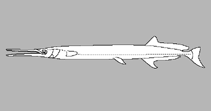
背的软条 (总数) : 29 - 34; 臀鳍软条: 25 - 29. This species can be distinguished from Potamorrhaphis eigenmanni and P. guianensis by having the posterior third of the labial membrane highly expanded laterally, reaching to or passing the level of the ventral margin of the maxilla when folded ventrally (vs. narrow, not reaching the level of the ventral margin of the maxilla when folded ventrally); from P. eigenmanni by having 3 rows of accessory teeth on the lower jaw (vs. 2 rows), and 115-128 scales on the lateral line (vs. 97-119); from P. guianensis by having the contralateral branchiostegal membranes overlapping in the midventral line (vs. branchiostegal membranes not overlapping ventrally), 3 rows of accessory teeth on the lower jaw (vs. 4 rows), and dentary with coronoid process salient (vs. coronoid process not salient); from P. petersi by the coloration of the labial membrane with melanophores only in the inner margin (vs. melanophores uniformly distributed), 29-34 dorsal-fin rays (vs. 35-43), 25-29 anal-fin rays (vs. 30-39), deeper caudal peduncle (2.1-2.7 vs. 1.1-1.6% BL), longer predorsal length (62.9-67.6 vs. 59.5-62.8% BL), longer pectoral-pelvic distance (38.5-42.6 vs. 36.0-38.1% BL), and longer head length (17.6-18.9 versus 15.8-17.9% BL) (Ref. 92518).
Length type used is body length (BL), measured from the anterior margin of the nasal bone to the hypural plate (Ref. 92518).
生命周期和交配行为 成熟度 | 繁殖 | 产卵场 | 卵 | 孕卵数 | 仔鱼
主要参考文献
上传您的参考资料 | 参考文献 | 合作者 : Collette, Bruce B. | 合作者
Sant'Anna, V.B., M.L.S Delapieve and R.E. Reis, 2012. A new species of Potamorrhaphis (Beloniformes: Belonidae) from the Amazon Basin. Copeia, 2012(4):663-669. (Ref. 92518)
CITES
Not Evaluated
对人类的威胁
人类利用
FAO - Publication: search | FishSource |
更多信息
营养生态学
食物(猎物)
食性组成
食物消耗量
口粮
捕食者
食物(猎物)
食性组成
食物消耗量
口粮
捕食者
生态学
生态学
生态学
人口动态
成长参数
最大年龄/尺寸
长度-重量关系
长短关系
体长-频率
质量转换
入添量
丰度
成长参数
最大年龄/尺寸
长度-重量关系
长短关系
体长-频率
质量转换
入添量
丰度
解剖学
鳃区
大脑
耳石
鳃区
大脑
耳石
生理学
身体成分
营养素
耗氧量
游泳类型
游泳速度
视觉色素
鱼声
疾病与寄生虫
毒性(半数致死浓度)
身体成分
营养素
耗氧量
游泳类型
游泳速度
视觉色素
鱼声
疾病与寄生虫
毒性(半数致死浓度)
遗传学
基因组
遗传学
异质性
遗传率
基因多样性
基因组
遗传学
异质性
遗传率
基因多样性
工具
特别资料
下载 XML
网络资源
AFORO (otoliths) | Aquatic Commons | BHL | Cloffa | Websites from users | 核实 FishWatcher | CISTI | Catalog of Fishes: 属, 种 | DiscoverLife | ECOTOX | FAO - Publication: search | Faunafri | Fishipedia | Fishtrace | GloBI | Google Books | Google Scholar | Google | IGFA World Record | OneZoom | Open Tree of Life | Otolith Atlas of Taiwan Fishes | PubMed | Reef Life Survey | Socotra Atlas | TreeBase | 树状分类阶层 | Wikipedia: 转至, 搜寻 | World Records Freshwater Fishing | 动物学的记录
基于模型的估算
系统发育多样性指数 (参考文献 82804): PD50 = 0.5625 [Uniqueness, from 0.5 = low to 2.0 = high].
Bayesian length-weight: a=0.00126 (0.00057 - 0.00279), b=3.11 (2.93 - 3.29), in cm total length, based on LWR estimates for this (Sub)family-body shape (Ref. 93245).
营养阶层 (参考文献 69278): 3.9 ±0.6 se; based on size and trophs of closest relatives
回复力 (参考文献 120179): 高度, 族群倍增时间少于 15个月 (Preliminary K or Fecundity.).