This website uses cookies to enhance your browsing experience and ensure the functionality of our site. For more detailed information about the types of cookies we use and how we protect your privacy, please visit our Privacy Information page.
×
Cookie Settings
This website uses different types of cookies to enhance your experience. Please select your preferences below:
> Ovalentaria/misc (Various families in series Ovalentaria) > Pomacentridae (Damselfishes) > Pomacentrinae
Etymology: Acanthochromis:Greek, akantha = thorn + Greek, chromis = a marine fish without identification, dealing with perch; cited by Plinius (Ref. 45335). More on author: Bleeker.
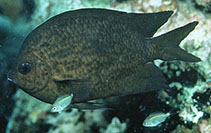
Taggstrålar i ryggfenan (totalt) : 17; Mjukstrålar i ryggfenan (totalt) : 14 - 16; Taggstrålar i analfenan: 2; Mjukstrålar i analfenan: 14 - 16. Body shape (shape guide): short and / or deep; Cross section: compressed.
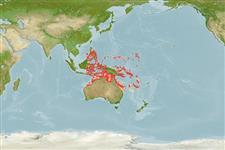
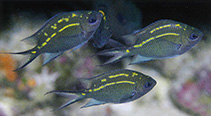
Adults inhabit inshore and offshore coral reefs (Ref. 9710). Also found in harbors, lagoons and outer reef slopes. The only pomacentrid species that lacks a pelagic larval stage. One of the very few marine fishes where fry are guarded by the parents (Ref. 9710, 48636). School as they grow and sub-adults are usually seen in small groups. Adults form pairs and are territorial when breeding (Ref. 48636). Monogamous (Ref. 52884). Oviparous (Ref. 205). Eggs are demersal and adhere to the substrate (Ref. 205). Males guard and aerate the eggs (Ref. 205).
Oviparous, distinct pairing during breeding (Ref. 205). Monogamous mating is observed as both obligate and genetic (Ref. 52884). Eggs are demersal and adhere to the substrate (Ref. 205). Males guard and aerate the eggs (Ref. 205). Does not have a juvenile bisexual phase and all males have the typical testicular morphology of gonochores (Ref. 103751).
Önskad temperatur (Ref. 123201): 25.1 - 28.9, mean 27.8 °C (based on 458 cells).
Index för fylogenetisk mångfald (Ref. 82804): PD50 = 1.0000 [Uniqueness, from 0.5 = low to 2.0 = high].
Bayesian length-weight: a=0.03236 (0.01943 - 0.05389), b=3.04 (2.89 - 3.19), in cm total length, based on LWR estimates for this species & (Sub)family-body (Ref. 93245).
Trofisk nivå (Ref. 69278): 2.7 ±0.30 se; based on food items.
Resiliens (Ref. 120179): Hög, lägsta populationsfördubblingstid mindre än 15 månader (Preliminary K or Fecundity.).
Sårbarhet i fisket (Ref. 59153): Low vulnerability (13 of 100). 🛈