



Carregue seu(sua) Fotos e vídeos
Imagem do Google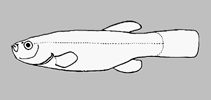 No image available for this species;
drawing shows typical species in Cyprinodontidae.
Imagem do Google
drawing shows typical species in Cyprinodontidae.
Classificação / Nomes Nomes comuns | Sinônimos | Catalog of Fishes(Gênero, Espécies) | ITIS | CoL | WoRMS | Cloffa
> Cyprinodontiformes (Rivulines, killifishes and live bearers) > Cyprinodontidae (Pupfishes) > Orestiinae
Etymology: Orestias: After Orestes in the Greek mythology?; gloriae: The specific epithet gloriae honors the research work of Gloria Arratia on Chilean fishes, and especially those of the Andean region (Ref. 89071).
Eponymy: Orestis or Orestes is a Greek name meaning “he who stands on the mountain”. [...] Dr Gloria Arratia is a Chilean biologist, ichthyologist and ichthyo-palaeontologist whose research focus is fish evolution, particularly of ‘ray-finned’ fish. [...] (Ref. 128868), visit book page.
Etymology: Orestias: After Orestes in the Greek mythology?; gloriae: The specific epithet gloriae honors the research work of Gloria Arratia on Chilean fishes, and especially those of the Andean region (Ref. 89071).
Eponymy: Orestis or Orestes is a Greek name meaning “he who stands on the mountain”. [...] Dr Gloria Arratia is a Chilean biologist, ichthyologist and ichthyo-palaeontologist whose research focus is fish evolution, particularly of ‘ray-finned’ fish. [...] (Ref. 128868), visit book page.
Meio ambiente: milieu / Zona climática / intervalo de profundidade / faixa de distribuição Ecologia
; Água doce pelágico(a,os,as). High altitude; 21°S - 22°S, 68°W - 69°W
Distribuição Territórios | Áreas da FAO | Ecossistemas | Ocorrências | Mapa de pontos | Introduções | Faunafri
South America: Chile. Loa Province, springs of Carcote saltpan (Ref. 89071).
Tamanho / Peso / Idade
Maturidade: Lm ? range ? - ? cm
Max length : 3.8 cm SL macho/indeterminado; (Ref. 89071); 7.0 cm (female)
Max length : 3.8 cm SL macho/indeterminado; (Ref. 89071); 7.0 cm (female)
Descrição suscinta Chaves de identificação | Morfologia | Morfometria
A relatively slender-bodied species, Orestias gloriae is clearly distinguished from all other species of Orestias by the following unique characters: (1) The lyre-shaped pattern of dorsal neuromasts, which is characteristics of Orestias is reduced to the rostral and anterior supraorbital lines formed by small neuromasts followed caudally by few and large isolated neuromasts, which are irregularly placed. (2) The infraorbital line of neuromasts is represented by a discontinuous series of few small neuromasts. (3) The supraorbital line of neuromasts is not connected with both the infraorbital and preopercle-mandibular lines. (4) The skull roof is covered by thick, irregularly-shaped cycloid scales some of which bear marked ridges, whereas other lack ornamentation. (5) The large, irregularly-shaped scales covering the posterior part of the skull roof are ankylosed to each other into a thin, rigid plate. In addition, O. gloriae presents a protractile upper jaw reaching one-third of the head length when extended. This value is higher than those found in other species of Orestias with protactibility and inhabiting the southern Chilean Altiplano. The new species has 29-31 vertebrae, a value that represents the lowest range among species of Orestias (Ref. 89071).
Ciclo de vida ou comportamento de acasalamento Maturidade | Reprodução | Desova | Ovos | Fecundidade | Larvas
Referência principal
Carregar suas referências | Referências | Coordenador : Costa, Wilson J.E.M. | Colaboradores
Vila, I., S. Scott, M.A. Mendez, F. Valenzuela, P. Iturra and E. Poulin, 2012. Orestias gloriae, a new species of cyprinodontid fish from saltpan spring of thesouthern high Andes (Teleostei: Cyprinodontidae). Ichthyol. Explor. Freshwat. 22(4):345-353. (Ref. 89071)
CITES
Not Evaluated
Ameaça para os humanos
Harmless
Uso pelos humanos
FAO - Publication: search | FishSource |
Mais informação
Ecologia Trófica
Itens alimentares (presas)
Composição da dieta
Consumo alimentar
Rações alimentares
Predadores
Itens alimentares (presas)
Composição da dieta
Consumo alimentar
Rações alimentares
Predadores
Dinâmica populacional
Parâmetros de crescimento
Idade máxima / tamanhos
Relação comprimento-peso.
Relação comprimento-comprimento.
Frequências de comprimento
Conversão de massa
Recrutamento
Abundância
Parâmetros de crescimento
Idade máxima / tamanhos
Relação comprimento-peso.
Relação comprimento-comprimento.
Frequências de comprimento
Conversão de massa
Recrutamento
Abundância
Ciclo de vida
Reprodução
Maturidade
Maturidade/Rel. das guelras
Fecundidade
Desova
Agregações de desova
Ovos
Desenvolvimento dos ovos
Larvas
Dinâmica larval
Reprodução
Maturidade
Maturidade/Rel. das guelras
Fecundidade
Desova
Agregações de desova
Ovos
Desenvolvimento dos ovos
Larvas
Dinâmica larval
Anatomia
Área branquial
Cérebro
Otólito
Área branquial
Cérebro
Otólito
Fisiologia
Composição corporal
Nutrientes
Consumo de oxigênio
Tipo de natação
Velocidade de natação
Pigmentos visuais
Som de peixe
Doenças e Parasitas
Toxicidade (LC50s)
Composição corporal
Nutrientes
Consumo de oxigênio
Tipo de natação
Velocidade de natação
Pigmentos visuais
Som de peixe
Doenças e Parasitas
Toxicidade (LC50s)
Genética
genoma
Genética
Heterozigosidade
Hereditariedade
Diversidade genética
genoma
Genética
Heterozigosidade
Hereditariedade
Diversidade genética
Relacionado a humanos
Sistemas de aquicultura
Perfis para aquacultura
Estirpes
Casos de Ciguatera
Selos, moedas, diversos.
Sistemas de aquicultura
Perfis para aquacultura
Estirpes
Casos de Ciguatera
Selos, moedas, diversos.
Ferramentas
Livro eletrônico | Guia de campo | Ferramenta auxiliar de frequências de comprimento | Ferramenta sobre a história de vida | Mapa de pontos |
Catch-MSY |
Relatórios especiais
Checar Manutenção em Aquário | Checar Planilhas de Fatos sobre as Espécies | Checar Planilhas de Fatos sobre Aquicultura
Baixar XML
Fontes da internet
AFORO (otoliths) | Aquatic Commons | BHL | Cloffa | Websites from users | Checar Observador de Peixes (FishWatcher) | CISTI | Catalog of Fishes: Gênero, Espécies | DiscoverLife | ECOTOX | FAO - Publication: search | Faunafri | Fishipedia | Fishtrace | GloBI | Google Books | Google Scholar | Google | IGFA World Record | OneZoom | Open Tree of Life | Otolith Atlas of Taiwan Fishes | PubMed | Reef Life Survey | Socotra Atlas | TreeBase | Árvore da vida | Wikipedia: Ir para, procura | World Records Freshwater Fishing | Zoobank | Registro zoológico
Estimativas baseadas em modelos
Índice de diversidade filogenética (Ref. 82804): PD50 = 0.5000 [Uniqueness, from 0.5 = low to 2.0 = high].
Bayesian length-weight: a=0.00389 (0.00180 - 0.00842), b=3.12 (2.94 - 3.30), in cm total length, based on all LWR estimates for this body shape (Ref. 93245).
Nível Trófico (Ref. 69278): 3.1 ±0.4 se; based on size and trophs of closest relatives