



Uploaden van uw Foto's en video's
Afbeeldingen | Google afbeelding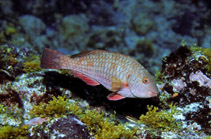 Sparisoma choati
Female Afbeelding van Wirtz, P.
Afbeeldingen | Google afbeelding
Female Afbeelding van Wirtz, P.
Classificatie / Namen Lokale namen | Synoniemen | Catalog of Fishes(Genus, Soort(en)) | ITIS | CoL | WoRMS | Cloffa
> Eupercaria/misc (Various families in series Eupercaria) > Labridae (Wrasses) > Scarinae
Etymology: Sparisoma: Latin, sparus = a fish with a golden head + Greek, soma = body (Ref. 45335); choati: Named for J. Howard Choat, in recognition of his extensive scientific work on parrotfishes. During his lengthy and productive career, Howard has made many significant contributions to our knowledge of parrotfish taxonomy, ecology, reproductive biology, demography, evolution and historical biogeography.
Eponymy: Dr John Howard Choat is Professor Emeritus of Marine Biology at the School of Marine and Tropical Biology, James Cook University, Queensland, Australia. [...] (Ref. 128868), visit book page.
Etymology: Sparisoma: Latin, sparus = a fish with a golden head + Greek, soma = body (Ref. 45335); choati: Named for J. Howard Choat, in recognition of his extensive scientific work on parrotfishes. During his lengthy and productive career, Howard has made many significant contributions to our knowledge of parrotfish taxonomy, ecology, reproductive biology, demography, evolution and historical biogeography.
Eponymy: Dr John Howard Choat is Professor Emeritus of Marine Biology at the School of Marine and Tropical Biology, James Cook University, Queensland, Australia. [...] (Ref. 128868), visit book page.
Milieu: milieu / Klimaatzone / Diepte / verspreidingsgebied Ecologie
marien rifbewoner; diepte 2 - 30 m (Ref. 88982). Tropical; 23°N - 21°N, 6°E - 7°E
Verspreiding Gebieden | FAO regio's | Ecosystemen | Voorkomen | Verspreidingskaart | Introducties | Faunafri
Eastern Atlantic: from Cape Verde islands and Senegal south to the offshore islands of the Gulf of Guinea and northern Angola.
Grootte / Gewicht / Leeftijd
Korte beschrijving Determinatiesleutels | Morfologie | Morfometrie
Dorsale stekels (totaal) : 9; Dorsale zachte stralen (totaal) : 10; Anale stekels: 3; Anale zachte stralen: 9. This species is distinguished from all of its congeners by the following set of characters: D IX,10; A III,9; pectoral rays 12-13 (rarely 13); pelvic rays I,5; lateral line scales 23-26; gill rakers on first arch 11 to 14; Initial phase of individuals and females greyish brown to greyish red, with chin and belly paler and reddish brown scales irregularly distributed singly or in clusters along flanks; pectoral fin translucent red with a dark red to black spot on upper fourth of its base. Terminal phase of individuals with brownish red head and upper half of anterior two-thirds of body; ventral portion of central third of body yellowish green; posterior third of body dark greenish grey; black spot on upper fifth of pectoral fin base (Ref. 88982).
Body shape (shape guide): fusiform / normal.
Body shape (shape guide): fusiform / normal.
Occurs in rocky reefs at 2-30 m depths, where it grazes on algae growing over rocky or calcareous substrate (Ref. 88982) and seagrasses (Ref. 7360). Males usually solitary, but females are often seen in pairs or small groups, juveniles in loose aggregations of up to 10 individuals (Ref. 88982).
Levenscyclus en paargedrag Maturiteit | Voortplanting | Paaien | Eieren | Fecunditeit | Larven
Hoofdreferentie
Upload uw referenties | Referenties | Coördinator : Westneat, Mark | Medewerkers
Rocha, L.A., A. Brito and D.R. Robertson, 2012. Sparisoma choati, a new species of Parrotfish (Labridae: Scarinae) from the tropical eastern Atlantic. Zootaxa 3152:61-67. (Ref. 88982)
CITES
Not Evaluated
Gevaar voor de mens
Harmless
Gebruik door de mens
FAO - Publication: search | FishSource |
Meer informatie
Trofische ecologie
Voedsel (prooien)
Dieetsamenstelling
Voedselconsumptie
Voedselrantsoenen
Predatoren
Voedsel (prooien)
Dieetsamenstelling
Voedselconsumptie
Voedselrantsoenen
Predatoren
Ecologie
Ecologie
Ecologie
Populatiedynamica
Groeiparameters
Max. leeftijden / maten
Lengte-gewicht rel.
Lengte-lengte rel.
Lengtefrequenties
Massaconversie
Rekrutering
Abundantie
Groeiparameters
Max. leeftijden / maten
Lengte-gewicht rel.
Lengte-lengte rel.
Lengtefrequenties
Massaconversie
Rekrutering
Abundantie
Levenscyclus
Voortplanting
Maturiteit
Rijpheid/kieuwen rel.
Fecunditeit
Paaien
Paaibestanden
Eieren
Ontwikkeling van de eieren
Larven
Larvale populatiedynamiek
Voortplanting
Maturiteit
Rijpheid/kieuwen rel.
Fecunditeit
Paaien
Paaibestanden
Eieren
Ontwikkeling van de eieren
Larven
Larvale populatiedynamiek
Anatomie
Kieuwoppervlak
Hersenen
Otoliet
Kieuwoppervlak
Hersenen
Otoliet
Fysiologie
Lichaamssamenstelling
Voedingsstoffen
Zuurstofverbruik
Type zwemmen
Zwemsnelheid
Visuele pigmenten
Vis geluid
Ziekten en parasieten
Toxiciteit (LC50)
Lichaamssamenstelling
Voedingsstoffen
Zuurstofverbruik
Type zwemmen
Zwemsnelheid
Visuele pigmenten
Vis geluid
Ziekten en parasieten
Toxiciteit (LC50)
Genetica
genoom
Genetica
Heterozygositeit
Erfelijkheid
Genetische diversiteit
genoom
Genetica
Heterozygositeit
Erfelijkheid
Genetische diversiteit
Menselijk gerelateerd
Aquacultuursystemen
Aquacultuurprofielen
Kweeklijnen
Ciguatera gevallen
Postzegels, munten, diversen.
Aquacultuursystemen
Aquacultuurprofielen
Kweeklijnen
Ciguatera gevallen
Postzegels, munten, diversen.
Tools
Speciale rapporten
Bekijk gegevens voor het houden in een aquarium | Bekijk Fact Sheets voor de soort | Bekijk Aquacultuur Fact Sheets
Download XML
Internetbronnen
AFORO (otoliths) | Aquatic Commons | BHL | Cloffa | Websites from users | Bekijk FishWatcher | CISTI | Catalog of Fishes: Genus, Soort(en) | DiscoverLife | ECOTOX | FAO - Publication: search | Faunafri | Fishipedia | Fishtrace | GloBI | Google Books | Google Scholar | Google | IGFA World Record | OneZoom | Open Tree of Life | Otolith Atlas of Taiwan Fishes | PubMed | Reef Life Survey | Socotra Atlas | TreeBase | Tree of Life | Wikipedia: ga naar, zoek | | Zoobank | Zoological Record
Schattingen op basis van modellen
|
Fylogenetische diversiteitsindex (Ref. 82804) |
PD50 = 0.5000 [Uniqueness, from 0.5 = low to 2.0 = high]. |
| Bayesian length-weight | a=0.00955 (0.00573 - 0.01590), b=3.00 (2.86 - 3.14), in cm total length, based on LWR estimates for this species & Genus-body shape (Ref. 93245). |
|
Trofisch niveau (Ref. 69278) |
2.0 ±0.1 se; based on size and trophs of closest relatives |
|
Weerstandsvermogen (Ref. 120179) |
Gemiddeld, minimale populatieverdubbelingstijd 1,4-4,4 jaar (Preliminary K or Fecundity.). |
|
Kwetsbaarheid van de visserij (Ref. 59153) |
Moderate vulnerability (42 of 100). 🛈 |