This website uses cookies to enhance your browsing experience and ensure the functionality of our site. For more detailed information about the types of cookies we use and how we protect your privacy, please visit our Privacy Information page.
×
Cookie Settings
This website uses different types of cookies to enhance your experience. Please select your preferences below:
> Ovalentaria/misc (Various families in series Ovalentaria) > Pomacentridae (Damselfishes) > Glyphisodontinae
Etymology: Abudefduf:Arabic, abu = father; this fish is the leader of the reef against other species (Ref. 45335). More on authors: Quoy & Gaimard.
Environnement : milieu / zone climatique / profondeur / gamme de distribution Écologie
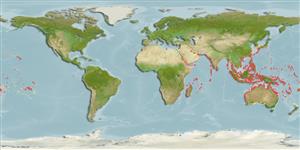
Indo-Pacific: Red Sea and eastern Africa to the Line and Tuamoto islands, north to southern Japan, south to Australia. Recorded in Bay of Islands, New Zealand (Ref. 35942). Often confused with the closely related Atlantic species Abudefduf saxatilis (Ref. 7247).
Longueur à la première maturité / Taille / Poids / Âge
Maturité: Lm12.0 range ? - ? cm Max length : 20.0 cm TL mâle / non sexé; (Ref. 4391)
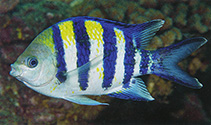
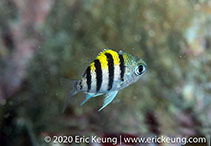
Épines dorsales (Total) : 13; Rayons mous dorsaux (Total) : 12 - 14; Épines anales: 2; Rayons mous anaux: 11 - 13. This species is characterized by having the following features: body depth 1.5-1.8 in SL; forked caudal fin; colour of body blue-green dorsally, shading to silvery white ventrally; five broad bluish black bars the first just behind the head, the narrow fifth on caudal peduncle, the third to fifth extending into the dorsal fin; dorsal part of body between the first and third dark bars often yellow (yellowish hue on anterodorsal part of the body apparent especially during courtship and nesting); caudal fin without dark bands (Ref. 11441, 90102). Body shape (shape guide): short and / or deep; Cross section: compressed.
Adults inhabit upper edge of outer reef slopes and inshore rocky reefs. Juveniles associated with drifting seaweed (Ref. 12114, 12115). Benthopelagic (Ref. 58302). Feed on zooplankton, benthic algae, and small invertebrates (Ref. 1602). Often in aggregations (Ref. 9710) feeding at midwater or tending nests among rocks and coral ledges (Ref. 90102). In large numbers at spawning sites that are timed with large tides that carry their pelagic offspring far offshore (Ref. 48636). Oviparous, distinct pairing during breeding (Ref. 205). Eggs are demersal and adhere to the substrate (Ref. 205). Males guard and aerate the eggs (Ref. 205). Minimum depth reported taken from Ref. 128797.
Oviparous, distinct pairing during breeding (Ref. 205). Eggs are demersal and adhere to the substrate (Ref. 205). Males guard and aerate the eggs (Ref. 205).
Physiologie Composition corporelle Nutriments Consommation d'oxygène Type de natation Vitesse de nage Pigments visuels Son de poisson Maladies et parasites Toxicité (CL50)
Température préférée (Réf. 123201): 21.9 - 29.3, mean 28.2 °C (based on 3494 cells).
Indice de diversité phylogénétique (Réf. 82804): PD50 = 0.5000 [Uniqueness, from 0.5 = low to 2.0 = high].
Bayesian length-weight: a=0.02512 (0.01495 - 0.04221), b=3.02 (2.88 - 3.16), in cm total length, based on LWR estimates for this species & Genus-body shape (Ref. 93245).
Niveau trophique (Réf. 69278): 2.6 ±0.4 se; based on diet studies.
Generation time: 1.3 ( na - na) years. Estimated as median ln(3)/K based on 1 growth studies.
Résilience (Réf. 120179): Haut, temps minimum de doublement de population inférieur à 15 mois (K=0.85).
Prior r = 1.20, 95% CL = 0.79 - 1.80, Based on 1 data-limited stock assessment.
Vulnérabilité de la pêche (Ref. 59153): Low vulnerability (16 of 100). 🛈