



Odontanthias randalli White, 2011
Lombok Swallowtail
Carregue seu(sua) Fotos e vídeos
Fotos | Imagem do Google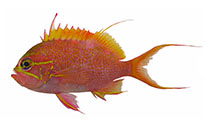 Odontanthias randalli
Foto de White, W.T.
Fotos | Imagem do Google
Foto de White, W.T.
Classificação / Nomes Nomes comuns | Sinônimos | Catalog of Fishes(Gênero, Espécies) | ITIS | CoL | WoRMS | Cloffa
> Perciformes/Serranoidei (Groupers) > Anthiadidae (Fairy basslets or Streamer basses)
Etymology: Odontanthias: Greek, odous = teeth + Greek, anthis = a fish, Sparus aurata (Ref. 45335); randalli: Named after John E. Randall, who has made such a significant contribution to the knowledge of anthiine fishes, and Indo–Pacific fishes in general. The review of the Odontanthias genus he co-authored provided detailed description of the nominal species and their relationships with closely related genera (Ref. 87803).
Eponymy: Dr John ‘Jack’ Ernest Randall Jr. [...] (Ref. 128868), visit book page.
Etymology: Odontanthias: Greek, odous = teeth + Greek, anthis = a fish, Sparus aurata (Ref. 45335); randalli: Named after John E. Randall, who has made such a significant contribution to the knowledge of anthiine fishes, and Indo–Pacific fishes in general. The review of the Odontanthias genus he co-authored provided detailed description of the nominal species and their relationships with closely related genera (Ref. 87803).
Eponymy: Dr John ‘Jack’ Ernest Randall Jr. [...] (Ref. 128868), visit book page.
Meio ambiente: milieu / Zona climática / intervalo de profundidade / faixa de distribuição Ecologia
marinhas bentopelágico. Tropical; 8°S - 9°S
Distribuição Territórios | Áreas da FAO | Ecossistemas | Ocorrências | Mapa de pontos | Introduções | Faunafri
Indo-Pacific: Indonesia. Tanjung Luar fish landing site, Lombok, East Nusa Tenggara (Ref. 87803).
Tamanho / Peso / Idade
Descrição suscinta Chaves de identificação | Morfologia | Morfometria
Espinhos dorsais (total) : 10; Raios dorsais (total) : 16 - 17; Espinhos anais: 3; Raios anais : 7. Body depth 2.2–2.5 in SL; spine at angle of preopercle moderately long, extending about half distance to margin of subopercle; vomerine tooth patch arrowhead-shaped; no teeth on mesopterygoids; scales dorsally on snout nearly reaching upper lip; 3rd dorsal spine elongate, 1.36–2.32 in head length; 3rd ray of dorsal fin the longest, greatly produced as a long filament; 2nd anal spine subequal to third, 2.32–2.78 in head length; caudal fin lunate, the lobes very long and filamentous, fin length 1.37–2.01 in SL. Colour when fresh mostly pink; scales on upper half of body each with a bright yellow spot; head pinkish with a vivid yellow, horizontal V-shaped marking originating on snout tip and extending posteriorly as two stripes; lower stripe running posteroventrally below eye to edge of opercle; upper stripe running posterodorsally through about the middle of eye to edge of the opercle just above primary opercular spine; nape yellowish; four pale pinkish blotches present below dorsal fin base; dorsal fin mostly yellow with some pink areas; anal fin pinkish with yellow pigment between second and third spines extending on to posterior portion of posteriorly adjacent fin membranes; caudal fin mostly pink with yellow pigment basally and extending along centre of filamentous lobes; pectoral fins pinkish with yellow stripe on anterior third extending from base of fin to about one-third distance of longest rays; pelvic fin mostly pink with yellow pigment on membrane between first and second soft rays (Ref. 87803).
Body shape (shape guide): fusiform / normal.
Body shape (shape guide): fusiform / normal.
Ciclo de vida ou comportamento de acasalamento Maturidade | Reprodução | Desova | Ovos | Fecundidade | Larvas
Referência principal
Carregar suas referências | Referências | Coordenador | Colaboradores
White, W.T., 2011. Odontanthias randalli n. sp., a new anthiine fish (Serranidae: Anthiinae) from Indonesia. Zootaxa 3015:21-28. (Ref. 87803)
CITES
Not Evaluated
Ameaça para os humanos
Harmless
Uso pelos humanos
FAO - Publication: search | FishSource |
Mais informação
Ecologia Trófica
Itens alimentares (presas)
Composição da dieta
Consumo alimentar
Rações alimentares
Predadores
Itens alimentares (presas)
Composição da dieta
Consumo alimentar
Rações alimentares
Predadores
Dinâmica populacional
Parâmetros de crescimento
Idade máxima / tamanhos
Relação comprimento-peso.
Relação comprimento-comprimento.
Frequências de comprimento
Conversão de massa
Recrutamento
Abundância
Parâmetros de crescimento
Idade máxima / tamanhos
Relação comprimento-peso.
Relação comprimento-comprimento.
Frequências de comprimento
Conversão de massa
Recrutamento
Abundância
Ciclo de vida
Reprodução
Maturidade
Maturidade/Rel. das guelras
Fecundidade
Desova
Agregações de desova
Ovos
Desenvolvimento dos ovos
Larvas
Dinâmica larval
Reprodução
Maturidade
Maturidade/Rel. das guelras
Fecundidade
Desova
Agregações de desova
Ovos
Desenvolvimento dos ovos
Larvas
Dinâmica larval
Anatomia
Área branquial
Cérebro
Otólito
Área branquial
Cérebro
Otólito
Fisiologia
Composição corporal
Nutrientes
Consumo de oxigênio
Tipo de natação
Velocidade de natação
Pigmentos visuais
Som de peixe
Doenças e Parasitas
Toxicidade (LC50s)
Composição corporal
Nutrientes
Consumo de oxigênio
Tipo de natação
Velocidade de natação
Pigmentos visuais
Som de peixe
Doenças e Parasitas
Toxicidade (LC50s)
Genética
genoma
Genética
Heterozigosidade
Hereditariedade
Diversidade genética
genoma
Genética
Heterozigosidade
Hereditariedade
Diversidade genética
Relacionado a humanos
Sistemas de aquicultura
Perfis para aquacultura
Estirpes
Casos de Ciguatera
Selos, moedas, diversos.
Sistemas de aquicultura
Perfis para aquacultura
Estirpes
Casos de Ciguatera
Selos, moedas, diversos.
Ferramentas
Livro eletrônico | Guia de campo | Ferramenta auxiliar de frequências de comprimento | Ferramenta sobre a história de vida | Mapa de pontos |
Catch-MSY |
Relatórios especiais
Checar Manutenção em Aquário | Checar Planilhas de Fatos sobre as Espécies | Checar Planilhas de Fatos sobre Aquicultura
Baixar XML
Fontes da internet
AFORO (otoliths) | Aquatic Commons | BHL | Cloffa | Websites from users | Checar Observador de Peixes (FishWatcher) | CISTI | Catalog of Fishes: Gênero, Espécies | DiscoverLife | ECOTOX | FAO - Publication: search | Faunafri | Fishipedia | Fishtrace | GloBI | Google Books | Google Scholar | Google | IGFA World Record | Bases de dados nacionais | OneZoom | Open Tree of Life | Otolith Atlas of Taiwan Fishes | PubMed | Reef Life Survey | Socotra Atlas | TreeBase | Árvore da vida | Wikipedia: Ir para, procura | World Records Freshwater Fishing | Zoobank | Registro zoológico
Estimativas baseadas em modelos
Índice de diversidade filogenética (Ref. 82804): PD50 = 0.5000 [Uniqueness, from 0.5 = low to 2.0 = high].
Bayesian length-weight: a=0.01413 (0.00621 - 0.03212), b=3.00 (2.81 - 3.19), in cm total length, based on LWR estimates for this (Sub)family-body shape (Ref. 93245).
Nível Trófico (Ref. 69278): 3.4 ±0.4 se; based on size and trophs of closest relatives
Resiliência (Ref. 120179): médio(a), tempo mínimo de duplicação da população 1,4 - 4,4 anos (Preliminary K or Fecundity.).