



Haplochromis vanoijeni de Zeeuw & Witte, 2010
Tải lên của bạn hình ảnh Và Video
Google image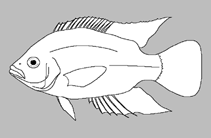 No image available for this species;
drawing shows typical species in Cichlidae.
Google image
drawing shows typical species in Cichlidae.
Phân loại / Tên Tên thường gặp | Các synonym ( Các tên trùng) | Catalog of Fishes(Giống, Các loài) | ITIS | CoL | WoRMS | Cloffa
> Cichliformes (Cichlids, convict blennies) > Cichlidae (Cichlids) > Pseudocrenilabrinae
Etymology: Haplochromis: Greek, Haploos = single + Greek, chromis = a fish, perhaps a perch (Ref. 45335); vanoijeni: This species is named in honour of Dr. Martien J.P. van Oijen, ichthyologist of the Netherlands Centre of Biodiversity, Naturalis, in appreciation for his work on taxonomy and ecology of the haplochromine cichlids of Lake Victoria; Dr. van oijen was one of the pioneers of the Haplochromis Ecology Survey Team (HEST) of Leiden University that started its fieldwork on Lake Victoria in 1977 (Ref. 85523).
Eponymy: Martien J P van Oijen is a Dutch ichthyologist at the Naturalis Biodiversity Centre (Leiden, Netherlands). [...] (Ref. 128868), visit book page.
Etymology: Haplochromis: Greek, Haploos = single + Greek, chromis = a fish, perhaps a perch (Ref. 45335); vanoijeni: This species is named in honour of Dr. Martien J.P. van Oijen, ichthyologist of the Netherlands Centre of Biodiversity, Naturalis, in appreciation for his work on taxonomy and ecology of the haplochromine cichlids of Lake Victoria; Dr. van oijen was one of the pioneers of the Haplochromis Ecology Survey Team (HEST) of Leiden University that started its fieldwork on Lake Victoria in 1977 (Ref. 85523).
Eponymy: Martien J P van Oijen is a Dutch ichthyologist at the Naturalis Biodiversity Centre (Leiden, Netherlands). [...] (Ref. 128868), visit book page.
Môi trường: môi trường / vùng khí hậu / Mức độ sâu / phạm vi phân phối Sinh thái học
; nước ngọt gần đáy. Tropical
Sự phân bố Lãnh thổ | Các khu vực của FAO | Các hệ sinh thái | Những lần xuất hiện | Bản đồ điểm | Những chỉ dẫn | Faunafri
Africa: Lake Victoria (Ref. 85523).
Bộ gần gũi / Khối lượng (Trọng lượng) / Tuổi
Chín muồi sinh dục: Lm ? range ? - ? cm
Max length : 8.9 cm SL con đực/không giới tính; (Ref. 85523)
Max length : 8.9 cm SL con đực/không giới tính; (Ref. 85523)
Mô tả ngắn gọn Khóa để định loại | Hình thái học | Sinh trắc học
Diagnosis: Haplochromis vanoijeni is a small sized (less than 9 cm standard length), micrognathic species with generalized body profile, but with a relatively long and acute snout; because of the latter, and its relatively small interorbital width, the species bears some resemblance with species of the 'tridens' group; indeed, it has some tricuspid teeth rostrally in the outer row of the oral jaws (Ref. 85523). It differs from eight of the nine described species in the 'tridens' group in the colouration of sexually active males: dorsum and flanks in sexually active males of Haplochromis vanoijeni are bright red; both males and females have conspicuously silverish-white cheeks, contrasting with the remaining head colours, which is a unique character among Lake Victoria haplochromines (Ref. 85523). From Haplochromis tridens, of which the colouration of live, sexually active males is unknown, it differs in the following characters: the lower jaw is shorter, lower jaw length 40.9-44.7% of head length vs. 43.3-51.8%; a larger interorbital width, 17.6-20.5% of head length vs. 15.0-19.5%; in contrast to H. vanoijeni, H. tridens has a dorsal head profile that is interrupted by a prominent premaxillary pedicel, and a cephalic line system with prominent pores (Ref. 85523). Besides by its specific colouration pattern, H. vanoijeni can be distinguished from all described species in the 'tridens' group by its larger body depth, 33.1-36.2% of standard length vs. 30.6-33.6%; the lower jaw of H. vanoijeni is shorter, 40.9-44.7% of standard length, than tah of most described species in the 'trident' group, except for that of H. cryptogramma and that of H. plutonius (Ref. 85523).
Body shape (shape guide): fusiform / normal.
Body shape (shape guide): fusiform / normal.
A benthic species, caught mainly in the deeper parts, more than 10 m depth, in the Mwanza Gulf, over mud bottoms; occasionally caught over mud in shallower areas (Ref. 85523). Before the ecological changes in Lake Victoria, this species fed mainly on detritus; occasionally remains of shrimps and insects were found (Ref. 85523). This species is a female mouth brooder (Ref. 85523).
Vòng đời và hành vi giao phối Chín muồi sinh dục | Sự tái sinh sản | Đẻ trứng | Các trứng | Sự sinh sản | Ấu trùng
This species is a female mouth brooder (Ref. 85523).
Tài liệu tham khảo chính
Tải lên tài liệu tham khảo của bạn | Các tài liệu tham khảo | Người điều phối : Kullander, Sven O. | Người cộng tác
de Zeeuw, M.P., M. Mietes, P. Niemantsverdriet, S. ter Huurne and F. Witte, 2010. Seven new species of detritivorous and phytoplanktivorous haplochromines from Lake Victoria. Zool. Meded. Leiden 84:201-250. (Ref. 85523)
Tình trạng Sách đỏ IUCN (Ref. 130435: Version 2025-2 (Global))
Dễ bị tổn thương (VU) (D2); Date assessed: 31 March 2010
CITES
Not Evaluated
Mối đe dọa đối với con người
Harmless
Sử dụng của con người
FAO - Publication: search | FishSource |
Thêm thông tin
Sinh thái dinh dưỡng
Thức ăn (con mồi)
Thành phần thức ăn
Thành phần thức ăn
Khẩu phần ăn
Các động vật ăn mồi
Thức ăn (con mồi)
Thành phần thức ăn
Thành phần thức ăn
Khẩu phần ăn
Các động vật ăn mồi
Biến động dân số
Các thông số tăng trưởng
Độ tuổi / kích thước tối đa
Chiều dài-trọng lượng tương đối
Chiều dài-chiều dài tương đối.
Chiều dài-tần số
Chuyển đổi khối lượng
Bổ xung
Sự phong phú
Các thông số tăng trưởng
Độ tuổi / kích thước tối đa
Chiều dài-trọng lượng tương đối
Chiều dài-chiều dài tương đối.
Chiều dài-tần số
Chuyển đổi khối lượng
Bổ xung
Sự phong phú
Vòng đời
Sự tái sinh sản
Chín muồi sinh dục
Độ trưởng thành/Mang liên quan
Sự sinh sản
Đẻ trứng
Tập hợp sinh sản
Các trứng
Sự phát triển của trứng
Ấu trùng
Sự biến động ấu trùng
Sự tái sinh sản
Chín muồi sinh dục
Độ trưởng thành/Mang liên quan
Sự sinh sản
Đẻ trứng
Tập hợp sinh sản
Các trứng
Sự phát triển của trứng
Ấu trùng
Sự biến động ấu trùng
Sự phân bố
Lãnh thổ
Các khu vực của FAO
Các hệ sinh thái
Những lần xuất hiện
Những chỉ dẫn
BRUVS - Video
Lãnh thổ
Các khu vực của FAO
Các hệ sinh thái
Những lần xuất hiện
Những chỉ dẫn
BRUVS - Video
Giải phẫu
Vùng mang
Não
sỏi tai
Vùng mang
Não
sỏi tai
Sinh lý học
Thành phần cơ thể
Chất dinh dưỡng
Thành phần ô-xy
Kiểu bơi
Tốc độ bơi
Sắc tố thị giác
Tiếng cá
Bệnh tật & Ký sinh trùng
Độc tính (LC50)
Thành phần cơ thể
Chất dinh dưỡng
Thành phần ô-xy
Kiểu bơi
Tốc độ bơi
Sắc tố thị giác
Tiếng cá
Bệnh tật & Ký sinh trùng
Độc tính (LC50)
Di truyền
Bộ gen
Di truyền
Sự dị hợp tử
Di sản
Đa dạng di truyền
Bộ gen
Di truyền
Sự dị hợp tử
Di sản
Đa dạng di truyền
Liên quan đến con người
Hệ thống nuôi trồng thủy sản
Các tổng quan nuôi trồng thủy sản
Các giống
Các trường hợp ngộ độc Ciguatera
Tem, tiền xu, v.v.
Hệ thống nuôi trồng thủy sản
Các tổng quan nuôi trồng thủy sản
Các giống
Các trường hợp ngộ độc Ciguatera
Tem, tiền xu, v.v.
Các công cụ
Sách điện tử | Hướng dẫn hiện trường | Tần suất chiều dài Wizard | Công cụ của vòng đời | Bản đồ điểm |
Bắt-MSY |
Báo cáo đặc biệt
Kiểm tra bảo trì bể cá | Kiểm tra các tờ thông tin về loài | Kiểm tra các tờ thông tin về nuôi trồng thủy sản
Tải xuống XML
Các nguồn internet
AFORO (otoliths) | Aquatic Commons | BHL | Cloffa | Websites from users | Check FishWatcher | CISTI | Catalog of Fishes: Giống, Các loài | DiscoverLife | ECOTOX | FAO - Publication: search | Faunafri | Fishipedia | Fishtrace | GloBI | Google Books | Google Scholar | Google | IGFA World Record | OneZoom | Open Tree of Life | Otolith Atlas of Taiwan Fishes | PubMed | Reef Life Survey | Socotra Atlas | TreeBase | Cây Đời sống | Wikipedia: Go, tìm | World Records Freshwater Fishing | Zoobank | Tạp chí Zoological Record
Ước tính dựa trên mô hình
Chỉ số đa dạng phát sinh loài (Tài liệu tham khảo 82804): PD50 = 0.5000 [Uniqueness, from 0.5 = low to 2.0 = high].
Bayesian length-weight: a=0.01445 (0.00671 - 0.03113), b=2.99 (2.82 - 3.16), in cm total length, based on LWR estimates for this (Sub)family-body shape (Ref. 93245).
Mức dinh dưỡng (Tài liệu tham khảo 69278): 3.3 ±0.4 se; based on size and trophs of closest relatives