



Haplochromis antleter Mietes & Witte, 2010
Sube tu fotos y Vídeos
Imágenes | Google image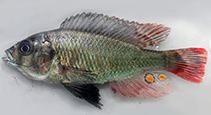 Haplochromis antleter
Foto de Moser, F. / eawag
Imágenes | Google image
Foto de Moser, F. / eawag
Clasificación / Nombres Nombres comunes | Sinónimos | Catalog of Fishes(Género, Especie) | ITIS | CoL | WoRMS | Cloffa
> Cichliformes (Cichlids, convict blennies) > Cichlidae (Cichlids) > Pseudocrenilabrinae
Etymology: Haplochromis: Greek, Haploos = single + Greek, chromis = a fish, perhaps a perch (Ref. 45335); antleter: The name antleter comes from the Greek word for scooper, dredger; 'άντλητήρ', from the stem of the verb ‘άντλεϊν’ (‘to scoop’, ‘to dredge’) and the ending '-τήρ' that indicates the acting person; the name refers to the dredging of mud bottoms, the ‘core business’ of this species (Ref. 85523).
Etymology: Haplochromis: Greek, Haploos = single + Greek, chromis = a fish, perhaps a perch (Ref. 45335); antleter: The name antleter comes from the Greek word for scooper, dredger; 'άντλητήρ', from the stem of the verb ‘άντλεϊν’ (‘to scoop’, ‘to dredge’) and the ending '-τήρ' that indicates the acting person; the name refers to the dredging of mud bottoms, the ‘core business’ of this species (Ref. 85523).
Entorno: milieu / zona climática / rango de profundidad / gama de distribución Ecología
; agua dulce demersal; rango de profundidad 2 - 11 m (Ref. 85523). Tropical
Distribución Territorios | Áreas FAO | Ecosistemas | Ocurrencias, apariciones | Mapa de puntos | Introducciones | Faunafri
Africa: Lake Victoria (Ref. 85523).
Tamaño / Peso / Edad
Descripción breve Claves de identificación | Morfología | Morfometría
Vértebra: 28 - 30. Diagnosis: Haplochromis antleter belongs to an assemblage of small sized (less than 9 cm standard length), relatively deep-bodied (body depth larger than 35% of standard length) micrognathic species with a moderately curved to straight dorsal head profile; the fish in this group have relatively small, mainly bicuspid, teeth in the oral jaws (Ref. 85523). It can be distinguished from Haplochromis cinctus, Haplochromis paropius and Haplochromis katunzii by live colouration of sexually active males: Haplochromis antleter is dusky coloured with no or faint vertical bars and it is the only species of this assemblage that has no or a faint lachrymal stripe; H. paropius has a red dorsum and a greenish flank with faint vertical bars; in contrast to the other three species H. paropius often has a mid-lateral band; H. cinctus has a red dorsum, an orange to yellowish flank and dark vertical bars; H. katunzii is sandy-brown and has, compared to H. antleter, more distinctive vertical bars (Ref. 85523). Haplochromis antleter has a shallower cheek depth, 16.1-21.1% of head length, than H. katunzii and H. paropius, 18.6-24.6% of head length and 18.1-24.2% respectively; and the interorbital width is smaller, 19.1-24.9% of head length, than in the type-specimens of H. cinctus, 24.3-27.2% of head length (Ref. 85523). Compared to H. katunzii, H. antleter has a less pronounced mental prominence on the lower jaw (Ref. 85523).
Body shape (shape guide): fusiform / normal.
Body shape (shape guide): fusiform / normal.
A benthic species found in sub-littoral areas of the Mwanza Gulf mainly over mud bottoms; the depth range is 2-11 m (Ref. 85523). Before the ecological changes in Lake Victoria, this species fed mainly on detritus, but also included phytoplankton, mainly Aulacoseira, and occasionally insect larvae and zooplankton in its diet (Ref. 85523). Based on the egg dummies on the anal fin of males and the egg size in ripe females, it is a female mouth brooder (Ref. 85523).
Ciclo vital y comportamiento de apareamiento Madurez | Reproducción | Puesta | Huevos | Fecundidad | Larva
Based on the egg dummies on the anal fin of males and the egg size in ripe females, it is a female mouth brooder (Ref. 85523).
Referencia principal
Suba sus referencias | Referencias | Coordinador : Kullander, Sven O. | Colaboradores
de Zeeuw, M.P., M. Mietes, P. Niemantsverdriet, S. ter Huurne and F. Witte, 2010. Seven new species of detritivorous and phytoplanktivorous haplochromines from Lake Victoria. Zool. Meded. Leiden 84:201-250. (Ref. 85523)
Situación en la Lista Roja de la UICN (Ref. 130435: Version 2025-2 (Global))
Critically Endangered (CR) (C2a(ii)); Date assessed: 31 March 2010
CITES
Not Evaluated
Amenaza para el ser humano
Harmless
Usos humanos
FAO - Publication: search | FishSource |
Más información
Ecología Trófica
Alimentos (presas)
Composición de la dieta
consumo de alimento
Raciones de comida
Despredadores
Alimentos (presas)
Composición de la dieta
consumo de alimento
Raciones de comida
Despredadores
Dinámica de la población
Coeficiente del crecimiento para
Edades / tallas máximas
Longitud-peso rel.
Longitud-longitud rel.
Longitud-frecuencias
Conversión de masas
Reclutamiento
Abundancia
Coeficiente del crecimiento para
Edades / tallas máximas
Longitud-peso rel.
Longitud-longitud rel.
Longitud-frecuencias
Conversión de masas
Reclutamiento
Abundancia
Ciclo de vida
Reproducción
Madurez
Madurez/Gills rel.
Fecundidad
Puesta
Agregaciones de desove
Huevos
Desarrollo de los huevos
Larva
Dinámica larvaria
Reproducción
Madurez
Madurez/Gills rel.
Fecundidad
Puesta
Agregaciones de desove
Huevos
Desarrollo de los huevos
Larva
Dinámica larvaria
Distribución
Territorios
Áreas FAO
Ecosistemas
Ocurrencias, apariciones
Introducciones
BRUVS - Vídeos
Territorios
Áreas FAO
Ecosistemas
Ocurrencias, apariciones
Introducciones
BRUVS - Vídeos
Anatomía
Superficie branquial
Cerebro
Otolito
Superficie branquial
Cerebro
Otolito
Fisiología
Composición corporal
Nutrientes
Consumo del oxígeno
Tipo de natación
Velocidad de natación
Pigmentos visuales
Sonido de peces
Enfermedades y parásitos
Toxicidad (CL50)
Composición corporal
Nutrientes
Consumo del oxígeno
Tipo de natación
Velocidad de natación
Pigmentos visuales
Sonido de peces
Enfermedades y parásitos
Toxicidad (CL50)
Genética
Genoma
Genética
Heterocigosidad
heritabilidad
Diversidad genética
Genoma
Genética
Heterocigosidad
heritabilidad
Diversidad genética
Relacionados con el ser humano
Sistemas de acuicultura
Perfiles de acuicultura
Razas
Ciguatera cases
Sellos, monedas, varios
Sistemas de acuicultura
Perfiles de acuicultura
Razas
Ciguatera cases
Sellos, monedas, varios
Herramientas
Libro electrónico | Guía de campo | Asistente para frecuencias de tallas | Herramienta de ciclo de vida | Mapa de puntos |
Catch-MSY |
Informes especiales
Comprobar el mantenimiento del acuario | Buscar fichas sobre especies | Consulte las hojas informativas sobre acuicultura
Descargar XML
Fuentes de Internet
AFORO (otoliths) | Aquatic Commons | BHL | Cloffa | Websites from users | Check FishWatcher | CISTI | Catalog of Fishes: Género, Especie | DiscoverLife | ECOTOX | FAO - Publication: search | Faunafri | Fishipedia | Fishtrace | GloBI | Google Books | Google Scholar | Google | IGFA World Record | OneZoom | Open Tree of Life | Otolith Atlas of Taiwan Fishes | PubMed | Reef Life Survey | Socotra Atlas | TreeBase | Árbol de la vida | Wikipedia: Go, búsqueda | World Records Freshwater Fishing | Zoobank | Expediente Zoológico
Estimaciones basadas en modelos
Índice de diversidad filogenética (Referencia 82804): PD50 = 0.5000 [Uniqueness, from 0.5 = low to 2.0 = high].
Bayesian length-weight: a=0.01445 (0.00671 - 0.03113), b=2.99 (2.82 - 3.16), in cm total length, based on LWR estimates for this (Sub)family-body shape (Ref. 93245).
Nivel trófico (Referencia 69278): 3.3 ±0.4 se; based on size and trophs of closest relatives