



Nothobranchius pienaari Shidlovskiy, Watters & Wildekamp, 2010
Загрузить свой Фото и Видео
Изображение на Google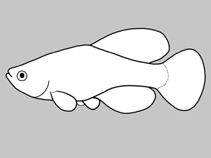 No image available for this species;
drawing shows typical species in Nothobranchiidae.
Изображение на Google
drawing shows typical species in Nothobranchiidae.
Классификация / Имена народные названия | синонимы | Catalog of Fishes(род, виды) | ITIS | CoL | WoRMS | Cloffa
> Cyprinodontiformes (Rivulines, killifishes and live bearers) > Nothobranchiidae (African rivulines)
Etymology: Nothobranchius: Greek, nothos = false + Greek, brangchia = gill (Ref. 45335); pienaari: Named after Dr. U. de V. Pienaar, retired biologist of the Kruger National Park, Republic of South Africa, and discoverer of Nothobranchius species, in honour of his efforts to protect and conserve these populations; the species name is pronounced 'pea-nahri' (Ref. 85866).
Eponymy: Dr Uys de Villiers ‘Tol’ Pienaar (1930–2011) was a South African biologist and game warden, whose doctorate was awarded by Wits Medical School (1953). [...] (Ref. 128868), visit book page.
Etymology: Nothobranchius: Greek, nothos = false + Greek, brangchia = gill (Ref. 45335); pienaari: Named after Dr. U. de V. Pienaar, retired biologist of the Kruger National Park, Republic of South Africa, and discoverer of Nothobranchius species, in honour of his efforts to protect and conserve these populations; the species name is pronounced 'pea-nahri' (Ref. 85866).
Eponymy: Dr Uys de Villiers ‘Tol’ Pienaar (1930–2011) was a South African biologist and game warden, whose doctorate was awarded by Wits Medical School (1953). [...] (Ref. 128868), visit book page.
Окружающая среда: среда / климатическая зона / пределы глубины / диапазон распространения экология
; пресноводный донно-пелагический. Tropical
распространение Территории | регионы FAO | Экосистемы | места находок | карта точек | интродукции | Faunafri
Africa: coastal lowlands of central and southern Mozambique and northeastern South Africa (Ref. 85866).
Размер / Вес / Возраст
половая зрелость: Lm ? range ? - ? cm
Max length : 3.9 cm SL самец/пол неопределен; (Ref. 85866); 3.6 cm SL (female)
Max length : 3.9 cm SL самец/пол неопределен; (Ref. 85866); 3.6 cm SL (female)
Краткое описание определительные ключи | морфология | морфометрия
колючие лучи спинного плавника (общее число) : 0; членистые (мягкие) лучи спинного плавника (общее число) : 14 - 16; колючие лучи анального плавника: 0; членистые (мягкие) лучи анального плавника: 15 - 17. Diagnosis: Morphology similar to Nothobranchius rachovii and N. krysanovi but distinguished from those by a slightly deeper body in males (Ref. 85866). Nothobranchius pienaari is distinguished from other species of the genus by the following combination og characters: male with colouration consisting of alternating blue-green to grey-green and dark red-brown to almost black scale margins and oblique bars on body and dorsal and anal fins, dark brown spotted basal half of caudal fin, and orange subterminal and black terminal band (Ref. 85866). It can be distinguished from the other species of the subgenus Nothobranchius as follows: from N. furzeri by male colouration and a slightly higher number of dorsal fin rays, 14-16 vs. 14-15; from N. orthonotus by male colouration, lower number of scales on the mid-longitudinal series, 26-31 vs. 28-33; and from N. kadleci by male colouration and shape of the frontal region, higher number of dorsal and anal fin rays, 14-16 vs. 13-14 and 15-17 vs. 13-14 (Ref. 85866). Female distinguished by faint brown oblique bars on posterior part of flanks (Ref. 85866). Nothobranchius pienaari can also be distinguished from N. rachovii and N. krysanovi by a much higher number of diploid chromosomes, 2n=34 vs. 2n=16 for N. rachovii and 2n=18 for N. krysanovi; it can also be distinguished from the karyotypes of N. furzeri and N. orthonotus that both have with 2n=38 a higher number of chromosomes (Ref. 85866).
Body shape (shape guide): fusiform / normal.
Body shape (shape guide): fusiform / normal.
Found in temporary pools and swamps in the floodplains of several rivers flowing into the Indian Ocean south of the lower Zambezi River; usually found in water-filled depressions in the floodplains of rivers and bordering swamps; water depth is variable with the progress of the season (Ref. 85866). Aquatic vegetation may consist of Nymphea, Ottelia, Lagarosiphon and Utricularia species (Ref. 85866).
Жизненный цикл и брачное поведение половая зрелость | размножение | нерест | икра | Плодовитость | личинки
Основная ссылка
Загрузите свои рекомендации | ссылки | координатор | соавторы
Shidlovskiy, K.M., B.R. Watters and R.H. Wildekamp, 2010. Notes on the annual killifish species Nothobranchius rachovii (Cyprinodontiformes; Nothobranchiidae) with the description of two new species. Zootaxa 2724:37-57. (Ref. 85866)
Статус Красного Списка МСОП (Ref. 130435: Version 2025-2 (Global))
Не вызывающий беспокойства (LC) ; Date assessed: 08 January 2019
CITES
Not Evaluated
Угроза для людей
Harmless
Использование человеком
FAO - Publication: search | FishSource |
дополнительная информация
Трофическая экология
Пищевые предметы (добыча)
состав пищи
потребление пищи
Продовольственные пайки
хищники
Пищевые предметы (добыча)
состав пищи
потребление пищи
Продовольственные пайки
хищники
Динамика численности населения
Параметры роста
Макс. возраст / размер
Отношение длины к весу.
Отношение длины к длине.
Размерный состав
Преобразование массы
пополнение
численность
Параметры роста
Макс. возраст / размер
Отношение длины к весу.
Отношение длины к длине.
Размерный состав
Преобразование массы
пополнение
численность
Жизненный цикл
размножение
половая зрелость
Зрелость/Жиры относительно.
Плодовитость
нерест
Нерестовые скопления
икра
Развитие икры
личинки
динамика численности личинок
размножение
половая зрелость
Зрелость/Жиры относительно.
Плодовитость
нерест
Нерестовые скопления
икра
Развитие икры
личинки
динамика численности личинок
Анатомия
жаберная область
Мозг
Отолит
жаберная область
Мозг
Отолит
Физиология
Состав тела
Питательные вещества
Потребление кислорода
Тип плавания
Скорость плавания
Зрительные пигменты
Звук рыбы
Болезни и паразиты
Токсичность (LC50s)
Состав тела
Питательные вещества
Потребление кислорода
Тип плавания
Скорость плавания
Зрительные пигменты
Звук рыбы
Болезни и паразиты
Токсичность (LC50s)
генетика
Геном
генетика
Гетерозиготность
наследуемость
Генетическое разнообразие
Геном
генетика
Гетерозиготность
наследуемость
Генетическое разнообразие
Связанные с человеком
Системы аквакультуры
особенности рыбоводства
степень растяжения
Случаи заболевания сигуатерой
Марки, монеты и прочее.
Системы аквакультуры
особенности рыбоводства
степень растяжения
Случаи заболевания сигуатерой
Марки, монеты и прочее.
инструменты
Специальные отчеты
Проверить содержание в аквариумах | Проверить опубликованные видовые данные | Проверить опубликованные данные по аквакультуре
Скачать в формате XML
ресурсы в Интернет
AFORO (otoliths) | Aquatic Commons | BHL | Cloffa | Websites from users | Проверить FishWatcher | CISTI | Catalog of Fishes: род, виды | DiscoverLife | ECOTOX | FAO - Publication: search | Faunafri | Fishipedia | Fishtrace | GloBI | Google Books | Google Scholar | Google | IGFA World Record | OneZoom | Open Tree of Life | Otolith Atlas of Taiwan Fishes | PubMed | Reef Life Survey | Socotra Atlas | TreeBase | Tree of Life | Wikipedia: Вперёд, поиск | World Records Freshwater Fishing | Zoobank | Зоологическая летопись
Оценки, основанные на моделях
Индекс филогенетического разнообразия (ссылка 82804): PD50 = 0.5000 [Uniqueness, from 0.5 = low to 2.0 = high].
Bayesian length-weight: a=0.00603 (0.00250 - 0.01453), b=3.13 (2.93 - 3.33), in cm total length, based on LWR estimates for this (Sub)family-body shape (Ref. 93245).
Трофический уровень (ссылка 69278): 3.2 ±0.4 se; based on size and trophs of closest relatives