



個人による観察記録の追加 Fish Watcher
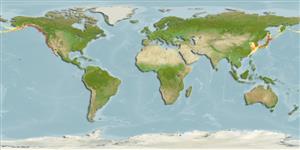
| Native range | All suitable habitat | Point map | Year 2050 |
|
| This map was computer-generated and has not yet been reviewed. |
| Squalus suckleyi AquaMaps Data sources: GBIF OBIS |
アップロード 写真 そして ビデオ
画像 | グーグルの画像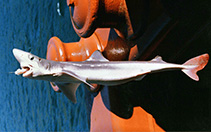 Squalus suckleyi
画像によって Modder, T.
画像 | グーグルの画像
画像によって Modder, T.
分類 / 名前 共通名の | 類義語 | Catalog of Fishes(部類, 種) | ITIS | CoL | WoRMS | Cloffa
板鰓亜鋼(サメとエイ類) (sharks and rays) > Squaliformes (Sleeper and dogfish sharks) > Squalidae (Dogfish sharks)
Etymology: Squalus: Genus name from Latin 'squalus' meaning shark (Ref. 6885, 27436); suckleyi: Named for George Suckley who collected the specimens used by Charles Girard in his original description.
Eponymy: Dr George Suckley (1830–1869) was an American Army surgeon and naturalist. [...] (Ref. 128868), visit book page.
More on author: Girard.
Etymology: Squalus: Genus name from Latin 'squalus' meaning shark (Ref. 6885, 27436); suckleyi: Named for George Suckley who collected the specimens used by Charles Girard in his original description.
Eponymy: Dr George Suckley (1830–1869) was an American Army surgeon and naturalist. [...] (Ref. 128868), visit book page.
More on author: Girard.
Taxonomic Remarks
Squalus suckleyi (Girard, 1855) has been resurected by Ebert et al. (2010: Ref. 85328) in the North Pacific where it replaces Squalus acanthias Linnaeus, 1758.
環境:環境 / 気候帯 / 深さの範囲 / 分布範囲 生態学
海; 汽水性の 底生の漂泳性; 深さの範囲 15 - 1244 m (Ref. 119696). Subtropical; 7°C - 15°C (Ref. 85328); 67°N - 29°N, 128°E - 115°W
分布 領土 | 国連食糧農業機関の区域 | エコシステム | 事件 | 目的のマップ | 導入 | Faunafri
North Pacific: Korea, Japan, northward to Russia (Kamchatka, Sea of Okhotsk and Sakhalin), the Bering Sea and the Aleutian Islands; eastwards in the Gulf of Alaska, British Columbia and Washington south to southern Baja California.
初回成熟時の長さ / サイズ / 重さ / 年齢
簡単な記述 検索表 | 形態学 | 形態計測学
脊つい: 97 - 106. This large-sized, slender bodied species is distinguished by the following set of characters: body slender, trunk height 10.8 (8.3-12.0)% TL; snout rounded, somewhat blunted at apex, it is relatively short, with prenarial length 1.4 (1.3-1.5) times mouth width, preoral length 2.0 (2.1) times prenarial length, 9.1 (8.6-9.5)% TL; eye moderate-sized, its length 3.8 (3.2-3.9)% TL; anterior nasal flap simple, no secondary lobe; dorsal fins small, raked; first dorsal originates just posterior to free-rear tip of pectoral fin, the first dorsal-fin spine moderate, relatively narrow-based; pectoral fin lobe-like, not or weakly falcate; flank denticles broadly unicuspidate to weakly tricuspidate (Ref. 85328).
Body shape (shape guide): fusiform / normal.
Body shape (shape guide): fusiform / normal.
A demersal species found in coastal and oceanic waters; mainly epibenthopelagic which may be solitary or in groups (Ref.. 119696). It appears to prefer water temperatures between 7 and 15°C, and often makes longitudinal and depth migrations to follow this temperature preference (Ref. 48844). Reported taken at water temperatures of 0-12.7°C, with maximum catches at over 8° C. Juveniles are reported pelagic within the upper 25 m, settling to the bottom with maturity, mostly at 50-200 meters. Opportunistic feeders, with no specific targeted prey, but fishes are the main prey of larger individuals; also consumes squids, octopi, medusae, ctenophores, crustaceans (e.g., shrimps, euphausiids, and amphipods), and polychaetes (Ref. 119696). Edible but not appreciated. Its liver once served as a source of oil for mine lamps in the Nanaimo area (Ref. 6885). Due to the high mercury content in large individuals, it is recommended that only those less than 60 cm are eaten (Ref. 11007). Males mature at 70-80 cm TL (median age is 18.5 years) and females at 80-100 cm TL (median age 35.5 years) (Ref. 85328). In the high seas, this fish is taken as bycatch with salmon gillnet surveys from north of 40° to south of the Aleutian chain, over the Aleutian Basin and Bering Sea to about 60°N, along the chain and all across the Gulf of Alaska offshore; by bottom and pelagic trawls and gillnets northward from South Korea the Hawaiian Is., and southern California (Ref. 119696).
ライフサイクルと交尾行動 成熟 | 繁殖 | 放精 | 卵 | 生産力 | 幼生
Distinct pairing with embrace (Ref. 205). Adult females undergo an extended resting period of 1 year or more between pregnancies (Ref. 91921).
主な参考文献
参考文献のアップロード | 参考文献 | コーディネーター : Compagno, Leonard J.V. | 協力者
Ebert, D.A., W.T. White, K.J. Goldman, L.J.V. Compagno, T.S. Daly-Engel and R.D. Ward, 2010. Resurrection and redescription of Squalus suckleyi (Girard, 1854) from the North Pacific, with comments on the Squalus acanthias subgroup (Squaliformes: Squalidae). Zootaxa 2612:22-40. (Ref. 85328)
CITES
Not Evaluated
人間に対する脅威
Harmless
人間の用途
水産業: 潜在的興味の
FAO - Publication: search | FishSource |
より多くの情報
解剖学
カマ
脳
オトリス
カマ
脳
オトリス
生理学
体組成
栄養素
酸素消費
水泳タイプ
泳ぐ速さ
視覚色素
フィッシュ・サウンド
病気と寄生虫
毒性(LC50)
体組成
栄養素
酸素消費
水泳タイプ
泳ぐ速さ
視覚色素
フィッシュ・サウンド
病気と寄生虫
毒性(LC50)
用具
特記事項
XMLをダウンロードして下さい
インターネットの情報源
AFORO (otoliths) | Aquatic Commons | BHL | Cloffa | Websites from users | Check FishWatcher | CISTI | Catalog of Fishes: 部類, 種 | DiscoverLife | ECOTOX | FAO - Publication: search | Faunafri | Fishipedia | Fishtrace | GloBI | Google Books | Google Scholar | Google | IGFA World Record | OceanAdapt | OneZoom | Open Tree of Life | Otolith Atlas of Taiwan Fishes | PubMed | Reef Life Survey | Socotra Atlas | TreeBase | 生命の木 | Wikipedia: 行く, 検索する | World Records Freshwater Fishing | 動物に関する記録
モデルに基づく推定値
好ましい温度 (参照 123201): 5.1 - 17.3, mean 10.2 °C (based on 231 cells).
系統多様性指数 (参照 82804): PD50 = 0.5000 [Uniqueness, from 0.5 = low to 2.0 = high].
Bayesian length-weight: a=0.00912 (0.00347 - 0.02396), b=3.03 (2.80 - 3.26), in cm total length, based on LWR estimates for this (Sub)family-body shape (Ref. 93245).
栄養段階 (参照 69278): 3.8 ±0.47 se; based on food items.
回復力 (参照 120179): 非常に低い, 14年以上の倍増期間の最小個体群 (K=0.3-0.15; tm=14-36; Fec=6).