



Mastacembelus reygeli Vreven & Snoeks, 2009
muatnaik fotos/gambar dan video
imej Google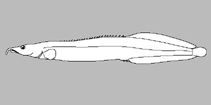 No image available for this species;
drawing shows typical species in Mastacembelidae.
imej Google
drawing shows typical species in Mastacembelidae.
klasifikasi / Nama Nama-nama umum | Sinonim (persamaan) | Catalog of Fishes(Marga, Jenis) | ITIS | CoL | WoRMS | Cloffa
> Synbranchiformes (Spiny eels) > Mastacembelidae (Spiny eels)
Etymology: Mastacembelus: Greek, mastax, -agos = bite + Greek, emballo = to throw oneself (Ref. 45335); reygeli: Named for Alain Reygel, artist at the MRAC in Tervuren in appreciation for his numerous beautiful drawings of African fishes.
Eponymy: Alain Marie Robert Godelieve Reygel (d: 1956) is a Belgian artist and scientific illustrator in the Department of Biology at Tervuren (MRAC) (1979–present). [...] (Ref. 128868), visit book page.
Etymology: Mastacembelus: Greek, mastax, -agos = bite + Greek, emballo = to throw oneself (Ref. 45335); reygeli: Named for Alain Reygel, artist at the MRAC in Tervuren in appreciation for his numerous beautiful drawings of African fishes.
Eponymy: Alain Marie Robert Godelieve Reygel (d: 1956) is a Belgian artist and scientific illustrator in the Department of Biology at Tervuren (MRAC) (1979–present). [...] (Ref. 128868), visit book page.
Lingkungan: lingkungan / zona iklim / kisaran kedalaman / jangkauan distribusi Ekologi
; air tawar bentopelagis; kisaran kedalaman 0 - 10 m (Ref. 82667). Tropical
Penyebaran Wilayah | Daerah-daerah FAO | Ekosistem | Kemunculan | peta titik | Introduksi | Faunafri
Africa: endemic to Lake Tanganyika, from Kalemie (Democratic Republic of Congo) to Kigoma (Tanzania) (Ref. 82667).
Ukuran / Berat / umur
deskripsi pendek Kunci identifiaksi (pengenalan) | Morfologi | Morfometrik
Duri punggung (Keseluruhan (total)) : 34 - 38; duri punggung lunak (Keseluruhan (total)) : 54 - 70; Duri dubur: 3; Sirip dubur lunak: 56 - 71; vertebrata, bertulang belakang: 78 - 83. Distinguished from its congeners in Lake Tanganyika by the following characters: short post-anal length 36.6-44.8% SL ( vs. 50.6-60.5 % SL in Mastacembelus ophidium and Mastacembelus polli); brown background color without or with only a limited and scattered dark brown reticulate pattern ( vs. yellow background color with a series of large, saddleshaped, dark brown spots on the dorso-lateral surface of head, body and tail region in Mastacembelus ellipsifer, Mastacembelus plagiostomus and Mastacembelus zebratus); higher number of dorsal spines 34-38 (vs. <30 in Mastacembelus platysoma, Mastacembelus cunningtoni and Mastacembelus moorii and similarly from Mastacembelus micropectus with 26-35 dorsal spines). Additional characters useful to separate from Mastacembelus micropectus include: pectoral-fin length 14.4-25.9% HL (vs. 4.8-22.8% HL); post-anal length 37.5-43.1% SL (vs. 43.9-49.0% HL); brown background color without or with only a limited and scattered dark brown reticulate pattern (vs. a unique color pattern characterized by a light or dark brown background color mostly with numerous tiny yellowish-white spots). Differs from Mastacembelus tanganicae by its lower number of dorsal spines 34-38 (vs. 38-43). In addition, Mastacembelus tanganicae has a unique colour pattern characterized by a
uniform light brown to yellowish background colour with dark brown to black spots on the head, body and tail region forming short zigzag lines on the tail region. This species can also be distinguished by color pattern from Mastacembelus flavidus, which has a uniform light brown to yellowish overall background colour with numerous small, dark brown spots mainly situated on the head, body (above the lateral line) and dorsal fin (Ref. 82667).
Body shape (shape guide): eel-like; Cross section: oval.
Body shape (shape guide): eel-like; Cross section: oval.
Found among rocks at depths from 0 to 10 m (Ref. 82667).
Siklus hidup dan perilaku kawin Kematangan | Reproduksi, perkembang biakan | Pemijahan | telur-telur | Fekunditas | Larva
rujukan utama
Unggah referensi Anda | Acuan | Koordinator | mitra
Vreven, E.J. and J. Snoeks, 2009. A new mastacembelid species from Lake Tanganyika: a case complex evolutionary history. J. Fish Biol. 75(5):1018-1047. (Ref. 82667)
Status IUCN Red List (Ref. 130435: Version 2025-2 (Global))
kurang bimbang (LC) ; Date assessed: 21 February 2025
CITES
Not Evaluated
ancaman kepada manusia
Harmless
penggunaan manusia
FAO - Publication: search | FishSource |
informasi lanjut
Ekologi trofik
Item makanan (mangsa)
Komposisi makanan
Konsumsi makanan
Ransum makanan
Pemangsa
Item makanan (mangsa)
Komposisi makanan
Konsumsi makanan
Ransum makanan
Pemangsa
Ekologi
Ekologi
Ekologi
Dinamika populasi
Parameter pertumbuhan
Maks. usia / ukuran
Panjang-berat rel.
Panjang-panjang rel.
ukuran frekuensi
Konversi massa
pemulihan
Kelimpahan
Parameter pertumbuhan
Maks. usia / ukuran
Panjang-berat rel.
Panjang-panjang rel.
ukuran frekuensi
Konversi massa
pemulihan
Kelimpahan
Siklus hidup
Reproduksi, perkembang biakan
Kematangan
Kedewasaan / insang rel.
Fekunditas
Pemijahan
Agregasi pemijahan
telur-telur
pekembangan telor
Larva
Dinamika larva
Reproduksi, perkembang biakan
Kematangan
Kedewasaan / insang rel.
Fekunditas
Pemijahan
Agregasi pemijahan
telur-telur
pekembangan telor
Larva
Dinamika larva
Anatomi
Area insang
Otak
Otolith
Area insang
Otak
Otolith
Fisiologi
Komposisi tubuh
Nutrisi
Konsumsi oksigen
Jenis renang
Kecepatan berenang
Pigmen visual
Suara ikan
Penyakit & Parasit
Toksisitas (LC50)
Komposisi tubuh
Nutrisi
Konsumsi oksigen
Jenis renang
Kecepatan berenang
Pigmen visual
Suara ikan
Penyakit & Parasit
Toksisitas (LC50)
Genetika
genom
Genetika
Heterozigositas
Diturunkan
Keanekaragaman Genetik
genom
Genetika
Heterozigositas
Diturunkan
Keanekaragaman Genetik
Yang berhubungan dengan manusia
Sistem akuakultur
profil budidaya air
Strain
Kasus Ciguatera
Perangko, koin, dll.
Sistem akuakultur
profil budidaya air
Strain
Kasus Ciguatera
Perangko, koin, dll.
Alat, peralatan
E-book | Penuntun lapangan | tanda freqkuenci panjang | peringkat sejarah hidup | peta titik |
Tangkap-MSY |
laporan khas
muat turun XML
Sumber internet
AFORO (otoliths) | Aquatic Commons | BHL | Cloffa | Websites from users | semak peneliti ikan | CISTI | Catalog of Fishes: Marga, Jenis | DiscoverLife | ECOTOX | FAO - Publication: search | Faunafri | Fishipedia | Fishtrace | GloBI | Google Books | Google Scholar | Google | IGFA World Record | OneZoom | Open Tree of Life | Otolith Atlas of Taiwan Fishes | PubMed | Reef Life Survey | Socotra Atlas | TreeBase | Tree of Life | Wikipedia: pergi, Cari | World Records Freshwater Fishing | Zoobank | Catatan Zoologi
Estimasi berdasarkan model
Indeks keanekaragaman filogenetik (Acuan 82804): PD50 = 0.5000 [Uniqueness, from 0.5 = low to 2.0 = high].
Bayesian length-weight: a=0.00269 (0.00129 - 0.00562), b=2.94 (2.76 - 3.12), in cm total length, based on LWR estimates for this (Sub)family-body shape (Ref. 93245).
Tingkat Trofik (Acuan 69278): 3.8 ±0.6 se; based on size and trophs of closest relatives
Daya lenting (Acuan 120179): Tinggi, Waktu penggandaan populasi minimum kurang dari 15 bulan (Preliminary K or Fecundity.).