



Salmo coruhensis Turan, Kottelat & Engin, 2010
Coruh trout
Adicionar o seu Fotografias e vídeos
Fotografias | Imagem do Google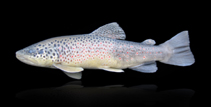 Salmo coruhensis
Fotografia de Kaya, C.
Fotografias | Imagem do Google
Fotografia de Kaya, C.
Classificação / Nomes Nomes comuns | Sinónimos | Catalog of Fishes(Género, Espécies) | ITIS | CoL | WoRMS | Cloffa
> Salmoniformes (Salmons) > Salmonidae (Salmonids) > Salmoninae
Etymology: Salmo: Latin, salmo, Plinius = salmon (Ref. 45335); coruhensis: Name derived from the Çoruh River; an adjective.
More on authors: Turan, Kottelat & Engin.
Etymology: Salmo: Latin, salmo, Plinius = salmon (Ref. 45335); coruhensis: Name derived from the Çoruh River; an adjective.
More on authors: Turan, Kottelat & Engin.
Ambiente: milieu / zona climática / intervalo de profundidade / gama de distribuição Ecologia
; Água doce bentopelágico. Subtropical
Distribuição Territórios | Áreas FAO | Ecossistemas | Ocorrências | Mapa dos pontos | Introduções | Faunafri
Asia: streams flowing to the southeastern Black Sea coast in Turkey, from the Yeşilırmak drainage in the west and the Coruh drainage in the east. Expected to be present in Georgia, at least in the lower Coruh.
Comprimento na primeira maturidade / Tamanho / Peso / Idade
Descrição breve Chaves de identificação | Morfologia | Morfometria
Raios anais moles: 10 - 12; Vértebras: 55 - 60. Distinguished from all its congeners in Turkey and adjacent waters by the combination of the following characters: large size, reaches up to at least 80 cm SL; body silvery in life; black spots on body medium to large (equal to or small than pupil), ocellated with circular white ring, scattered on back (sometimes present in predorsal area immediately in front of dorsal fin), middle and upper part of flank, and anterior part of lower half of flank in males larger than 23 cm SL, their number increasing with size; red spots irregularly shaped, surrounded with an irregular white ring, not conspicuous, scattered on a broad longitudinal area along middle of flank, their number increasing with size in specimens larger than 23 cm SL; head somewhat short (length 24.1-28.4% SL in both sexes), approximately 1.0-1.2 times body depth at dorsal-fin origin; maxilla short (length 8.5-10.7% SL in males, 8.5-9.6 in females), reaching beyond eye in specimens larger than 15 cm SL, upper edge convex posteriorly; and adipose fin somewhat deep, upper edge convex anteriorly (Ref. 85599).
Body shape (shape guide): fusiform / normal.
Body shape (shape guide): fusiform / normal.
Found in clear and moderately swift flowing water, with a substrate of sand and pebbles. Prefers to inhabit middle stretches of the main branches of rivers and streams, sometime the lower stretches. Also occurs in very short coastal streams (less than 5 km) and usually has not been encountered in intermediate size streams (5-35 km). Moves to the sea or the lower stretches of streams and rivers after spawning, where it stays until about April-May, when temperatures of the water start to rise. Possibly does not go far into the sea, but may stay in river mouths or at sea close to river mouths during winter. Spawns in October-November. Migrates upstreams in small groups of more than 10 individuals and probably comes back after breeding (Ref. 85599).
Ciclo de vida e comportamento de acasalamento Maturidade | Reprodução | Desova | Ovos | Fecundidade | Larvas
Referência principal
Carregar as suas referências | Referências | Coordenador | Colaboradores
Turan, D., M. Kottelat and S. Engin, 2009. Two new species of trouts, resident and migratory, sympatric in streams of northern Anatolia (Salmoniformes: Salmonidae). Ichthyol. Explor. Freshwat. 20(4):333-364. (Ref. 85599)
Categoria na Lista Vermelha da IUCN (Ref. 130435: Version 2025-2 (Global))
Quase ameaçada (NT) (A2c); Date assessed: 15 March 2013
CITES
Not Evaluated
Ameaça para o homem
Harmless
Utilização humana
Pescarias: de interesse potencial
FAO - Publication: search | FishSource |
Mais informação
Ecologia Trófica
Produtos alimentares (presas)
Composição da dieta
Consumo alimentar
Rações alimentares
Predadores
Produtos alimentares (presas)
Composição da dieta
Consumo alimentar
Rações alimentares
Predadores
Dinâmica das populações
Parâmetros de crescimento
Idades / tamanhos máximos
Comprimento-peso rel.
Comprimento-comprimento rel.
Frequência de comprimento
Conversão de massa
Recrutamento
Abundância
Parâmetros de crescimento
Idades / tamanhos máximos
Comprimento-peso rel.
Comprimento-comprimento rel.
Frequência de comprimento
Conversão de massa
Recrutamento
Abundância
Ciclo de vida
Reprodução
Maturidade
Maturidade/Rel. das guelras
Fecundidade
Desova
Agregações de desova
Ovos
Desenvolvimento dos ovos
Larvas
Dinâmica larvar
Reprodução
Maturidade
Maturidade/Rel. das guelras
Fecundidade
Desova
Agregações de desova
Ovos
Desenvolvimento dos ovos
Larvas
Dinâmica larvar
Anatomia
Área branquial
Cérebro
Otólitos
Área branquial
Cérebro
Otólitos
Fisiologia
Composição corporal
Nutrientes
Consumo de oxigénio
Tipo de natação
Velocidade de natação
Pigmentos visuais
Som de peixe
Doenças e Parasitas
Toxicidade (LC50s)
Composição corporal
Nutrientes
Consumo de oxigénio
Tipo de natação
Velocidade de natação
Pigmentos visuais
Som de peixe
Doenças e Parasitas
Toxicidade (LC50s)
Genética
genoma
Genética
Heterozigotia
Hereditariedade
Diversidade genética
genoma
Genética
Heterozigotia
Hereditariedade
Diversidade genética
Relacionado com o ser humano
Sistemas de aquacultura
Perfis para aquacultura
Estirpes
Casos de Ciguatera
Selos, moedas, diversos.
Sistemas de aquacultura
Perfis para aquacultura
Estirpes
Casos de Ciguatera
Selos, moedas, diversos.
Ferramentas
E-book | Guia de campo | Ferramenta auxiliar de frequências de comprimento | Ferramenta sobre a história de vida | Mapa dos pontos |
Captura-MSY |
Relatórios especiais
Descarregue XML
Fontes da internet
AFORO (otoliths) | Aquatic Commons | BHL | Cloffa | Websites from users | Consultar FishWatcher | CISTI | Catalog of Fishes: Género, Espécies | DiscoverLife | ECOTOX | FAO - Publication: search | Faunafri | Fishipedia | Fishtrace | GloBI | Google Books | Google Scholar | Google | IGFA World Record | Bases de dados nacionais | OneZoom | Open Tree of Life | Otolith Atlas of Taiwan Fishes | PubMed | Reef Life Survey | Socotra Atlas | TreeBase | Árvore da vida | Wikipedia: ir para, procurar | World Records Freshwater Fishing | Zoobank | Registo zoológico
Estimativas baseadas em modelos
Índice de diversidade filogenética (Ref. 82804): PD50 = 0.5000 [Uniqueness, from 0.5 = low to 2.0 = high].
Bayesian length-weight: a=0.01047 (0.00486 - 0.02255), b=3.03 (2.86 - 3.20), in cm total length, based on LWR estimates for this Genus-body shape (Ref. 93245).
Nível Trófico (Ref. 69278): 3.7 ±0.5 se; based on size and trophs of closest relatives
Resiliência (Ref. 120179): Muito baixo, tempo mínimo de duplicação da população maior que 14 anos (Preliminary K or Fecundity.).