



Salmo coruhensis Turan, Kottelat & Engin, 2010
Coruh trout
Uploaden van uw Foto's en video's
Afbeeldingen | Google afbeelding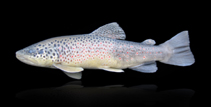 Salmo coruhensis
Afbeelding van Kaya, C.
Afbeeldingen | Google afbeelding
Afbeelding van Kaya, C.
Classificatie / Namen Lokale namen | Synoniemen | Catalog of Fishes(Genus, Soort(en)) | ITIS | CoL | WoRMS | Cloffa
> Salmoniformes (Salmons) > Salmonidae (Salmonids) > Salmoninae
Etymology: Salmo: Latin, salmo, Plinius = salmon (Ref. 45335); coruhensis: Name derived from the Çoruh River; an adjective.
More on authors: Turan, Kottelat & Engin.
Etymology: Salmo: Latin, salmo, Plinius = salmon (Ref. 45335); coruhensis: Name derived from the Çoruh River; an adjective.
More on authors: Turan, Kottelat & Engin.
Milieu: milieu / Klimaatzone / Diepte / verspreidingsgebied Ecologie
; zoet water benthopelagisch. Subtropical
Verspreiding Gebieden | FAO regio's | Ecosystemen | Voorkomen | Verspreidingskaart | Introducties | Faunafri
Asia: streams flowing to the southeastern Black Sea coast in Turkey, from the Yeşilırmak drainage in the west and the Coruh drainage in the east. Expected to be present in Georgia, at least in the lower Coruh.
Lengte bij maturiteit / Grootte / Gewicht / Leeftijd
Maturiteit: Lm ?, range 16 - ? cm
Max length : 80.0 cm SL mannelijk / geslacht onbekend; (Ref. 85599)
Max length : 80.0 cm SL mannelijk / geslacht onbekend; (Ref. 85599)
Korte beschrijving Determinatiesleutels | Morfologie | Morfometrie
Anale zachte stralen: 10 - 12; Wervels: 55 - 60. Distinguished from all its congeners in Turkey and adjacent waters by the combination of the following characters: large size, reaches up to at least 80 cm SL; body silvery in life; black spots on body medium to large (equal to or small than pupil), ocellated with circular white ring, scattered on back (sometimes present in predorsal area immediately in front of dorsal fin), middle and upper part of flank, and anterior part of lower half of flank in males larger than 23 cm SL, their number increasing with size; red spots irregularly shaped, surrounded with an irregular white ring, not conspicuous, scattered on a broad longitudinal area along middle of flank, their number increasing with size in specimens larger than 23 cm SL; head somewhat short (length 24.1-28.4% SL in both sexes), approximately 1.0-1.2 times body depth at dorsal-fin origin; maxilla short (length 8.5-10.7% SL in males, 8.5-9.6 in females), reaching beyond eye in specimens larger than 15 cm SL, upper edge convex posteriorly; and adipose fin somewhat deep, upper edge convex anteriorly (Ref. 85599).
Body shape (shape guide): fusiform / normal.
Body shape (shape guide): fusiform / normal.
Found in clear and moderately swift flowing water, with a substrate of sand and pebbles. Prefers to inhabit middle stretches of the main branches of rivers and streams, sometime the lower stretches. Also occurs in very short coastal streams (less than 5 km) and usually has not been encountered in intermediate size streams (5-35 km). Moves to the sea or the lower stretches of streams and rivers after spawning, where it stays until about April-May, when temperatures of the water start to rise. Possibly does not go far into the sea, but may stay in river mouths or at sea close to river mouths during winter. Spawns in October-November. Migrates upstreams in small groups of more than 10 individuals and probably comes back after breeding (Ref. 85599).
Levenscyclus en paargedrag Maturiteit | Voortplanting | Paaien | Eieren | Fecunditeit | Larven
Hoofdreferentie
Upload uw referenties | Referenties | Coördinator | Medewerkers
Turan, D., M. Kottelat and S. Engin, 2009. Two new species of trouts, resident and migratory, sympatric in streams of northern Anatolia (Salmoniformes: Salmonidae). Ichthyol. Explor. Freshwat. 20(4):333-364. (Ref. 85599)
Status op de Rode Lijst van het IUCN (Ref. 130435: Version 2025-2 (Global))
Gevoelig (NT) (A2c); Date assessed: 15 March 2013
CITES
Not Evaluated
Gevaar voor de mens
Harmless
Gebruik door de mens
Visserij: van potentieel belang
FAO - Publication: search | FishSource |
Meer informatie
Trofische ecologie
Voedsel (prooien)
Dieetsamenstelling
Voedselconsumptie
Voedselrantsoenen
Predatoren
Voedsel (prooien)
Dieetsamenstelling
Voedselconsumptie
Voedselrantsoenen
Predatoren
Populatiedynamica
Groeiparameters
Max. leeftijden / maten
Lengte-gewicht rel.
Lengte-lengte rel.
Lengtefrequenties
Massaconversie
Rekrutering
Abundantie
Groeiparameters
Max. leeftijden / maten
Lengte-gewicht rel.
Lengte-lengte rel.
Lengtefrequenties
Massaconversie
Rekrutering
Abundantie
Levenscyclus
Voortplanting
Maturiteit
Rijpheid/kieuwen rel.
Fecunditeit
Paaien
Paaibestanden
Eieren
Ontwikkeling van de eieren
Larven
Larvale populatiedynamiek
Voortplanting
Maturiteit
Rijpheid/kieuwen rel.
Fecunditeit
Paaien
Paaibestanden
Eieren
Ontwikkeling van de eieren
Larven
Larvale populatiedynamiek
Anatomie
Kieuwoppervlak
Hersenen
Otoliet
Kieuwoppervlak
Hersenen
Otoliet
Fysiologie
Lichaamssamenstelling
Voedingsstoffen
Zuurstofverbruik
Type zwemmen
Zwemsnelheid
Visuele pigmenten
Vis geluid
Ziekten en parasieten
Toxiciteit (LC50)
Lichaamssamenstelling
Voedingsstoffen
Zuurstofverbruik
Type zwemmen
Zwemsnelheid
Visuele pigmenten
Vis geluid
Ziekten en parasieten
Toxiciteit (LC50)
Genetica
genoom
Genetica
Heterozygositeit
Erfelijkheid
Genetische diversiteit
genoom
Genetica
Heterozygositeit
Erfelijkheid
Genetische diversiteit
Menselijk gerelateerd
Aquacultuursystemen
Aquacultuurprofielen
Kweeklijnen
Ciguatera gevallen
Postzegels, munten, diversen.
Aquacultuursystemen
Aquacultuurprofielen
Kweeklijnen
Ciguatera gevallen
Postzegels, munten, diversen.
Tools
Speciale rapporten
Bekijk gegevens voor het houden in een aquarium | Bekijk Fact Sheets voor de soort | Bekijk Aquacultuur Fact Sheets
Download XML
Internetbronnen
AFORO (otoliths) | Aquatic Commons | BHL | Cloffa | Websites from users | Bekijk FishWatcher | CISTI | Catalog of Fishes: Genus, Soort(en) | DiscoverLife | ECOTOX | FAO - Publication: search | Faunafri | Fishipedia | Fishtrace | GloBI | Google Books | Google Scholar | Google | IGFA World Record | Nationale databanken | OneZoom | Open Tree of Life | Otolith Atlas of Taiwan Fishes | PubMed | Reef Life Survey | Socotra Atlas | TreeBase | Tree of Life | Wikipedia: ga naar, zoek | World Records Freshwater Fishing | Zoobank | Zoological Record
Schattingen op basis van modellen
Fylogenetische diversiteitsindex (Ref. 82804): PD50 = 0.5000 [Uniqueness, from 0.5 = low to 2.0 = high].
Bayesian length-weight: a=0.01047 (0.00486 - 0.02255), b=3.03 (2.86 - 3.20), in cm total length, based on LWR estimates for this Genus-body shape (Ref. 93245).
Trofisch niveau (Ref. 69278): 3.7 ±0.5 se; based on size and trophs of closest relatives
Weerstandsvermogen (Ref. 120179): Zeer laag, minimale populatieverdubbelingstijd meer dan 14 jaar (Preliminary K or Fecundity.).