



Envoyez vos Photos et vidéos
Images | Images Google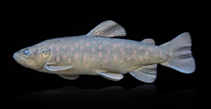 Salmo rizeensis
Photo de Kaya, C.
Images | Images Google
Photo de Kaya, C.
Classification / Noms Noms communs | Synonymes | Catalog of Fishes(Genre, Espèce) | ITIS | CoL | WoRMS | Cloffa
> Salmoniformes (Salmons) > Salmonidae (Salmonids) > Salmoninae
Etymology: Salmo: Latin, salmo, Plinius = salmon (Ref. 45335); rizeensis: Named for the city and homonymous province of Rize, where it is widely distributed and was first observed; an adjective.
More on authors: Turan, Kottelat & Engin.
Etymology: Salmo: Latin, salmo, Plinius = salmon (Ref. 45335); rizeensis: Named for the city and homonymous province of Rize, where it is widely distributed and was first observed; an adjective.
More on authors: Turan, Kottelat & Engin.
Environnement : milieu / zone climatique / profondeur / gamme de distribution Écologie
; eau douce benthopélagique. Subtropical
Distribution Territoires | Zones FAO | Écosystèmes | Occurrences | Carte par point | Introductions | Faunafri
Asia: headwaters and upper reaches of the streams and rivers entering the Black Sea along its southeastern and southern coasts in Turkey, between Sakarya drainage in the west and Coruh drainage in the east. Apparently present in Georgia.
Longueur à la première maturité / Taille / Poids / Âge
Description synthétique Clés d'identification | Morphologie | Morphométrie
Rayons mous anaux: 11; Vertèbres: 55 - 57. Distinguished from all its congeners in Turkey and adjacent areas by the combination of the following characters: small size, maximum length of about 25 cm SL; body brownish in life; black spots on body, small to medium (usually smaller than pupil), ocellated, restricted to back (missing in mid-dorsal area in front of dorsal fin) and to upper part of flank, few (decreasing in number with size); red spots few, small, ocellated, not very conspicuous, usually organized in three or four irregular longitudinal rows on median and lower part of flank, their appearance, size and number not changing with size; head long (27.8-31.1% SL in males, 25.3-27.4 in females), 1.2-1.4 times body depth at dorsal fin origin in male, distinctly sexually dimorphic; maxilla long (length 9.6-12.1 % SL in males, 8.6-9.8 in females), reaching beyond eye in both adults and juveniles, upper edge straight or slightly convex posteriorly in males; adipose fin slender, upper edge straight or very slightly convex anteriorly (Ref. 85599).
Body shape (shape guide): fusiform / normal.
Body shape (shape guide): fusiform / normal.
Occurs in small pools of streams with cold, clear and very swift flowing water, with high concentration of dissolved oxygen and substrate consisting of rocks, stones and few pebbles. Spends whole life and spawns in the upper reaches. Does not undertake migration during spawning period. Spawns in September-October. Overwinters into sand or gravel or under rocks and stones in small streams. Seems to stop feeding during winter as all specimens collected in winter had empty stomach (Ref. 85599).
Cycle de vie et comportement reproducteur Maturité | Reproduction | Frai | Œufs | Fécondité | Larves
Référence principale
Téléchargez vos références | Références | Coordinateur | Collaborateurs
Turan, D., M. Kottelat and S. Engin, 2009. Two new species of trouts, resident and migratory, sympatric in streams of northern Anatolia (Salmoniformes: Salmonidae). Ichthyol. Explor. Freshwat. 20(4):333-364. (Ref. 85599)
Statut dans la liste rouge de l'IUCN (Ref. 130435: Version 2025-2 (Global))
Préoccupation mineure (LC) ; Date assessed: 18 March 2013
CITES
Not Evaluated
Menace pour l'homme
Harmless
Utilisations par l'homme
Pêcheries: d'intérêt potentiel
FAO - Publication: search | FishSource |
Plus d'informations
Écologie trophique
Aliments (proies)
Composition du régime alimentaire
Consommation alimentaire
Rations alimentaires
Prédateurs
Aliments (proies)
Composition du régime alimentaire
Consommation alimentaire
Rations alimentaires
Prédateurs
Écologie
Écologie
Écologie
Dynamique des populations
Paramètres de croissance
Âges / tailles maximales
Longueur-poids rel.
Rel. longueur-longueur.
Fréquences de longueurs
Conversion de masse
Recrutement
Abondance
Paramètres de croissance
Âges / tailles maximales
Longueur-poids rel.
Rel. longueur-longueur.
Fréquences de longueurs
Conversion de masse
Recrutement
Abondance
Anatomie
Surface branchiale
Cerveau
Otolithe
Surface branchiale
Cerveau
Otolithe
Physiologie
Composition corporelle
Nutriments
Consommation d'oxygène
Type de natation
Vitesse de nage
Pigments visuels
Son de poisson
Maladies et parasites
Toxicité (CL50)
Composition corporelle
Nutriments
Consommation d'oxygène
Type de natation
Vitesse de nage
Pigments visuels
Son de poisson
Maladies et parasites
Toxicité (CL50)
Génétique
génôme
Génétique
Hétérozygotie
Héritabilité
Diversité génétique
génôme
Génétique
Hétérozygotie
Héritabilité
Diversité génétique
Liées à l'homme
Systèmes d'aquaculture
Profils d'aquaculture
Souches
Cas de ciguatera
Timbres, pièces de monnaie, divers
Systèmes d'aquaculture
Profils d'aquaculture
Souches
Cas de ciguatera
Timbres, pièces de monnaie, divers
Outils
E-book | Guide de terrain | Générateur de fréquences de longueur | Outil de dynamique de population | Carte par point |
Capture-MSY |
Articles particuliers
Télécharger en XML
Sources Internet
AFORO (otoliths) | Aquatic Commons | BHL | Cloffa | Websites from users | FishWatcher | CISTI | Catalog of Fishes: Genre, Espèce | DiscoverLife | ECOTOX | FAO - Publication: search | Faunafri | Fishipedia | Fishtrace | GloBI | Google Books | Google Scholar | Google | IGFA World Record | Bases de données nationales | OneZoom | Open Tree of Life | Otolith Atlas of Taiwan Fishes | PubMed | Reef Life Survey | Socotra Atlas | TreeBase | Arbre de Vie | Wikipedia: aller à, chercher | World Records Freshwater Fishing | Zoobank | Zoological Record
Estimations basées sur des modèles
Indice de diversité phylogénétique (Réf. 82804): PD50 = 0.5000 [Uniqueness, from 0.5 = low to 2.0 = high].
Bayesian length-weight: a=0.01047 (0.00486 - 0.02255), b=3.03 (2.86 - 3.20), in cm total length, based on LWR estimates for this Genus-body shape (Ref. 93245).
Niveau trophique (Réf. 69278): 3.5 ±0.5 se; based on size and trophs of closest relatives
Résilience (Réf. 120179): Milieu, temps minimum de doublement de population : 1,4 à 4,4 années (Preliminary K or Fecundity.).