



Uploaden van uw Foto's en video's
Afbeeldingen | Google afbeelding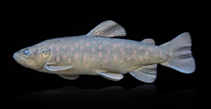 Salmo rizeensis
Afbeelding van Kaya, C.
Afbeeldingen | Google afbeelding
Afbeelding van Kaya, C.
Classificatie / Namen Lokale namen | Synoniemen | Catalog of Fishes(Genus, Soort(en)) | ITIS | CoL | WoRMS | Cloffa
> Salmoniformes (Salmons) > Salmonidae (Salmonids) > Salmoninae
Etymology: Salmo: Latin, salmo, Plinius = salmon (Ref. 45335); rizeensis: Named for the city and homonymous province of Rize, where it is widely distributed and was first observed; an adjective.
More on authors: Turan, Kottelat & Engin.
Etymology: Salmo: Latin, salmo, Plinius = salmon (Ref. 45335); rizeensis: Named for the city and homonymous province of Rize, where it is widely distributed and was first observed; an adjective.
More on authors: Turan, Kottelat & Engin.
Milieu: milieu / Klimaatzone / Diepte / verspreidingsgebied Ecologie
; zoet water benthopelagisch. Subtropical
Verspreiding Gebieden | FAO regio's | Ecosystemen | Voorkomen | Verspreidingskaart | Introducties | Faunafri
Asia: headwaters and upper reaches of the streams and rivers entering the Black Sea along its southeastern and southern coasts in Turkey, between Sakarya drainage in the west and Coruh drainage in the east. Apparently present in Georgia.
Lengte bij maturiteit / Grootte / Gewicht / Leeftijd
Maturiteit: Lm ?, range 11 - ? cm
Max length : 25.0 cm SL mannelijk / geslacht onbekend; (Ref. 85599)
Max length : 25.0 cm SL mannelijk / geslacht onbekend; (Ref. 85599)
Korte beschrijving Determinatiesleutels | Morfologie | Morfometrie
Anale zachte stralen: 11; Wervels: 55 - 57. Distinguished from all its congeners in Turkey and adjacent areas by the combination of the following characters: small size, maximum length of about 25 cm SL; body brownish in life; black spots on body, small to medium (usually smaller than pupil), ocellated, restricted to back (missing in mid-dorsal area in front of dorsal fin) and to upper part of flank, few (decreasing in number with size); red spots few, small, ocellated, not very conspicuous, usually organized in three or four irregular longitudinal rows on median and lower part of flank, their appearance, size and number not changing with size; head long (27.8-31.1% SL in males, 25.3-27.4 in females), 1.2-1.4 times body depth at dorsal fin origin in male, distinctly sexually dimorphic; maxilla long (length 9.6-12.1 % SL in males, 8.6-9.8 in females), reaching beyond eye in both adults and juveniles, upper edge straight or slightly convex posteriorly in males; adipose fin slender, upper edge straight or very slightly convex anteriorly (Ref. 85599).
Body shape (shape guide): fusiform / normal.
Body shape (shape guide): fusiform / normal.
Occurs in small pools of streams with cold, clear and very swift flowing water, with high concentration of dissolved oxygen and substrate consisting of rocks, stones and few pebbles. Spends whole life and spawns in the upper reaches. Does not undertake migration during spawning period. Spawns in September-October. Overwinters into sand or gravel or under rocks and stones in small streams. Seems to stop feeding during winter as all specimens collected in winter had empty stomach (Ref. 85599).
Levenscyclus en paargedrag Maturiteit | Voortplanting | Paaien | Eieren | Fecunditeit | Larven
Hoofdreferentie
Upload uw referenties | Referenties | Coördinator | Medewerkers
Turan, D., M. Kottelat and S. Engin, 2009. Two new species of trouts, resident and migratory, sympatric in streams of northern Anatolia (Salmoniformes: Salmonidae). Ichthyol. Explor. Freshwat. 20(4):333-364. (Ref. 85599)
Status op de Rode Lijst van het IUCN (Ref. 130435: Version 2025-2 (Global))
Niet bedreigd (LC) ; Date assessed: 18 March 2013
CITES
Not Evaluated
Gevaar voor de mens
Harmless
Gebruik door de mens
Visserij: van potentieel belang
FAO - Publication: search | FishSource |
Meer informatie
Trofische ecologie
Voedsel (prooien)
Dieetsamenstelling
Voedselconsumptie
Voedselrantsoenen
Predatoren
Voedsel (prooien)
Dieetsamenstelling
Voedselconsumptie
Voedselrantsoenen
Predatoren
Ecologie
Ecologie
Ecologie
Populatiedynamica
Groeiparameters
Max. leeftijden / maten
Lengte-gewicht rel.
Lengte-lengte rel.
Lengtefrequenties
Massaconversie
Rekrutering
Abundantie
Groeiparameters
Max. leeftijden / maten
Lengte-gewicht rel.
Lengte-lengte rel.
Lengtefrequenties
Massaconversie
Rekrutering
Abundantie
Levenscyclus
Voortplanting
Maturiteit
Rijpheid/kieuwen rel.
Fecunditeit
Paaien
Paaibestanden
Eieren
Ontwikkeling van de eieren
Larven
Larvale populatiedynamiek
Voortplanting
Maturiteit
Rijpheid/kieuwen rel.
Fecunditeit
Paaien
Paaibestanden
Eieren
Ontwikkeling van de eieren
Larven
Larvale populatiedynamiek
Anatomie
Kieuwoppervlak
Hersenen
Otoliet
Kieuwoppervlak
Hersenen
Otoliet
Fysiologie
Lichaamssamenstelling
Voedingsstoffen
Zuurstofverbruik
Type zwemmen
Zwemsnelheid
Visuele pigmenten
Vis geluid
Ziekten en parasieten
Toxiciteit (LC50)
Lichaamssamenstelling
Voedingsstoffen
Zuurstofverbruik
Type zwemmen
Zwemsnelheid
Visuele pigmenten
Vis geluid
Ziekten en parasieten
Toxiciteit (LC50)
Genetica
genoom
Genetica
Heterozygositeit
Erfelijkheid
Genetische diversiteit
genoom
Genetica
Heterozygositeit
Erfelijkheid
Genetische diversiteit
Menselijk gerelateerd
Aquacultuursystemen
Aquacultuurprofielen
Kweeklijnen
Ciguatera gevallen
Postzegels, munten, diversen.
Aquacultuursystemen
Aquacultuurprofielen
Kweeklijnen
Ciguatera gevallen
Postzegels, munten, diversen.
Tools
Speciale rapporten
Bekijk gegevens voor het houden in een aquarium | Bekijk Fact Sheets voor de soort | Bekijk Aquacultuur Fact Sheets
Download XML
Internetbronnen
AFORO (otoliths) | Aquatic Commons | BHL | Cloffa | Websites from users | Bekijk FishWatcher | CISTI | Catalog of Fishes: Genus, Soort(en) | DiscoverLife | ECOTOX | FAO - Publication: search | Faunafri | Fishipedia | Fishtrace | GloBI | Google Books | Google Scholar | Google | IGFA World Record | Nationale databanken | OneZoom | Open Tree of Life | Otolith Atlas of Taiwan Fishes | PubMed | Reef Life Survey | Socotra Atlas | TreeBase | Tree of Life | Wikipedia: ga naar, zoek | World Records Freshwater Fishing | Zoobank | Zoological Record
Schattingen op basis van modellen
Fylogenetische diversiteitsindex (Ref. 82804): PD50 = 0.5000 [Uniqueness, from 0.5 = low to 2.0 = high].
Bayesian length-weight: a=0.01047 (0.00486 - 0.02255), b=3.03 (2.86 - 3.20), in cm total length, based on LWR estimates for this Genus-body shape (Ref. 93245).
Trofisch niveau (Ref. 69278): 3.5 ±0.5 se; based on size and trophs of closest relatives
Weerstandsvermogen (Ref. 120179): Gemiddeld, minimale populatieverdubbelingstijd 1,4-4,4 jaar (Preliminary K or Fecundity.).