



Centrophorus uyato (Rafinesque, 1810)
Little gulper shark
Beobachtung melden im Fish Watcher
| Native range | All suitable habitat | Point map | Year 2050 |

|
| This map was computer-generated and has not yet been reviewed. |
| Centrophorus uyato AquaMaps Data sources: GBIF OBIS |
Hochladen Photos und videos
Bilder | Google Bild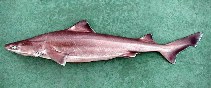 Centrophorus uyato
Male Photo von Cambraia Duarte, P.M.N. (c)ImagDOP
Bilder | Google Bild
Male Photo von Cambraia Duarte, P.M.N. (c)ImagDOP
Klassifizierung / Names Namen | Synonyme | Catalog of Fishes(Gattung, Arten) | ITIS | CoL | WoRMS | Cloffa
Elasmobranchii (Haie und Rochen) (sharks and rays) > Squaliformes (Sleeper and dogfish sharks) > Centrophoridae (Gulper sharks)
Etymology: Centrophorus: centr[um] (L.), prickle or sharp point; phorus, from phoreus (Gr.), bearer or carrier, referring to grooved spines on dorsal fins (See ETYFish); uyato: uyat or uyato, derived from agullats or ahullats, vernacular for dogfish sharks in the Mediterranean, based on a Mediterranean Squalus (Squalidae), now applied to this gulper shark from the eastern Indian Ocean and north Atlantic (See ETYFish).
More on author: Rafinesque.
Etymology: Centrophorus: centr[um] (L.), prickle or sharp point; phorus, from phoreus (Gr.), bearer or carrier, referring to grooved spines on dorsal fins (See ETYFish); uyato: uyat or uyato, derived from agullats or ahullats, vernacular for dogfish sharks in the Mediterranean, based on a Mediterranean Squalus (Squalidae), now applied to this gulper shark from the eastern Indian Ocean and north Atlantic (See ETYFish).
More on author: Rafinesque.
Taxonomic Remarks
Discussion on generic placement in Ref. 27638.
Umwelt: Milieu / Klimazone / Tiefenbereich / Verbreitungsgebiet Ökologie
seewasser bathydemersal; tiefenbereich 50 - 1400 m (Ref. 247), usually 200 - ? m (Ref. 247). Deep-water; 43°N - 43°S
Verbreitung Territorien | FAO Gebiete | Ökosysteme | Vorkommen | Punkt Karte | Einführungen | Faunafri
Indo-Pacific, Eastern Atlantic and the Mediterranean and Westerrn Atlantic.
Länge bei der ersten Reifung / Größe / Gewicht / Alter
Geschlechtsreife: Lm 82.0, range 75 - 89 cm
Max length : 110 cm TL Männchen/unbestimmt; (Ref. 27000); max. veröff. Gewicht: 7.3 kg (Ref. 40637)
Max length : 110 cm TL Männchen/unbestimmt; (Ref. 27000); max. veröff. Gewicht: 7.3 kg (Ref. 40637)
Kurzbeschreibung Bestimmungsschlüssel | Morphologie | Morphometrie
Rückenflossenstacheln (insgesamt) : 2; Afterflossenstacheln: 0. A small, slender gulper shark with a long, narrow snout, a short 1st dorsal fin and a high 2nd dorsal fin; pectoral rear tips usually very long; denticles small and flat (Ref. 5578). Brownish-grey above, light grey below (Ref. 5578).
Body shape (shape guide): elongated.
Body shape (shape guide): elongated.
A common deepwater dogfish of the outer continental shelves and upper slopes, on or near the bottom. Adults feed on bony fishes and squid. Males mature by 80 cm TL (Ref. 94782). Ovoviviparous (Ref. 50449). Utilized dried salted for human consumption and probably for fishmeal and liver oil (Ref. 247).
Lebenszyklus und Paarungsverhalten Geschlechtsreife | Fortpflanzung | Ablaichen | Eier | Fruchtbarkeit | Larven
Ovoviviparous, embryos feed solely on yolk (Ref. 50449). Number of young usually only 1. Size at birth between 40 and 50 cm (Ref. 247). Distinct pairing with embrace (Ref. 205).
Hauptreferenz
Laden Sie Ihre Referenzen hoch | Referenzen | Koordinator : Compagno, Leonard J.V. | Partner
White, W.T., D.A. Ebert and L.J.V. Compagno, 2008. Description of two new species of gulper sharks, genus Centrophorus (Chondrichthyes: Squaliformes: Centrophoridae) from Australia. pp. 1-21. In P.R. Last, W.T. White and J.J. Pogonoski (eds). Descriptions of new Australian chondrichthyans. CSIRO Marine and Atmospheric Research Paper no. 22. 365 p. (Ref. 76933)
IUCN Rote Liste Status (Ref. 130435: Version 2025-2 (Global))
stark gefährdet (EN) (A2bd); Date assessed: 27 February 2024
CITES
Not Evaluated
Bedrohung für Menschen
Harmless
Nutzung durch Menschen
Fischereien: weniger kommerziell; Sportfisch: ja
FAO - Publication: search | FishSource |
Mehr Information
Trophische Ökologie
Lebensmittel (Beutetiere)
Nahrungszusammensetzung
Nahrungsaufnahme
Lebensmittelrationen
Räuber
Lebensmittel (Beutetiere)
Nahrungszusammensetzung
Nahrungsaufnahme
Lebensmittelrationen
Räuber
Populationsdynamik
Wachstumsparameter
Max. Alter/Größen
Länge-Gewicht-Rel.
Länge-Länge-Verhältnis.
Längenhäufigkeiten
Massenkonvertierung
Rekrutierung
Dichte
Wachstumsparameter
Max. Alter/Größen
Länge-Gewicht-Rel.
Länge-Länge-Verhältnis.
Längenhäufigkeiten
Massenkonvertierung
Rekrutierung
Dichte
Lebenszyklus
Fortpflanzung
Geschlechtsreife
Reifung/Kiemen rel.
Fruchtbarkeit
Ablaichen
Laichaggregationen
Eier
Eientwicklung
Larven
Larven Pop.Dyn.
Fortpflanzung
Geschlechtsreife
Reifung/Kiemen rel.
Fruchtbarkeit
Ablaichen
Laichaggregationen
Eier
Eientwicklung
Larven
Larven Pop.Dyn.
Anatomie
Kiemenoberfläche
Gehirn
Otolith
Kiemenoberfläche
Gehirn
Otolith
Physiologie
Körperliche Zusammensetzung
Nährstoffe
Sauerstoffverbrauch
Schwimmart
Schwimmgeschwindigkeit
Visuelle Pigmente
Fischgeräusche
Krankheiten und Parasiten
Toxizität (LC50s)
Körperliche Zusammensetzung
Nährstoffe
Sauerstoffverbrauch
Schwimmart
Schwimmgeschwindigkeit
Visuelle Pigmente
Fischgeräusche
Krankheiten und Parasiten
Toxizität (LC50s)
Menschenbezogen
Aquakultur-Systeme
Aquakultur Profile
Zuchtlinien
Ciguatera-Fälle
Briefmarken, Münzen, Verschiedenes.
Aquakultur-Systeme
Aquakultur Profile
Zuchtlinien
Ciguatera-Fälle
Briefmarken, Münzen, Verschiedenes.
Tools
E-Book | Feldführer | Bestimmungsschlüssel | Längenhäufigkeits Tool | Lebensdaten Tool | Punkt Karte |
Catch-MSY |
Zusatzinformationen
Download XML
Zusammenfassung | Punktdaten | Namen | Photos
Internet Quellen
AFORO (otoliths) | Aquatic Commons | BHL | Cloffa | Websites from users | FishWatcher Einträge suchen | CISTI | Catalog of Fishes: Gattung, Arten | DiscoverLife | ECOTOX | FAO - Publication: search | Faunafri | Fishipedia | Fishtrace | GloBI | Google Books | Google Scholar | Google | IGFA World Record | Nationale Datenbanken | OneZoom | Open Tree of Life | Otolith Atlas of Taiwan Fishes | PubMed | Reef Life Survey | Socotra Atlas | TreeBase | Tree of Life | Wikipedia: Gehe zu, Suchen | World Records Freshwater Fishing | Zoologischer Rekord
Schätzungen auf der Grundlage von Modellen
Bevorzugte Temperatur (Ref. 123201): 7.3 - 16.7, mean 11.6 °C (based on 823 cells).
Phylogenetischer Diversitätsindex (Ref. 82804): PD50 = 0.5001 [Uniqueness, from 0.5 = low to 2.0 = high].
Bayesian length-weight: a=0.00245 (0.00159 - 0.00378), b=3.18 (3.05 - 3.31), in cm total length, based on LWR estimates for this species & (Sub)family-body (Ref. 93245).
Trophische Ebene (Ref. 69278): 4.5 ±0.60 se; based on food items.
Widerstandsfähigkeit (Ref. 120179): sehr niedrig, Verdopplung der Population dauert mehr als 14 Jahre. (Fec=1).
Nährstoffe (Ref. 124155): Calcium = 6.64 [1.37, 35.02] mg/100g; Iron = 0.306 [0.071, 0.999] mg/100g; Protein = 20 [18, 22] %; Omega3 = 0.307 [0.113, 0.983] g/100g; Selenium = 16.3 [5.1, 48.0] μg/100g; VitaminA = 12.5 [2.8, 57.5] μg/100g; Zinc = 0.261 [0.127, 0.502] mg/100g (wet weight);