



Hypostomus kopeyaka Carvalho, Lima & Zawadzki, 2010
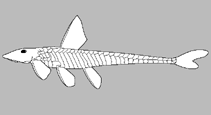
分類 / 名稱 俗名 | 同種異名 | Catalog of Fishes(屬, 種) | ITIS | CoL | WoRMS | Cloffa
Teleostei > Siluriformes (Catfishes) 鯰形目 (Catfishes) > Loricariidae (Armored catfishes) 甲鯰科 (Armored catfishes) > Hypostominae
Etymology: Hypostomus: Greek, hypo = under + Greek, stoma = mouth (Ref. 45335); kopeyaka: After its common name among the Tuyuka and Tukano indians, kope yaka, or kope ya’ka, meaning “pleco from the holes”, an allusion to the fact that, according to the Indians, the fishes spend most of their time hiding in holes in the river ban.
Etymology: Hypostomus: Greek, hypo = under + Greek, stoma = mouth (Ref. 45335); kopeyaka: After its common name among the Tuyuka and Tukano indians, kope yaka, or kope ya’ka, meaning “pleco from the holes”, an allusion to the fact that, according to the Indians, the fishes spend most of their time hiding in holes in the river ban.
環境: 環境 / 氣候帶 / 深度上下限 / 配送範圍 生態學
; 淡水 居於水底的. ; 1°N - 0°N, 69°W - 70°W
分布 領土 | FAO區域 | 生態系 | 發現紀錄 | 分布圖 | 簡介 | Faunafri
South America: Brazil and probably Colombia. Hypostomus kopeyaka is known only from the rio Tiquié basin, a tributary of the rio Uaupés, upper rio Negro drainage, Brazil. According to Tuyuka fishermen, the species also occurs at the upper rio Tiquié into Departamento Vaupés in Colombia, but no specimens are available from the latter area (Ref. 83896).
大小 / 重量 / 年齡
簡短描述 檢索表 | 型態特徵 | 形態測量圖
Distinguished from all congeners, except those belonging to the Hypostomus cochliodon group, by having few teeth (10 to 13) bearing a small lateral cusp and acutely angled dentaries. Diagnosed from the remaining members of the Hypostomus cochliodon group, except H. hemicochliodon, H. sculpodon, H. soniae Hollanda, Carvalho & Weber, and H. weberi, by possessing bicuspid teeth with mesial cusp rounded, considerably larger than outer cusp (vs. teeth generally unicuspid, outer cusp, if present, almost imperceptible, mesial cusp large and distinctly spoon-shaped). Hypostomus kopeyaka can be distinguished from H. hemicochliodon, H. sculpodon, H. soniae, and H. weberi by a distinctive color pattern composed of conspicuously horizontally elongated, closely-set black spots on the head and dorsal surfaces of the body (vs. spots absent in H. soniae, spots present but rounded in the remaining species, spots small in H. hemicochliodon and H. sculpodon, and large and widely-set in H. weberi). Additionally, it is differs from all the members of the Hypostomus cochliodon group, except H. weberi, H. ericae Hollanda Carvalho & Weber, H. hemicochliodon, H. paucipunctatus Hollanda Carvalho & Weber, H. sculpodon and H. waiampi Hollanda Carvalho & Weber, by possessing a buccal papilla (Ref. 83896).
Body shape (shape guide): elongated.
Body shape (shape guide): elongated.
Facultative air-breathing in the genus (Ref. 126274); Found in rapids, cataract pools, and slow-flowing portions of the rio Tiquié and some large tributaries (Ref. 83896).
生命週期和交配行為 成熟度 | 繁殖 | 產卵場 | 卵 | 孕卵數 | 仔魚
主要參考資料
上傳您的推薦信 | 參考文獻 | 合作者 : Fisch-Muller, Sonia | 合作者
Carvalho, P.H., F.C.T. Lima and C.H. Zawadzki, 2010. Two new species of the Hypostomus cochliodon group (Siluriformes: Loricariidae) from the Rio Negro basin in Brazil. Neotrop. Ichthyol. 8(1):39-48. (Ref. 83896)
CITES
Not Evaluated
對人類具威脅
人類使用
漁業: 沒有興趣
FAO - Publication: search | FishSource |
更多資訊
解剖學
鰓區
腦部
耳石
鰓區
腦部
耳石
生理學
身體成分
營養素
耗氧量
游泳類型
游泳速度
視覺色素
魚聲
疾病與寄生蟲
毒性 (LC50s)
身體成分
營養素
耗氧量
游泳類型
游泳速度
視覺色素
魚聲
疾病與寄生蟲
毒性 (LC50s)
遺傳學
基因組
遺傳學
異種性
遺傳率
遺傳多樣性
基因組
遺傳學
異種性
遺傳率
遺傳多樣性
工具
特別的報告
下載 XML
網路資源
AFORO (otoliths) | Aquatic Commons | BHL | Cloffa | Websites from users | 檢查 FishWatcher | CISTI | Catalog of Fishes: 屬, 種 | DiscoverLife | ECOTOX | FAO - Publication: search | Faunafri | Fishipedia | Fishtrace | GloBI | Google Books | Google Scholar | Google | IGFA World Record | OneZoom | Open Tree of Life | Otolith Atlas of Taiwan Fishes | PubMed | Reef Life Survey | Socotra Atlas | TreeBase | 樹狀分類階層 | Wikipedia: 去, 搜尋 | World Records Freshwater Fishing | Zoobank | 動物學的記錄
基於模型的估計
系統發育多樣性指數 (參考文獻 82804): PD50 = 0.5000 [Uniqueness, from 0.5 = low to 2.0 = high].
Bayesian length-weight: a=0.01585 (0.00726 - 0.03460), b=2.95 (2.78 - 3.12), in cm total length, based on LWR estimates for this Genus-body shape (Ref. 93245).
回復力 (參考文獻 120179): 中等的, 族群倍增時間最少 1.4 - 4.4年 (Preliminary K or Fecundity.).