



Canthigaster axiologus Whitley, 1931
Pacific crown toby
Beobachtung melden im Fish Watcher
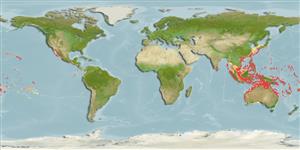
| Native range | All suitable habitat | Point map | Year 2050 |
|
| This map was computer-generated and has not yet been reviewed. |
| Canthigaster axiologus AquaMaps Data sources: GBIF OBIS |
Hochladen Photos und videos
Bilder | Google Bild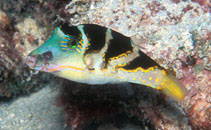 Canthigaster axiologus
Photo von Johnson, J.
Bilder | Google Bild
Photo von Johnson, J.
Klassifizierung / Names Namen | Synonyme | Catalog of Fishes(Gattung, Arten) | ITIS | CoL | WoRMS | Cloffa
> Tetraodontiformes (Puffers and filefishes) > Tetraodontidae (Puffers) > Canthigasterinae
Etymology: Canthigaster: Greek, kanthos = the outer or inner corner of the eye, where the lids meet, 1646 + Greek, gaster = stomach (Ref. 45335); axiologus: The species name axiologus stems from the Greek words αξίος and λόγος, the latter Latinised to logus; it is a noun in apposition and does not change its ending, though Canthigaster is feminine (Ref. 88002).
More on author: Whitley.
Etymology: Canthigaster: Greek, kanthos = the outer or inner corner of the eye, where the lids meet, 1646 + Greek, gaster = stomach (Ref. 45335); axiologus: The species name axiologus stems from the Greek words αξίος and λόγος, the latter Latinised to logus; it is a noun in apposition and does not change its ending, though Canthigaster is feminine (Ref. 88002).
More on author: Whitley.
Umwelt: Milieu / Klimazone / Tiefenbereich / Verbreitungsgebiet Ökologie
seewasser riff-verbunden; tiefenbereich 10 - 80 m (Ref. 90102). Tropical
Verbreitung Territorien | FAO Gebiete | Ökosysteme | Vorkommen | Punkt Karte | Einführungen | Faunafri
Pacific: Japan to Australia, east to the Marshall Islands and Tonga; with records from Western Australia, from Exmouth Gulf northwards.
Größe / Gewicht / Alter
Kurzbeschreibung Bestimmungsschlüssel | Morphologie | Morphometrie
Rückenflossenweichstrahlen (insgesamt) : 9 - 11; Afterflossenweichstrahlen: 9 - 10. This species is distinguished by the following characters: D 9-11 (usually 10, rarely 11); A 9-10 (usually 9); pectoral rays 15-18 (modally 16 in the North Pacific and 17 in the South Pacific); gill rakers 7-9; body depth between origins of dorsal and anal fins 3.0-3.3 in SL; head length (HL) 2.3-2.5 in SL; interorbital width 3.75-4.4 in HL; gill opening 4.8-5.55 in HL; origin of anal fin below or posterior to rear base of dorsal fin, the preanal length 1.25-1.35 in SL; longest dorsal ray 2.4-2.9 in HL; preserved colour pale grey to pale tan with 3 saddle-like, dark brown bars on body, similar to C. coronata, the edges of bars with close-set, small, pale-edged dark spots or short lines, irregularly alternating with unpigmented pale spots or lines; ventral part of body with or without small pale spots or pale-edged dark spots; across posterior interorbital and anterior occiput is a broad dark brown band; below base of pectoral fin is a dark brown spot; from chin to below gill opening, a narrow curved pale band edged in small dark spots; around eye is a pale area with radiating dark brown lines (except adjacent interorbital band); on head and abdomen is a midventral dark brown line varying from faint to conspicuous; lips pale, usually rimmed by a dusky band; fins pale grey, the upper and lower edges of caudal fin with or without a broad dark marginal band (Ref. 83660).
Body shape (shape guide): short and / or deep; Cross section: angular.
Body shape (shape guide): short and / or deep; Cross section: angular.
Occurs in sheltered habitat, often on open sand and rubble bottom near reefs; but appears to be far less common than C. coronata (Ref. 83660). Solitary (Ref. 90102).
Lebenszyklus und Paarungsverhalten Geschlechtsreife | Fortpflanzung | Ablaichen | Eier | Fruchtbarkeit | Larven
Oviparous (Ref. 205).
Hauptreferenz
Laden Sie Ihre Referenzen hoch | Referenzen | Koordinator : Matsuura, Keiichi | Partner
Randall, J.E., J.T. Williams and L.A. Rocha, 2008. The Indo-Pacific tetraodontid fish Canthigaster coronata, a complex of three species. Smithiana, Publ. Aquatic Biodiv. Bull. 9:3-13. (Ref. 83660)
IUCN Rote Liste Status (Ref. 130435: Version 2025-2 (Global))
nicht bedroht (LC) ; Date assessed: 07 June 2011
CITES
Not Evaluated
Bedrohung für Menschen
Harmless
Nutzung durch Menschen
FAO - Publication: search | FishSource |
Mehr Information
Trophische Ökologie
Lebensmittel (Beutetiere)
Nahrungszusammensetzung
Nahrungsaufnahme
Lebensmittelrationen
Räuber
Lebensmittel (Beutetiere)
Nahrungszusammensetzung
Nahrungsaufnahme
Lebensmittelrationen
Räuber
Ökologie
Ökologie
Ökologie
Populationsdynamik
Wachstumsparameter
Max. Alter/Größen
Länge-Gewicht-Rel.
Länge-Länge-Verhältnis.
Längenhäufigkeiten
Massenkonvertierung
Rekrutierung
Dichte
Wachstumsparameter
Max. Alter/Größen
Länge-Gewicht-Rel.
Länge-Länge-Verhältnis.
Längenhäufigkeiten
Massenkonvertierung
Rekrutierung
Dichte
Lebenszyklus
Fortpflanzung
Geschlechtsreife
Reifung/Kiemen rel.
Fruchtbarkeit
Ablaichen
Laichaggregationen
Eier
Eientwicklung
Larven
Larven Pop.Dyn.
Fortpflanzung
Geschlechtsreife
Reifung/Kiemen rel.
Fruchtbarkeit
Ablaichen
Laichaggregationen
Eier
Eientwicklung
Larven
Larven Pop.Dyn.
Anatomie
Kiemenoberfläche
Gehirn
Otolith
Kiemenoberfläche
Gehirn
Otolith
Physiologie
Körperliche Zusammensetzung
Nährstoffe
Sauerstoffverbrauch
Schwimmart
Schwimmgeschwindigkeit
Visuelle Pigmente
Fischgeräusche
Krankheiten und Parasiten
Toxizität (LC50s)
Körperliche Zusammensetzung
Nährstoffe
Sauerstoffverbrauch
Schwimmart
Schwimmgeschwindigkeit
Visuelle Pigmente
Fischgeräusche
Krankheiten und Parasiten
Toxizität (LC50s)
Menschenbezogen
Aquakultur-Systeme
Aquakultur Profile
Zuchtlinien
Ciguatera-Fälle
Briefmarken, Münzen, Verschiedenes.
Aquakultur-Systeme
Aquakultur Profile
Zuchtlinien
Ciguatera-Fälle
Briefmarken, Münzen, Verschiedenes.
Tools
Zusatzinformationen
Download XML
Zusammenfassung | Punktdaten | Namen | Photos
Internet Quellen
AFORO (otoliths) | Aquatic Commons | BHL | Cloffa | Websites from users | FishWatcher Einträge suchen | CISTI | Catalog of Fishes: Gattung, Arten | DiscoverLife | DORIS | ECOTOX | FAO - Publication: search | Faunafri | Fishipedia | Fishtrace | GloBI | Google Books | Google Scholar | Google | IGFA World Record | Nationale Datenbanken | OneZoom | Open Tree of Life | Otolith Atlas of Taiwan Fishes | PubMed | Reef Life Survey | Socotra Atlas | TreeBase | Tree of Life | Wikipedia: Gehe zu, Suchen | | Zoobank | Zoologischer Rekord
Schätzungen auf der Grundlage von Modellen
|
Phylogenetischer Diversitätsindex (Ref. 82804) |
PD50 = 0.5000 [Uniqueness, from 0.5 = low to 2.0 = high]. |
| Bayesian length-weight | a=0.03631 (0.01561 - 0.08443), b=2.88 (2.69 - 3.07), in cm total length, based on LWR estimates for this Genus-body shape (Ref. 93245). |
|
Trophische Ebene (Ref. 69278) |
3.1 ±0.3 se; based on size and trophs of closest relatives |
|
Widerstandsfähigkeit (Ref. 120179) |
hoch, Verdopplung der Population dauert weniger als 15 Monate. (Preliminary K or Fecundity.). |
|
Anfälligkeit der Fischerei (Ref. 59153) |
Low vulnerability (11 of 100). 🛈 |
|
Nährstoffe (Ref. 124155) |
Calcium = 107 [49, 256] mg/100g; Iron = 0.976 [0.481, 2.314] mg/100g; Protein = 18 [16, 20] %; Omega3 = 0.14 [0.07, 0.28] g/100g; Selenium = 38.9 [18.4, 87.6] μg/100g; VitaminA = 59.1 [16.2, 235.1] μg/100g; Zinc = 1.73 [1.12, 2.61] mg/100g (wet weight); |