



Canthigaster axiologus Whitley, 1931
Pacific crown toby
Waarneming toevoegen in Fish Watcher
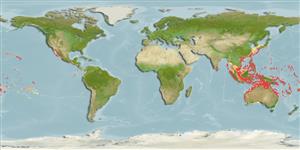
| Native range | All suitable habitat | Point map | Year 2050 |
|
| This map was computer-generated and has not yet been reviewed. |
| Canthigaster axiologus AquaMaps Data sources: GBIF OBIS |
Uploaden van uw Foto's en video's
Afbeeldingen | Google afbeelding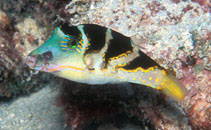 Canthigaster axiologus
Afbeelding van Johnson, J.
Afbeeldingen | Google afbeelding
Afbeelding van Johnson, J.
Classificatie / Namen Lokale namen | Synoniemen | Catalog of Fishes(Genus, Soort(en)) | ITIS | CoL | WoRMS | Cloffa
> Tetraodontiformes (Puffers and filefishes) > Tetraodontidae (Puffers) > Canthigasterinae
Etymology: Canthigaster: Greek, kanthos = the outer or inner corner of the eye, where the lids meet, 1646 + Greek, gaster = stomach (Ref. 45335); axiologus: The species name axiologus stems from the Greek words αξίος and λόγος, the latter Latinised to logus; it is a noun in apposition and does not change its ending, though Canthigaster is feminine (Ref. 88002).
More on author: Whitley.
Etymology: Canthigaster: Greek, kanthos = the outer or inner corner of the eye, where the lids meet, 1646 + Greek, gaster = stomach (Ref. 45335); axiologus: The species name axiologus stems from the Greek words αξίος and λόγος, the latter Latinised to logus; it is a noun in apposition and does not change its ending, though Canthigaster is feminine (Ref. 88002).
More on author: Whitley.
Milieu: milieu / Klimaatzone / Diepte / verspreidingsgebied Ecologie
marien rifbewoner; diepte 10 - 80 m (Ref. 90102). Tropical
Verspreiding Gebieden | FAO regio's | Ecosystemen | Voorkomen | Verspreidingskaart | Introducties | Faunafri
Pacific: Japan to Australia, east to the Marshall Islands and Tonga; with records from Western Australia, from Exmouth Gulf northwards.
Grootte / Gewicht / Leeftijd
Korte beschrijving Determinatiesleutels | Morfologie | Morfometrie
Dorsale zachte stralen (totaal) : 9 - 11; Anale zachte stralen: 9 - 10. This species is distinguished by the following characters: D 9-11 (usually 10, rarely 11); A 9-10 (usually 9); pectoral rays 15-18 (modally 16 in the North Pacific and 17 in the South Pacific); gill rakers 7-9; body depth between origins of dorsal and anal fins 3.0-3.3 in SL; head length (HL) 2.3-2.5 in SL; interorbital width 3.75-4.4 in HL; gill opening 4.8-5.55 in HL; origin of anal fin below or posterior to rear base of dorsal fin, the preanal length 1.25-1.35 in SL; longest dorsal ray 2.4-2.9 in HL; preserved colour pale grey to pale tan with 3 saddle-like, dark brown bars on body, similar to C. coronata, the edges of bars with close-set, small, pale-edged dark spots or short lines, irregularly alternating with unpigmented pale spots or lines; ventral part of body with or without small pale spots or pale-edged dark spots; across posterior interorbital and anterior occiput is a broad dark brown band; below base of pectoral fin is a dark brown spot; from chin to below gill opening, a narrow curved pale band edged in small dark spots; around eye is a pale area with radiating dark brown lines (except adjacent interorbital band); on head and abdomen is a midventral dark brown line varying from faint to conspicuous; lips pale, usually rimmed by a dusky band; fins pale grey, the upper and lower edges of caudal fin with or without a broad dark marginal band (Ref. 83660).
Body shape (shape guide): short and / or deep; Cross section: angular.
Body shape (shape guide): short and / or deep; Cross section: angular.
Occurs in sheltered habitat, often on open sand and rubble bottom near reefs; but appears to be far less common than C. coronata (Ref. 83660). Solitary (Ref. 90102).
Levenscyclus en paargedrag Maturiteit | Voortplanting | Paaien | Eieren | Fecunditeit | Larven
Oviparous (Ref. 205).
Hoofdreferentie
Upload uw referenties | Referenties | Coördinator : Matsuura, Keiichi | Medewerkers
Randall, J.E., J.T. Williams and L.A. Rocha, 2008. The Indo-Pacific tetraodontid fish Canthigaster coronata, a complex of three species. Smithiana, Publ. Aquatic Biodiv. Bull. 9:3-13. (Ref. 83660)
Status op de Rode Lijst van het IUCN (Ref. 130435: Version 2025-2 (Global))
Niet bedreigd (LC) ; Date assessed: 07 June 2011
CITES
Not Evaluated
Gevaar voor de mens
Harmless
Gebruik door de mens
FAO - Publication: search | FishSource |
Meer informatie
Trofische ecologie
Voedsel (prooien)
Dieetsamenstelling
Voedselconsumptie
Voedselrantsoenen
Predatoren
Voedsel (prooien)
Dieetsamenstelling
Voedselconsumptie
Voedselrantsoenen
Predatoren
Ecologie
Ecologie
Ecologie
Populatiedynamica
Groeiparameters
Max. leeftijden / maten
Lengte-gewicht rel.
Lengte-lengte rel.
Lengtefrequenties
Massaconversie
Rekrutering
Abundantie
Groeiparameters
Max. leeftijden / maten
Lengte-gewicht rel.
Lengte-lengte rel.
Lengtefrequenties
Massaconversie
Rekrutering
Abundantie
Levenscyclus
Voortplanting
Maturiteit
Rijpheid/kieuwen rel.
Fecunditeit
Paaien
Paaibestanden
Eieren
Ontwikkeling van de eieren
Larven
Larvale populatiedynamiek
Voortplanting
Maturiteit
Rijpheid/kieuwen rel.
Fecunditeit
Paaien
Paaibestanden
Eieren
Ontwikkeling van de eieren
Larven
Larvale populatiedynamiek
Anatomie
Kieuwoppervlak
Hersenen
Otoliet
Kieuwoppervlak
Hersenen
Otoliet
Fysiologie
Lichaamssamenstelling
Voedingsstoffen
Zuurstofverbruik
Type zwemmen
Zwemsnelheid
Visuele pigmenten
Vis geluid
Ziekten en parasieten
Toxiciteit (LC50)
Lichaamssamenstelling
Voedingsstoffen
Zuurstofverbruik
Type zwemmen
Zwemsnelheid
Visuele pigmenten
Vis geluid
Ziekten en parasieten
Toxiciteit (LC50)
Menselijk gerelateerd
Aquacultuursystemen
Aquacultuurprofielen
Kweeklijnen
Ciguatera gevallen
Postzegels, munten, diversen.
Aquacultuursystemen
Aquacultuurprofielen
Kweeklijnen
Ciguatera gevallen
Postzegels, munten, diversen.
Tools
Speciale rapporten
Bekijk gegevens voor het houden in een aquarium | Bekijk Fact Sheets voor de soort | Bekijk Aquacultuur Fact Sheets
Download XML
Internetbronnen
AFORO (otoliths) | Aquatic Commons | BHL | Cloffa | Websites from users | Bekijk FishWatcher | CISTI | Catalog of Fishes: Genus, Soort(en) | DiscoverLife | DORIS | ECOTOX | FAO - Publication: search | Faunafri | Fishipedia | Fishtrace | GloBI | Google Books | Google Scholar | Google | IGFA World Record | Nationale databanken | OneZoom | Open Tree of Life | Otolith Atlas of Taiwan Fishes | PubMed | Reef Life Survey | Socotra Atlas | TreeBase | Tree of Life | Wikipedia: ga naar, zoek | | Zoobank | Zoological Record
Schattingen op basis van modellen
|
Fylogenetische diversiteitsindex (Ref. 82804) |
PD50 = 0.5000 [Uniqueness, from 0.5 = low to 2.0 = high]. |
| Bayesian length-weight | a=0.03631 (0.01561 - 0.08443), b=2.88 (2.69 - 3.07), in cm total length, based on LWR estimates for this Genus-body shape (Ref. 93245). |
|
Trofisch niveau (Ref. 69278) |
3.1 ±0.3 se; based on size and trophs of closest relatives |
|
Weerstandsvermogen (Ref. 120179) |
Hoog, minimale populatieverdubbelingstijd minder dan 15 maanden (Preliminary K or Fecundity.). |
|
Kwetsbaarheid van de visserij (Ref. 59153) |
Low vulnerability (11 of 100). 🛈 |
|
Voedingsstoffen (Ref. 124155) |
Calcium = 107 [49, 256] mg/100g; Iron = 0.976 [0.481, 2.314] mg/100g; Protein = 18 [16, 20] %; Omega3 = 0.14 [0.07, 0.28] g/100g; Selenium = 38.9 [18.4, 87.6] μg/100g; VitaminA = 59.1 [16.2, 235.1] μg/100g; Zinc = 1.73 [1.12, 2.61] mg/100g (wet weight); |