



Candidia pingtungensis Chen, Wu & Hsu, 2008
Hochladen Photos und videos
Google Bild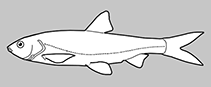 No image available for this species;
drawing shows typical species in Xenocyprididae.
Google Bild
drawing shows typical species in Xenocyprididae.
Klassifizierung / Names Namen | Synonyme | Catalog of Fishes(Gattung, Arten) | ITIS | CoL | WoRMS | Cloffa
> Cypriniformes (Carps) > Xenocyprididae (East Asian minnows)
Etymology: Candidia: Latin, candidus, candere = to be white, glisten (Ref. 45335); pingtungensis: Named after the County Pingtung in southern Taiwan.
Etymology: Candidia: Latin, candidus, candere = to be white, glisten (Ref. 45335); pingtungensis: Named after the County Pingtung in southern Taiwan.
Umwelt: Milieu / Klimazone / Tiefenbereich / Verbreitungsgebiet Ökologie
; süßwasser benthopelagisch; pH range: 7.5 - 8.8. Subtropical
Verbreitung Territorien | FAO Gebiete | Ökosysteme | Vorkommen | Punkt Karte | Einführungen | Faunafri
Asia: Tongkang River southwards to all western drainages of Hengchuen Peninsula and also to the eastern drainage of the Kongkou River and most of Pingtung Country, Taiwan.
Größe / Gewicht / Alter
Kurzbeschreibung Bestimmungsschlüssel | Morphologie | Morphometrie
Rückenflossenweichstrahlen (insgesamt) : 10; Afterflossenweichstrahlen: 12 - 13; Wirbelzahl: 44 - 46. Diagnosed from all other species of the genus Candidia by the following unique combination of characters: dorsal fin with iii,7 rays; anal fin with iii,9-10 rays; pectoral fin with I, 14 rays ; scales on lateral line 46-50; scales above lateral line 9-10; scales below lateral line 3-4; predorsal scales 19-21; gill rakers 2+6 (total 8); pharyngeal teeth always 1,3,5 -4,4,1; shallow ventral keel on the posterior half of region between pelvic fin and anus; cheek with a series of 3-5 nuptial tubercles on cheek and lower jaw in adult males with 5-7 nuptial tubercles; eye large, eye diameter about equal to cheek depth in adult male; body with a uniform broad, longitudinal black stripe from upper opercle, through mid-lateral to caudal fin base; dorsal side dark grayish, a broad silvery white stripe just above the longitudinal black stripe; ventral side silvery-white; dorsal fin pinkish-red with distal transverse black bars in male; and eye with red-black region on dorsal two-third of eye iris (Ref. 79878).
Body shape (shape guide): elongated.
Body shape (shape guide): elongated.
Occurs in the anterior portion of pools and edge-water habitats up to 2 m depth with benthic substratum composed of small pebbles to large boulders under slow to moderate water flow, in small and very clear tributaries and headwaters with better shaded vegetation along the stream bank (Ref. 79878).
Lebenszyklus und Paarungsverhalten Geschlechtsreife | Fortpflanzung | Ablaichen | Eier | Fruchtbarkeit | Larven
Hauptreferenz
Laden Sie Ihre Referenzen hoch | Referenzen | Koordinator | Partner
Chen, I.-S., J.-H. Wu and C.-H. Hsu, 2008. The taxonomy and phylogeny of Candidia (Teleostei: Cyprinidae) from Taiwan, with description of a new species and comments on a new genus. The Raffles Bull. Zool. 19:203-214. (Ref. 79878)
CITES
Not Evaluated
Bedrohung für Menschen
Harmless
Nutzung durch Menschen
FAO - Publication: search | FishSource |
Mehr Information
Trophische Ökologie
Lebensmittel (Beutetiere)
Nahrungszusammensetzung
Nahrungsaufnahme
Lebensmittelrationen
Räuber
Lebensmittel (Beutetiere)
Nahrungszusammensetzung
Nahrungsaufnahme
Lebensmittelrationen
Räuber
Ökologie
Ökologie
Ökologie
Populationsdynamik
Wachstumsparameter
Max. Alter/Größen
Länge-Gewicht-Rel.
Länge-Länge-Verhältnis.
Längenhäufigkeiten
Massenkonvertierung
Rekrutierung
Dichte
Wachstumsparameter
Max. Alter/Größen
Länge-Gewicht-Rel.
Länge-Länge-Verhältnis.
Längenhäufigkeiten
Massenkonvertierung
Rekrutierung
Dichte
Lebenszyklus
Fortpflanzung
Geschlechtsreife
Reifung/Kiemen rel.
Fruchtbarkeit
Ablaichen
Laichaggregationen
Eier
Eientwicklung
Larven
Larven Pop.Dyn.
Fortpflanzung
Geschlechtsreife
Reifung/Kiemen rel.
Fruchtbarkeit
Ablaichen
Laichaggregationen
Eier
Eientwicklung
Larven
Larven Pop.Dyn.
Anatomie
Kiemenoberfläche
Gehirn
Otolith
Kiemenoberfläche
Gehirn
Otolith
Physiologie
Körperliche Zusammensetzung
Nährstoffe
Sauerstoffverbrauch
Schwimmart
Schwimmgeschwindigkeit
Visuelle Pigmente
Fischgeräusche
Krankheiten und Parasiten
Toxizität (LC50s)
Körperliche Zusammensetzung
Nährstoffe
Sauerstoffverbrauch
Schwimmart
Schwimmgeschwindigkeit
Visuelle Pigmente
Fischgeräusche
Krankheiten und Parasiten
Toxizität (LC50s)
Genetik
Genom
Genetik
Heterozygotie
Vererbbarkeit
Genetische Vielfalt
Genom
Genetik
Heterozygotie
Vererbbarkeit
Genetische Vielfalt
Menschenbezogen
Aquakultur-Systeme
Aquakultur Profile
Zuchtlinien
Ciguatera-Fälle
Briefmarken, Münzen, Verschiedenes.
Aquakultur-Systeme
Aquakultur Profile
Zuchtlinien
Ciguatera-Fälle
Briefmarken, Münzen, Verschiedenes.
Tools
Zusatzinformationen
Download XML
Zusammenfassung | Punktdaten | Namen | Photos
Internet Quellen
AFORO (otoliths) | Aquatic Commons | BHL | Cloffa | Websites from users | FishWatcher Einträge suchen | CISTI | Catalog of Fishes: Gattung, Arten | DiscoverLife | ECOTOX | FAO - Publication: search | Faunafri | Fishipedia | Fishtrace | GloBI | Google Books | Google Scholar | Google | IGFA World Record | Nationale Datenbanken | OneZoom | Open Tree of Life | Otolith Atlas of Taiwan Fishes | PubMed | Reef Life Survey | Socotra Atlas | TreeBase | Tree of Life | Wikipedia: Gehe zu, Suchen | World Records Freshwater Fishing | Zoobank | Zoologischer Rekord
Schätzungen auf der Grundlage von Modellen
Phylogenetischer Diversitätsindex (Ref. 82804): PD50 = 0.7500 [Uniqueness, from 0.5 = low to 2.0 = high].
Bayesian length-weight: a=0.00631 (0.00298 - 0.01335), b=3.07 (2.90 - 3.24), in cm total length, based on LWR estimates for this (Sub)family-body shape (Ref. 93245).
Trophische Ebene (Ref. 69278): 3.1 ±0.4 se; based on size and trophs of closest relatives
Widerstandsfähigkeit (Ref. 120179): hoch, Verdopplung der Population dauert weniger als 15 Monate. (Preliminary K or Fecundity.).