



Beobachtung melden im Fish Watcher
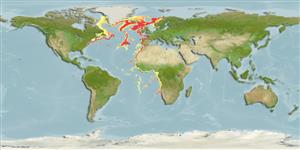
| Native range | All suitable habitat | Point map | Year 2050 |
|
| This map was computer-generated and has not yet been reviewed. |
| Aphanopus carbo AquaMaps Data sources: GBIF OBIS |
Hochladen Photos und videos
Bilder | Google Bild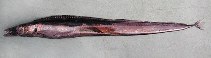 Aphanopus carbo
Female Photo von Cambraia Duarte, P.M.N. (c)ImagDOP
Bilder | Google Bild
Female Photo von Cambraia Duarte, P.M.N. (c)ImagDOP
Klassifizierung / Names Namen | Synonyme | Catalog of Fishes(Gattung, Arten) | ITIS | CoL | WoRMS | Cloffa
> Scombriformes (Mackerels) > Trichiuridae (Cutlassfishes) > Aphanopodinae
Etymology: Aphanopus: Greek, aphanes = hidden + Greek, pous = foot (Ref. 45335).
More on author: Lowe.
Etymology: Aphanopus: Greek, aphanes = hidden + Greek, pous = foot (Ref. 45335).
More on author: Lowe.
Umwelt: Milieu / Klimazone / Tiefenbereich / Verbreitungsgebiet Ökologie
seewasser bathypelagisch; ozeanodrom (Ref. 108735); tiefenbereich 200 - 2300 m (Ref. 108733), usually 700 - 1300 m (Ref. 108735). Deep-water; 71°N - 23°S, 82°W - 17°E (Ref. 6181)
Verbreitung Territorien | FAO Gebiete | Ökosysteme | Vorkommen | Punkt Karte | Einführungen | Faunafri
North Atlantic: on both sides and at underwater rises from Denmark Strait to Cape Verde.
Länge bei der ersten Reifung / Größe / Gewicht / Alter
Geschlechtsreife: Lm 111.6 range ? - 117.5 cm
Max length : 151 cm TL Männchen/unbestimmt; (Ref. 108708); common length : 70.0 cm SL Männchen/unbestimmt; (Ref. 3698); max. veröff. Gewicht: 0.00 g
Max length : 151 cm TL Männchen/unbestimmt; (Ref. 108708); common length : 70.0 cm SL Männchen/unbestimmt; (Ref. 3698); max. veröff. Gewicht: 0.00 g
Kurzbeschreibung Bestimmungsschlüssel | Morphologie | Morphometrie
Rückenflossenstacheln (insgesamt) : 34 - 41; Rückenflossenweichstrahlen (insgesamt) : 52 - 56; Afterflossenstacheln: 2; Afterflossenweichstrahlen: 43 - 48; Wirbelzahl: 97 - 100. Body is extremely elongated, with body depth 10.8 to 13.4 times in SL. The snout is large with strong fang-like teeth. Pelvic fins represented by a single spine in juveniles but entirely absent in adults. Color is coppery black with iridescent tint. The inside of the mouth and gill cavities black.
Body shape (shape guide): eel-like; Cross section: compressed.
Body shape (shape guide): eel-like; Cross section: compressed.
Juveniles mesopelagic (Ref. 6181). Bathypelagic (Ref. 58426). Migrate to midwater at night and feed on crustaceans, cephalopods and fishes (mostly macrourids, morids and alepocephalids). Mature at 80 to 85 cm. Eggs and larvae are pelagic (Ref. 6768). Data from study reveal mature individuals undertake horizontal migration to spawning and nursery grounds located off the Madeira and Canary islands (Ref. 108708). Commercial catch up to 1000 t was caught off Madeira with a specialized commercial deep water longline (Ref. 6255). Appear as bycatch in the trawl fishery west of the British Isles, along the Middle-Atlantic Ridge and at Corner Rise. Important and fabled food fish in Madeira (Ref. 4537). Some specimens reach 145 cm (Nuno Marques, Nomad@netmadeira.com, 12/09).
Lebenszyklus und Paarungsverhalten Geschlechtsreife | Fortpflanzung | Ablaichen | Eier | Fruchtbarkeit | Larven
Displays determinate fecundity (Ref. 108695). Mature individuals undertake horizontal migration to spawning and nursery grounds (Ref. 108708). Suspended pre-spawning stages occurred in some areas of the Northeast Atlantic caused by atresia in ovaries (Ref. 108708).
Hauptreferenz
Laden Sie Ihre Referenzen hoch | Referenzen | Koordinator : Parin, Nikolay V. | Partner
Nakamura, I. and N.V. Parin, 1993. FAO Species Catalogue. Vol. 15. Snake mackerels and cutlassfishes of the world (families Gempylidae and Trichiuridae). An annotated and illustrated catalogue of the snake mackerels, snoeks, escolars, gemfishes, sackfishes, domine, oilfish, cutlassfishes,. scabbardfishes, hairtails, and frostfishes known to date. FAO Fish. Synop. 125(15):136 p. (Ref. 6181)
IUCN Rote Liste Status (Ref. 130435: Version 2025-2 (Global))
nicht bedroht (LC) ; Date assessed: 12 October 2018
CITES
Not Evaluated
Bedrohung für Menschen
Harmless
Nutzung durch Menschen
Fischereien: hoch kommerziell
FAO - Fischereien: landungen, Artbeschreibung; Publication: search | FIRMS - Stock assessments | FishSource | Das Meer um uns herum
Mehr Information
Trophische Ökologie
Lebensmittel (Beutetiere)
Nahrungszusammensetzung
Nahrungsaufnahme
Lebensmittelrationen
Räuber
Lebensmittel (Beutetiere)
Nahrungszusammensetzung
Nahrungsaufnahme
Lebensmittelrationen
Räuber
Populationsdynamik
Wachstumsparameter
Max. Alter/Größen
Länge-Gewicht-Rel.
Länge-Länge-Verhältnis.
Längenhäufigkeiten
Massenkonvertierung
Rekrutierung
Dichte
Wachstumsparameter
Max. Alter/Größen
Länge-Gewicht-Rel.
Länge-Länge-Verhältnis.
Längenhäufigkeiten
Massenkonvertierung
Rekrutierung
Dichte
Lebenszyklus
Fortpflanzung
Geschlechtsreife
Reifung/Kiemen rel.
Fruchtbarkeit
Ablaichen
Laichaggregationen
Eier
Eientwicklung
Larven
Larven Pop.Dyn.
Fortpflanzung
Geschlechtsreife
Reifung/Kiemen rel.
Fruchtbarkeit
Ablaichen
Laichaggregationen
Eier
Eientwicklung
Larven
Larven Pop.Dyn.
Physiologie
Körperliche Zusammensetzung
Nährstoffe
Sauerstoffverbrauch
Schwimmart
Schwimmgeschwindigkeit
Visuelle Pigmente
Fischgeräusche
Krankheiten und Parasiten
Toxizität (LC50s)
Körperliche Zusammensetzung
Nährstoffe
Sauerstoffverbrauch
Schwimmart
Schwimmgeschwindigkeit
Visuelle Pigmente
Fischgeräusche
Krankheiten und Parasiten
Toxizität (LC50s)
Genetik
Genom
Genetik
Heterozygotie
Vererbbarkeit
Genetische Vielfalt
Genom
Genetik
Heterozygotie
Vererbbarkeit
Genetische Vielfalt
Menschenbezogen
Aquakultur-Systeme
Aquakultur Profile
Zuchtlinien
Ciguatera-Fälle
Briefmarken, Münzen, Verschiedenes.
Aquakultur-Systeme
Aquakultur Profile
Zuchtlinien
Ciguatera-Fälle
Briefmarken, Münzen, Verschiedenes.
Tools
E-Book | Feldführer | Bestimmungsschlüssel | Längenhäufigkeits Tool | Lebensdaten Tool | Punkt Karte |
Catch-MSY |
Zusatzinformationen
Download XML
Zusammenfassung | Punktdaten | Namen | Photos
Internet Quellen
AFORO (otoliths) | Aquatic Commons | BHL | Cloffa | Websites from users | FishWatcher Einträge suchen | CISTI | Catalog of Fishes: Gattung, Arten | DiscoverLife | ECOTOX | FAO - Fischereien: landungen, Artbeschreibung; Publication: search | Faunafri | Fishipedia | Fishtrace | GloBI | Google Books | Google Scholar | Google | IGFA World Record | Nationale Datenbanken | OneZoom | Open Tree of Life | Otolith Atlas of Taiwan Fishes | PubMed | Reef Life Survey | Socotra Atlas | TreeBase | Tree of Life | Wikipedia: Gehe zu, Suchen | World Records Freshwater Fishing | Zoobank | Zoologischer Rekord
Schätzungen auf der Grundlage von Modellen
Bevorzugte Temperatur (Ref. 123201): 1.1 - 12.6, mean 7.1 °C (based on 244 cells).
Phylogenetischer Diversitätsindex (Ref. 82804): PD50 = 0.5078 [Uniqueness, from 0.5 = low to 2.0 = high].
Bayesian length-weight: a=0.00046 (0.00033 - 0.00063), b=3.15 (3.06 - 3.24), in cm total length, based on LWR estimates for this species (Ref. 93245).
Trophische Ebene (Ref. 69278): 4.5 ±0.77 se; based on food items.
Widerstandsfähigkeit (Ref. 120179): mittel, Verdopplung der Population dauert 1,4 - 4,4 Jahre. (K=0.11-0.25, tmax=14?; tm=3).
Prior r = 0.20, 95% CL = 0.13 - 0.30, Based on 3 full stock assessments.
Nährstoffe (Ref. 124155): Calcium = 11.6 [6.0, 18.7] mg/100g; Iron = 0.192 [0.097, 0.400] mg/100g; Protein = 17.4 [16.1, 18.7] %; Omega3 = 0.161 [0.071, 0.370] g/100g; Selenium = 34.7 [15.7, 77.9] μg/100g; VitaminA = 15.8 [1.6, 130.4] μg/100g; Zinc = 0.391 [0.267, 0.539] mg/100g (wet weight); based on nutrient studies.