



Ajouter votre observation dans Fish Watcher
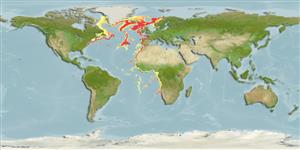
| Native range | All suitable habitat | Point map | Year 2050 |
|
| This map was computer-generated and has not yet been reviewed. |
| Aphanopus carbo AquaMaps Data sources: GBIF OBIS |
Envoyez vos Photos et vidéos
Images | Images Google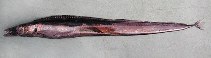 Aphanopus carbo
Female Photo de Cambraia Duarte, P.M.N. (c)ImagDOP
Images | Images Google
Female Photo de Cambraia Duarte, P.M.N. (c)ImagDOP
Classification / Noms Noms communs | Synonymes | Catalog of Fishes(Genre, Espèce) | ITIS | CoL | WoRMS | Cloffa
> Scombriformes (Mackerels) > Trichiuridae (Cutlassfishes) > Aphanopodinae
Etymology: Aphanopus: Greek, aphanes = hidden + Greek, pous = foot (Ref. 45335).
More on author: Lowe.
Etymology: Aphanopus: Greek, aphanes = hidden + Greek, pous = foot (Ref. 45335).
More on author: Lowe.
Environnement : milieu / zone climatique / profondeur / gamme de distribution Écologie
marin bathypélagique; océanodrome (Ref. 108735); profondeur 200 - 2300 m (Ref. 108733), usually 700 - 1300 m (Ref. 108735). Deep-water; 71°N - 23°S, 82°W - 17°E (Ref. 6181)
Distribution Territoires | Zones FAO | Écosystèmes | Occurrences | Carte par point | Introductions | Faunafri
North Atlantic: on both sides and at underwater rises from Denmark Strait to Cape Verde.
Longueur à la première maturité / Taille / Poids / Âge
Maturité: Lm 111.6 range ? - 117.5 cm
Max length : 151 cm TL mâle / non sexé; (Ref. 108708); common length : 70.0 cm SL mâle / non sexé; (Ref. 3698); poids max. publié: 0.00 g
Max length : 151 cm TL mâle / non sexé; (Ref. 108708); common length : 70.0 cm SL mâle / non sexé; (Ref. 3698); poids max. publié: 0.00 g
Description synthétique Clés d'identification | Morphologie | Morphométrie
Épines dorsales (Total) : 34 - 41; Rayons mous dorsaux (Total) : 52 - 56; Épines anales: 2; Rayons mous anaux: 43 - 48; Vertèbres: 97 - 100. Body is extremely elongated, with body depth 10.8 to 13.4 times in SL. The snout is large with strong fang-like teeth. Pelvic fins represented by a single spine in juveniles but entirely absent in adults. Color is coppery black with iridescent tint. The inside of the mouth and gill cavities black.
Body shape (shape guide): eel-like; Cross section: compressed.
Body shape (shape guide): eel-like; Cross section: compressed.
Juveniles mesopelagic (Ref. 6181). Bathypelagic (Ref. 58426). Migrate to midwater at night and feed on crustaceans, cephalopods and fishes (mostly macrourids, morids and alepocephalids). Mature at 80 to 85 cm. Eggs and larvae are pelagic (Ref. 6768). Data from study reveal mature individuals undertake horizontal migration to spawning and nursery grounds located off the Madeira and Canary islands (Ref. 108708). Commercial catch up to 1000 t was caught off Madeira with a specialized commercial deep water longline (Ref. 6255). Appear as bycatch in the trawl fishery west of the British Isles, along the Middle-Atlantic Ridge and at Corner Rise. Important and fabled food fish in Madeira (Ref. 4537). Some specimens reach 145 cm (Nuno Marques, Nomad@netmadeira.com, 12/09).
Cycle de vie et comportement reproducteur Maturité | Reproduction | Frai | Œufs | Fécondité | Larves
Displays determinate fecundity (Ref. 108695). Mature individuals undertake horizontal migration to spawning and nursery grounds (Ref. 108708). Suspended pre-spawning stages occurred in some areas of the Northeast Atlantic caused by atresia in ovaries (Ref. 108708).
Référence principale
Téléchargez vos références | Références | Coordinateur : Parin, Nikolay V. | Collaborateurs
Nakamura, I. and N.V. Parin, 1993. FAO Species Catalogue. Vol. 15. Snake mackerels and cutlassfishes of the world (families Gempylidae and Trichiuridae). An annotated and illustrated catalogue of the snake mackerels, snoeks, escolars, gemfishes, sackfishes, domine, oilfish, cutlassfishes,. scabbardfishes, hairtails, and frostfishes known to date. FAO Fish. Synop. 125(15):136 p. (Ref. 6181)
Statut dans la liste rouge de l'IUCN (Ref. 130435: Version 2025-2 (Global))
Préoccupation mineure (LC) ; Date assessed: 12 October 2018
CITES
Not Evaluated
Menace pour l'homme
Harmless
Utilisations par l'homme
Pêcheries: hautement commercial
FAO - pêcheries: débarquements, Résumé espèce; Publication: search | FIRMS - Stock assessments | FishSource | Sea Around Us
Plus d'informations
Écologie trophique
Aliments (proies)
Composition du régime alimentaire
Consommation alimentaire
Rations alimentaires
Prédateurs
Aliments (proies)
Composition du régime alimentaire
Consommation alimentaire
Rations alimentaires
Prédateurs
Dynamique des populations
Paramètres de croissance
Âges / tailles maximales
Longueur-poids rel.
Rel. longueur-longueur.
Fréquences de longueurs
Conversion de masse
Recrutement
Abondance
Paramètres de croissance
Âges / tailles maximales
Longueur-poids rel.
Rel. longueur-longueur.
Fréquences de longueurs
Conversion de masse
Recrutement
Abondance
Physiologie
Composition corporelle
Nutriments
Consommation d'oxygène
Type de natation
Vitesse de nage
Pigments visuels
Son de poisson
Maladies et parasites
Toxicité (CL50)
Composition corporelle
Nutriments
Consommation d'oxygène
Type de natation
Vitesse de nage
Pigments visuels
Son de poisson
Maladies et parasites
Toxicité (CL50)
Génétique
génôme
Génétique
Hétérozygotie
Héritabilité
Diversité génétique
génôme
Génétique
Hétérozygotie
Héritabilité
Diversité génétique
Liées à l'homme
Systèmes d'aquaculture
Profils d'aquaculture
Souches
Cas de ciguatera
Timbres, pièces de monnaie, divers
Systèmes d'aquaculture
Profils d'aquaculture
Souches
Cas de ciguatera
Timbres, pièces de monnaie, divers
Outils
E-book | Guide de terrain | Clés d'identification | Générateur de fréquences de longueur | Outil de dynamique de population | Carte par point |
Capture-MSY |
Articles particuliers
Télécharger en XML
Sources Internet
AFORO (otoliths) | Aquatic Commons | BHL | Cloffa | Websites from users | FishWatcher | CISTI | Catalog of Fishes: Genre, Espèce | DiscoverLife | ECOTOX | FAO - pêcheries: débarquements, Résumé espèce; Publication: search | Faunafri | Fishipedia | Fishtrace | GloBI | Google Books | Google Scholar | Google | IGFA World Record | Bases de données nationales | OneZoom | Open Tree of Life | Otolith Atlas of Taiwan Fishes | PubMed | Reef Life Survey | Socotra Atlas | TreeBase | Arbre de Vie | Wikipedia: aller à, chercher | World Records Freshwater Fishing | Zoobank | Zoological Record
Estimations basées sur des modèles
Température préférée (Réf. 123201): 1.1 - 12.6, mean 7.1 °C (based on 244 cells).
Indice de diversité phylogénétique (Réf. 82804): PD50 = 0.5078 [Uniqueness, from 0.5 = low to 2.0 = high].
Bayesian length-weight: a=0.00046 (0.00033 - 0.00063), b=3.15 (3.06 - 3.24), in cm total length, based on LWR estimates for this species (Ref. 93245).
Niveau trophique (Réf. 69278): 4.5 ±0.77 se; based on food items.
Résilience (Réf. 120179): Milieu, temps minimum de doublement de population : 1,4 à 4,4 années (K=0.11-0.25, tmax=14?; tm=3).
Prior r = 0.20, 95% CL = 0.13 - 0.30, Based on 3 full stock assessments.
Nutriments (Ref. 124155): Calcium = 11.6 [6.0, 18.7] mg/100g; Iron = 0.192 [0.097, 0.400] mg/100g; Protein = 17.4 [16.1, 18.7] %; Omega3 = 0.161 [0.071, 0.370] g/100g; Selenium = 34.7 [15.7, 77.9] μg/100g; VitaminA = 15.8 [1.6, 130.4] μg/100g; Zinc = 0.391 [0.267, 0.539] mg/100g (wet weight); based on nutrient studies.