



Aapticheilichthys websteri (Huber, 2007)
Ladda upp din foton och Videor
Bilder | Google image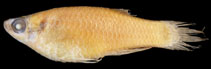 Aapticheilichthys websteri
Bild av Musschoot, T.
Bilder | Google image
Bild av Musschoot, T.
Klassificering / Namn Populärnamn | synonymer | Catalog of Fishes(Släkte, Arter) | ITIS | CoL | WoRMS | Cloffa
> Cyprinodontiformes (Rivulines, killifishes and live bearers) > Procatopodidae (African lampeyes) > Procatopodinae
Etymology: websteri: Named for Kent Webster, discoverer of the species on the night of the Asian tsunami, who has devoted much of his life to breeding aquarium fishes, notably Australian and New Guinean rainbows, professionally in the Peninsula Hatchery, Gardena, California (Ref. 78622).
Eponymy: Kent Webster (d: 1959) is an American aquarist at the Peninsula Hatchery, Gardena, California. He discovered this killifish and was honoured as he has “…devoted much of his life to breeding aquarium fishes”, notably Australasian rainbowfish. (Ref. 128868), visit book page.
Etymology: websteri: Named for Kent Webster, discoverer of the species on the night of the Asian tsunami, who has devoted much of his life to breeding aquarium fishes, notably Australian and New Guinean rainbows, professionally in the Peninsula Hatchery, Gardena, California (Ref. 78622).
Eponymy: Kent Webster (d: 1959) is an American aquarist at the Peninsula Hatchery, Gardena, California. He discovered this killifish and was honoured as he has “…devoted much of his life to breeding aquarium fishes”, notably Australasian rainbowfish. (Ref. 128868), visit book page.
Miljö: miljö / Klimatzon / djupintervall / distributionsområde Ekologi
; sötvatten bentopelagisk. Tropical
Utbredning Territorier | FAO områden | Ekosystem | Förekomster | Prickkarta | Utplanteringar | Faunafri
Africa: Akaka Camp in western Gabon (Ref. 78622).
Storlek / Vikt / Ålder
Kort beskrivning Bestämningsnycklar | Morfologi | Morfometri
Taggstrålar i ryggfenan (totalt) : 0; Mjukstrålar i ryggfenan (totalt) : 7 - 9; Taggstrålar i analfenan: 0; Mjukstrålar i analfenan: 11 - 13. Diagnosis: It is distinguished from all other lampeyes by the superimposed insertion of dorsal and anal fins vs. dorsal fin insertion always posterior to anal fin insertion by at least 4 rays; besides it is separated from the similarly patterned and sympatric Aplocheilichthys spilauchen by the smaller maximum size in both sexes, by the more advanced dorsal fin, by the less high peduncular depth, by the presence of red pigment markings on male sides and unpaired fins vs. silvery or gold markings, by the absence of a barred pattern on male sides vs. presence, by the absence of melanistic pigments on body vs. with many dark small spots, by the absence of extended rays in male posterior anal fin vs. presence, and by being more laterally compressed; it is separated from Procatopus, Plataplochilus and Rhexipanchax species by the more sharply pointed mouth in addition to the D/A value (Ref. 78622). It is separated from its congeners living in the same region from southern Equatorial Guinea to Cabinda by the rounded shape of the posterior margin of dorsal and anal fins in both sexes vs. cut straight along the last ray, by the vertical red bars in male vs. never such a pattern, by the more conspicious reticulated gray 'net along scale edges vs. faint or absent, and by the absence of an upper acumen or extension in caudal fin of dominant male vs. presence (Ref. 78622).
Body shape (shape guide): fusiform / normal.
Body shape (shape guide): fusiform / normal.
Found in a river less than 10 meters wide and less than 1 meter depth during dry season, warm water of over 80°F during the day, slightly acid water, pH just over 6, in primary forest (Ref. 78622). Non-annual reproduction with two weeks' water incubation of eggs and schooling in small groups of a few dozens of specimens of various ages and dominance; several individualos may have gone through a sex change (Ref. 78622).
Livscykel och parningsbeteende Könsmognad | Reproduktion | Lek | Ägg | Fekunditet | Larver
Huvudreferens
Ladda upp dina referenser | referenser | Koordinator | Medarbetare
Huber, J.H., 2007. Procatopus websteri: a new species of lampeye killifish from Akaka Camp, western Gabon (Teleostei: Poeciliidae: Aplocheilichthyinae), exhibiting similarities of pattern and morphology with another sympatric lampeye species, Aplocheilichthys spilauchen. Trop. Fish Hobbyist 55(1):110-114. (Ref. 78622)
CITES
Not Evaluated
Hot mot människor
Harmless
Mänskliga användningsområden
Fiskeri: saknar intresse
FAO - Publication: search | FishSource |
Ytterligare information
Trofisk ekologi
Livsmedelsartiklar (preys)
Födosammansättning
Födointag
Matransoner
Predatorer
Livsmedelsartiklar (preys)
Födosammansättning
Födointag
Matransoner
Predatorer
Populationsdynamik
Tillväxtparametrar
Max. åldrar / storlekar
Längd-vikt rel.
Längd-längd rel.
Längd-frekvenser
Massakonvertering
Rekrytering
Abundans
Tillväxtparametrar
Max. åldrar / storlekar
Längd-vikt rel.
Längd-längd rel.
Längd-frekvenser
Massakonvertering
Rekrytering
Abundans
Livscykel
Reproduktion
Könsmognad
Mognad/Gills rel.
Fekunditet
Lek
Lekande aggregat
Ägg
Utveckling av ägg
Larver
Larvdynamik
Reproduktion
Könsmognad
Mognad/Gills rel.
Fekunditet
Lek
Lekande aggregat
Ägg
Utveckling av ägg
Larver
Larvdynamik
Anatomi
Gälyta
Hjärna
Otolit
Gälyta
Hjärna
Otolit
Fysiologi
Kroppssammansättning
Näringsämnen
Syreförbrukning
Typ av simning
Simhastighet
Visuella pigment
Ljud från fisk
Sjukdomar & Parasiter
Toxicitet (LC50)
Kroppssammansättning
Näringsämnen
Syreförbrukning
Typ av simning
Simhastighet
Visuella pigment
Ljud från fisk
Sjukdomar & Parasiter
Toxicitet (LC50)
Genetik
Genom
Genetik
Heterozygositet
Ärftlighet
Genetisk mångfald
Genom
Genetik
Heterozygositet
Ärftlighet
Genetisk mångfald
Människorelaterad
Vattenbrukssystem
Vattenbruksprofiler
Avelslinjer
Ciguatera-fall
Frimärken, mynt, diverse.
Vattenbrukssystem
Vattenbruksprofiler
Avelslinjer
Ciguatera-fall
Frimärken, mynt, diverse.
Verktyg
Särskilda rapporter
Kontrollera för underhåll av akvarium | Kontrollera om det finns faktablad om arter | Kontrollera om det finns faktablad om vattenbruk
Ladda ner XML
Internet-källor
AFORO (otoliths) | Aquatic Commons | BHL | Cloffa | Websites from users | Check FishWatcher | CISTI | Catalog of Fishes: Släkte, Arter | DiscoverLife | ECOTOX | FAO - Publication: search | Faunafri | Fishipedia | Fishtrace | GloBI | Google Books | Google Scholar | Google | IGFA World Record | OneZoom | Open Tree of Life | Otolith Atlas of Taiwan Fishes | PubMed | Reef Life Survey | Socotra Atlas | TreeBase | Tree of Life | Wikipedia: Go, sök | World Records Freshwater Fishing | Zoologiskt register
Uppskattningar baserade på modeller
Index för fylogenetisk mångfald (Ref. 82804): PD50 = 1.0000 [Uniqueness, from 0.5 = low to 2.0 = high].
Bayesian length-weight: a=0.01122 (0.00514 - 0.02450), b=3.04 (2.87 - 3.21), in cm total length, based on all LWR estimates for this body shape (Ref. 93245).
Trofisk nivå (Ref. 69278): 3.1 ±0.4 se; based on size and trophs of closest relatives