



Aapticheilichthys websteri (Huber, 2007)
Envoyez vos Photos et vidéos
Images | Images Google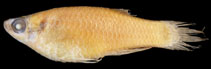 Aapticheilichthys websteri
Photo de Musschoot, T.
Images | Images Google
Photo de Musschoot, T.
Classification / Noms Noms communs | Synonymes | Catalog of Fishes(Genre, Espèce) | ITIS | CoL | WoRMS | Cloffa
> Cyprinodontiformes (Rivulines, killifishes and live bearers) > Procatopodidae (African lampeyes) > Procatopodinae
Etymology: websteri: Named for Kent Webster, discoverer of the species on the night of the Asian tsunami, who has devoted much of his life to breeding aquarium fishes, notably Australian and New Guinean rainbows, professionally in the Peninsula Hatchery, Gardena, California (Ref. 78622).
Eponymy: Kent Webster (d: 1959) is an American aquarist at the Peninsula Hatchery, Gardena, California. He discovered this killifish and was honoured as he has “…devoted much of his life to breeding aquarium fishes”, notably Australasian rainbowfish. (Ref. 128868), visit book page.
Etymology: websteri: Named for Kent Webster, discoverer of the species on the night of the Asian tsunami, who has devoted much of his life to breeding aquarium fishes, notably Australian and New Guinean rainbows, professionally in the Peninsula Hatchery, Gardena, California (Ref. 78622).
Eponymy: Kent Webster (d: 1959) is an American aquarist at the Peninsula Hatchery, Gardena, California. He discovered this killifish and was honoured as he has “…devoted much of his life to breeding aquarium fishes”, notably Australasian rainbowfish. (Ref. 128868), visit book page.
Environnement : milieu / zone climatique / profondeur / gamme de distribution Écologie
; eau douce benthopélagique. Tropical
Distribution Territoires | Zones FAO | Écosystèmes | Occurrences | Carte par point | Introductions | Faunafri
Africa: Akaka Camp in western Gabon (Ref. 78622).
Taille / Poids / Âge
Description synthétique Clés d'identification | Morphologie | Morphométrie
Épines dorsales (Total) : 0; Rayons mous dorsaux (Total) : 7 - 9; Épines anales: 0; Rayons mous anaux: 11 - 13. Diagnosis: It is distinguished from all other lampeyes by the superimposed insertion of dorsal and anal fins vs. dorsal fin insertion always posterior to anal fin insertion by at least 4 rays; besides it is separated from the similarly patterned and sympatric Aplocheilichthys spilauchen by the smaller maximum size in both sexes, by the more advanced dorsal fin, by the less high peduncular depth, by the presence of red pigment markings on male sides and unpaired fins vs. silvery or gold markings, by the absence of a barred pattern on male sides vs. presence, by the absence of melanistic pigments on body vs. with many dark small spots, by the absence of extended rays in male posterior anal fin vs. presence, and by being more laterally compressed; it is separated from Procatopus, Plataplochilus and Rhexipanchax species by the more sharply pointed mouth in addition to the D/A value (Ref. 78622). It is separated from its congeners living in the same region from southern Equatorial Guinea to Cabinda by the rounded shape of the posterior margin of dorsal and anal fins in both sexes vs. cut straight along the last ray, by the vertical red bars in male vs. never such a pattern, by the more conspicious reticulated gray 'net along scale edges vs. faint or absent, and by the absence of an upper acumen or extension in caudal fin of dominant male vs. presence (Ref. 78622).
Body shape (shape guide): fusiform / normal.
Body shape (shape guide): fusiform / normal.
Found in a river less than 10 meters wide and less than 1 meter depth during dry season, warm water of over 80°F during the day, slightly acid water, pH just over 6, in primary forest (Ref. 78622). Non-annual reproduction with two weeks' water incubation of eggs and schooling in small groups of a few dozens of specimens of various ages and dominance; several individualos may have gone through a sex change (Ref. 78622).
Cycle de vie et comportement reproducteur Maturité | Reproduction | Frai | Œufs | Fécondité | Larves
Référence principale
Téléchargez vos références | Références | Coordinateur | Collaborateurs
Huber, J.H., 2007. Procatopus websteri: a new species of lampeye killifish from Akaka Camp, western Gabon (Teleostei: Poeciliidae: Aplocheilichthyinae), exhibiting similarities of pattern and morphology with another sympatric lampeye species, Aplocheilichthys spilauchen. Trop. Fish Hobbyist 55(1):110-114. (Ref. 78622)
CITES
Not Evaluated
Menace pour l'homme
Harmless
Utilisations par l'homme
Pêcheries: sans intérêt
FAO - Publication: search | FishSource |
Plus d'informations
Écologie trophique
Aliments (proies)
Composition du régime alimentaire
Consommation alimentaire
Rations alimentaires
Prédateurs
Aliments (proies)
Composition du régime alimentaire
Consommation alimentaire
Rations alimentaires
Prédateurs
Dynamique des populations
Paramètres de croissance
Âges / tailles maximales
Longueur-poids rel.
Rel. longueur-longueur.
Fréquences de longueurs
Conversion de masse
Recrutement
Abondance
Paramètres de croissance
Âges / tailles maximales
Longueur-poids rel.
Rel. longueur-longueur.
Fréquences de longueurs
Conversion de masse
Recrutement
Abondance
Cycle de vie
Reproduction
Maturité
Maturité/épines rel.
Fécondité
Frai
Agrégats de frai
Œufs
Développement de l'œuf
Larves
Dynamique des populations larvaires
Reproduction
Maturité
Maturité/épines rel.
Fécondité
Frai
Agrégats de frai
Œufs
Développement de l'œuf
Larves
Dynamique des populations larvaires
Anatomie
Surface branchiale
Cerveau
Otolithe
Surface branchiale
Cerveau
Otolithe
Physiologie
Composition corporelle
Nutriments
Consommation d'oxygène
Type de natation
Vitesse de nage
Pigments visuels
Son de poisson
Maladies et parasites
Toxicité (CL50)
Composition corporelle
Nutriments
Consommation d'oxygène
Type de natation
Vitesse de nage
Pigments visuels
Son de poisson
Maladies et parasites
Toxicité (CL50)
Génétique
génôme
Génétique
Hétérozygotie
Héritabilité
Diversité génétique
génôme
Génétique
Hétérozygotie
Héritabilité
Diversité génétique
Liées à l'homme
Systèmes d'aquaculture
Profils d'aquaculture
Souches
Cas de ciguatera
Timbres, pièces de monnaie, divers
Systèmes d'aquaculture
Profils d'aquaculture
Souches
Cas de ciguatera
Timbres, pièces de monnaie, divers
Outils
E-book | Guide de terrain | Générateur de fréquences de longueur | Outil de dynamique de population | Carte par point |
Capture-MSY |
Articles particuliers
Télécharger en XML
Sources Internet
AFORO (otoliths) | Aquatic Commons | BHL | Cloffa | Websites from users | FishWatcher | CISTI | Catalog of Fishes: Genre, Espèce | DiscoverLife | ECOTOX | FAO - Publication: search | Faunafri | Fishipedia | Fishtrace | GloBI | Google Books | Google Scholar | Google | IGFA World Record | OneZoom | Open Tree of Life | Otolith Atlas of Taiwan Fishes | PubMed | Reef Life Survey | Socotra Atlas | TreeBase | Arbre de Vie | Wikipedia: aller à, chercher | World Records Freshwater Fishing | Zoological Record
Estimations basées sur des modèles
Indice de diversité phylogénétique (Réf. 82804): PD50 = 1.0000 [Uniqueness, from 0.5 = low to 2.0 = high].
Bayesian length-weight: a=0.01122 (0.00514 - 0.02450), b=3.04 (2.87 - 3.21), in cm total length, based on all LWR estimates for this body shape (Ref. 93245).
Niveau trophique (Réf. 69278): 3.1 ±0.4 se; based on size and trophs of closest relatives