



Marcusenius devosi Kramer, Skelton, van der Bank & Wink, 2007
Sube tu fotos y Vídeos
Google image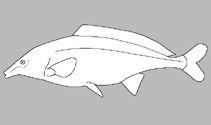 No image available for this species;
drawing shows typical species in Mormyridae.
Google image
drawing shows typical species in Mormyridae.
Clasificación / Nombres Nombres comunes | Sinónimos | Catalog of Fishes(Género, Especie) | ITIS | CoL | WoRMS | Cloffa
> Osteoglossiformes (Bony tongues) > Mormyridae (Elephantfishes)
Etymology: Marcusenius: Becasue of J. Marcusen, author of "Zur Phauna des Schwarzen Meeres", 1867; ichthyologist; devosi: Marcusenius devosi is named in honour of Dr. Luc De Vos, late curator of fishes at Nairobi Museum, for his contributions to African ichthyology and promotion of ichthyology in East Africa (Ref. 75962).
Eponymy: Dr Johann Andreas Marcusen (1817–1894) was a Latvian of German descent who was a physician, ichthyologist and zoologist. [...] Dr Luc De Vos (1957–2003) was a Belgian ichthyologist who was Curator of Fishes at the Nairobi Museum, Kenya. [...] (Ref. 128868), visit book page.
Etymology: Marcusenius: Becasue of J. Marcusen, author of "Zur Phauna des Schwarzen Meeres", 1867; ichthyologist; devosi: Marcusenius devosi is named in honour of Dr. Luc De Vos, late curator of fishes at Nairobi Museum, for his contributions to African ichthyology and promotion of ichthyology in East Africa (Ref. 75962).
Eponymy: Dr Johann Andreas Marcusen (1817–1894) was a Latvian of German descent who was a physician, ichthyologist and zoologist. [...] Dr Luc De Vos (1957–2003) was a Belgian ichthyologist who was Curator of Fishes at the Nairobi Museum, Kenya. [...] (Ref. 128868), visit book page.
Entorno: milieu / zona climática / rango de profundidad / gama de distribución Ecología
; agua dulce demersal. Tropical
Distribución Territorios | Áreas FAO | Ecosistemas | Ocurrencias, apariciones | Mapa de puntos | Introducciones | Faunafri
Africa: Tana River, but range extension both to the north and south likely (Ref. 75962).
Tamaño / Peso / Edad
Descripción breve Claves de identificación | Morfología | Morfometría
Espinas dorsales (total) : 0; Radios blandos dorsales (total) : 21 - 24; Espinas anales: 0; Radios blandos anales: 26 - 30. Diagnosis: Marcusenius devosi can be distinguished from its congeners by the following characters: distance dorsal fin origin to end of caudal peduncle 39.5-43.4% of standard length, preanal distance 57.0-61.0% of standard length, predorsal distance 59.8-64.0% of standard length, caudal peduncle length 19.2-22.1% of standard length, number of scales in linear series along the lateral line row 56-66, dorsal fin rays 21-24, anal fin rays 26-30, and 14-18 scales around caudal peduncle (Ref. 75962). Electric organ discharge lacking weak head-negative pre-potential, strong Namp relative to Pamp, but short Ndur, Pdur of long duration (Ref. 75962).
description: Head with terminal mouth well in front of eye, mental lobe on lower jaw protruding beyond upper jaw; head and body dorsolaterally compressed (Ref. 75962). Dorsal fin situated about two thirds of standard length from snout, obliquely orientated, anteriorly higher and posteriorly lower, distal margin sometimes only slightly crescentic with anterior two or three rays longer than posterior rays, number of rays 21-24; anal fin opposite dorsal fin with distinctly more anterior origin, obliquely orientated, anteriorly lower and posteriorly higher, anterior rays longer than posterior ones, especially in males where they also appear stronger and often darkened, distal margin crescentic, number of rays 26-30 (Ref. 75962). Scales cycloid with reticulate striae, scales extending anteriorly to operculum and pectoral fins; scales on caudal peduncle circumference, 14-18 (Ref. 75962). Caudal peduncle relatively deep, subcylindrical enire length, usually 19.0-21.0 on standard length (Ref. 75962). Electric organ discharge biphasic lacking a weak pre-potential, Pamp of relatively long duration, increasing with standard length at least in females and juveniles, Ndur of very short duration, but very strong Namp; no sexual dimorphism recognized (Ref. 75962).
Colouration: Colour in preservation: head and back when seen from above, dark; body sides light brown to light ochre, the ochre found especially on lower parts and underside; dorsal fin usually darker than anal fin; homogeneous colouration without any blotches, increasingly lighter from back to belly (Ref. 75962).
Body shape (shape guide): fusiform / normal; Cross section: compressed.
Body shape (shape guide): fusiform / normal; Cross section: compressed.
Ciclo vital y comportamiento de apareamiento Madurez | Reproducción | Puesta | Huevos | Fecundidad | Larva
Referencia principal
Suba sus referencias | Referencias | Coordinador | Colaboradores
Kramer, B., P. Skelton, H. van der Bank and M. Wink, 2007. Allopatric differentiation in the Marcusenius macrolepidotus species complex in southern and eastern Africa: the resurrection of M. pongolensis and M. angolensis, and the description of two new species (Mormyridae, Teleostei). J. Nat. Hist. 41(9-12):647-708. (Ref. 75962)
Situación en la Lista Roja de la UICN (Ref. 130435: Version 2025-2 (Global))
Near Threatened (NT) (B1ab(i,ii,iii)); Date assessed: 29 June 2022
CITES
Not Evaluated
Amenaza para el ser humano
Harmless
Usos humanos
FAO - Publication: search | FishSource |
Más información
Ecología Trófica
Alimentos (presas)
Composición de la dieta
consumo de alimento
Raciones de comida
Despredadores
Alimentos (presas)
Composición de la dieta
consumo de alimento
Raciones de comida
Despredadores
Ecología
Ecología
Ecología
Dinámica de la población
Coeficiente del crecimiento para
Edades / tallas máximas
Longitud-peso rel.
Longitud-longitud rel.
Longitud-frecuencias
Conversión de masas
Reclutamiento
Abundancia
Coeficiente del crecimiento para
Edades / tallas máximas
Longitud-peso rel.
Longitud-longitud rel.
Longitud-frecuencias
Conversión de masas
Reclutamiento
Abundancia
Ciclo de vida
Reproducción
Madurez
Madurez/Gills rel.
Fecundidad
Puesta
Agregaciones de desove
Huevos
Desarrollo de los huevos
Larva
Dinámica larvaria
Reproducción
Madurez
Madurez/Gills rel.
Fecundidad
Puesta
Agregaciones de desove
Huevos
Desarrollo de los huevos
Larva
Dinámica larvaria
Distribución
Territorios
Áreas FAO
Ecosistemas
Ocurrencias, apariciones
Introducciones
BRUVS - Vídeos
Territorios
Áreas FAO
Ecosistemas
Ocurrencias, apariciones
Introducciones
BRUVS - Vídeos
Anatomía
Superficie branquial
Cerebro
Otolito
Superficie branquial
Cerebro
Otolito
Fisiología
Composición corporal
Nutrientes
Consumo del oxígeno
Tipo de natación
Velocidad de natación
Pigmentos visuales
Sonido de peces
Enfermedades y parásitos
Toxicidad (CL50)
Composición corporal
Nutrientes
Consumo del oxígeno
Tipo de natación
Velocidad de natación
Pigmentos visuales
Sonido de peces
Enfermedades y parásitos
Toxicidad (CL50)
Genética
Genoma
Genética
Heterocigosidad
heritabilidad
Diversidad genética
Genoma
Genética
Heterocigosidad
heritabilidad
Diversidad genética
Relacionados con el ser humano
Sistemas de acuicultura
Perfiles de acuicultura
Razas
Ciguatera cases
Sellos, monedas, varios
Sistemas de acuicultura
Perfiles de acuicultura
Razas
Ciguatera cases
Sellos, monedas, varios
Herramientas
Libro electrónico | Guía de campo | Asistente para frecuencias de tallas | Herramienta de ciclo de vida | Mapa de puntos |
Catch-MSY |
Informes especiales
Comprobar el mantenimiento del acuario | Buscar fichas sobre especies | Consulte las hojas informativas sobre acuicultura
Descargar XML
Fuentes de Internet
AFORO (otoliths) | Aquatic Commons | BHL | Cloffa | Websites from users | Check FishWatcher | CISTI | Catalog of Fishes: Género, Especie | DiscoverLife | ECOTOX | FAO - Publication: search | Faunafri | Fishipedia | Fishtrace | GloBI | Google Books | Google Scholar | Google | IGFA World Record | OneZoom | Open Tree of Life | Otolith Atlas of Taiwan Fishes | PubMed | Reef Life Survey | Socotra Atlas | TreeBase | Árbol de la vida | Wikipedia: Go, búsqueda | World Records Freshwater Fishing | Zoobank | Expediente Zoológico
Estimaciones basadas en modelos
Índice de diversidad filogenética (Referencia 82804): PD50 = 0.5000 [Uniqueness, from 0.5 = low to 2.0 = high].
Bayesian length-weight: a=0.00562 (0.00248 - 0.01273), b=3.05 (2.85 - 3.25), in cm total length, based on LWR estimates for this (Sub)family-body shape (Ref. 93245).
Nivel trófico (Referencia 69278): 3.2 ±0.4 se; based on size and trophs of closest relatives
Resiliencia (Referencia 120179): Muy bajo, población duplicada en un tiempo mínimo superior a 14 años (Preliminary K or Fecundity.).