



Marcusenius devosi Kramer, Skelton, van der Bank & Wink, 2007
Загрузить свой Фото и Видео
Изображение на Google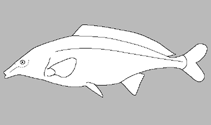 No image available for this species;
drawing shows typical species in Mormyridae.
Изображение на Google
drawing shows typical species in Mormyridae.
Классификация / Имена народные названия | синонимы | Catalog of Fishes(род, виды) | ITIS | CoL | WoRMS | Cloffa
> Osteoglossiformes (Bony tongues) > Mormyridae (Elephantfishes)
Etymology: Marcusenius: Becasue of J. Marcusen, author of "Zur Phauna des Schwarzen Meeres", 1867; ichthyologist; devosi: Marcusenius devosi is named in honour of Dr. Luc De Vos, late curator of fishes at Nairobi Museum, for his contributions to African ichthyology and promotion of ichthyology in East Africa (Ref. 75962).
Eponymy: Dr Johann Andreas Marcusen (1817–1894) was a Latvian of German descent who was a physician, ichthyologist and zoologist. [...] Dr Luc De Vos (1957–2003) was a Belgian ichthyologist who was Curator of Fishes at the Nairobi Museum, Kenya. [...] (Ref. 128868), visit book page.
Etymology: Marcusenius: Becasue of J. Marcusen, author of "Zur Phauna des Schwarzen Meeres", 1867; ichthyologist; devosi: Marcusenius devosi is named in honour of Dr. Luc De Vos, late curator of fishes at Nairobi Museum, for his contributions to African ichthyology and promotion of ichthyology in East Africa (Ref. 75962).
Eponymy: Dr Johann Andreas Marcusen (1817–1894) was a Latvian of German descent who was a physician, ichthyologist and zoologist. [...] Dr Luc De Vos (1957–2003) was a Belgian ichthyologist who was Curator of Fishes at the Nairobi Museum, Kenya. [...] (Ref. 128868), visit book page.
Окружающая среда: среда / климатическая зона / пределы глубины / диапазон распространения экология
; пресноводный демерсальный. Tropical
распространение Территории | регионы FAO | Экосистемы | места находок | карта точек | интродукции | Faunafri
Africa: Tana River, but range extension both to the north and south likely (Ref. 75962).
Размер / Вес / Возраст
Краткое описание определительные ключи | морфология | морфометрия
колючие лучи спинного плавника (общее число) : 0; членистые (мягкие) лучи спинного плавника (общее число) : 21 - 24; колючие лучи анального плавника: 0; членистые (мягкие) лучи анального плавника: 26 - 30. Diagnosis: Marcusenius devosi can be distinguished from its congeners by the following characters: distance dorsal fin origin to end of caudal peduncle 39.5-43.4% of standard length, preanal distance 57.0-61.0% of standard length, predorsal distance 59.8-64.0% of standard length, caudal peduncle length 19.2-22.1% of standard length, number of scales in linear series along the lateral line row 56-66, dorsal fin rays 21-24, anal fin rays 26-30, and 14-18 scales around caudal peduncle (Ref. 75962). Electric organ discharge lacking weak head-negative pre-potential, strong Namp relative to Pamp, but short Ndur, Pdur of long duration (Ref. 75962).
description: Head with terminal mouth well in front of eye, mental lobe on lower jaw protruding beyond upper jaw; head and body dorsolaterally compressed (Ref. 75962). Dorsal fin situated about two thirds of standard length from snout, obliquely orientated, anteriorly higher and posteriorly lower, distal margin sometimes only slightly crescentic with anterior two or three rays longer than posterior rays, number of rays 21-24; anal fin opposite dorsal fin with distinctly more anterior origin, obliquely orientated, anteriorly lower and posteriorly higher, anterior rays longer than posterior ones, especially in males where they also appear stronger and often darkened, distal margin crescentic, number of rays 26-30 (Ref. 75962). Scales cycloid with reticulate striae, scales extending anteriorly to operculum and pectoral fins; scales on caudal peduncle circumference, 14-18 (Ref. 75962). Caudal peduncle relatively deep, subcylindrical enire length, usually 19.0-21.0 on standard length (Ref. 75962). Electric organ discharge biphasic lacking a weak pre-potential, Pamp of relatively long duration, increasing with standard length at least in females and juveniles, Ndur of very short duration, but very strong Namp; no sexual dimorphism recognized (Ref. 75962).
Colouration: Colour in preservation: head and back when seen from above, dark; body sides light brown to light ochre, the ochre found especially on lower parts and underside; dorsal fin usually darker than anal fin; homogeneous colouration without any blotches, increasingly lighter from back to belly (Ref. 75962).
Body shape (shape guide): fusiform / normal; Cross section: compressed.
Body shape (shape guide): fusiform / normal; Cross section: compressed.
Жизненный цикл и брачное поведение половая зрелость | размножение | нерест | икра | Плодовитость | личинки
Основная ссылка
Загрузите свои рекомендации | ссылки | координатор | соавторы
Kramer, B., P. Skelton, H. van der Bank and M. Wink, 2007. Allopatric differentiation in the Marcusenius macrolepidotus species complex in southern and eastern Africa: the resurrection of M. pongolensis and M. angolensis, and the description of two new species (Mormyridae, Teleostei). J. Nat. Hist. 41(9-12):647-708. (Ref. 75962)
Статус Красного Списка МСОП (Ref. 130435: Version 2025-2 (Global))
Близок к исчезновению (NT) (B1ab(i,ii,iii)); Date assessed: 29 June 2022
CITES
Not Evaluated
Угроза для людей
Harmless
Использование человеком
FAO - Publication: search | FishSource |
дополнительная информация
Трофическая экология
Пищевые предметы (добыча)
состав пищи
потребление пищи
Продовольственные пайки
хищники
Пищевые предметы (добыча)
состав пищи
потребление пищи
Продовольственные пайки
хищники
экология
экология
экология
Динамика численности населения
Параметры роста
Макс. возраст / размер
Отношение длины к весу.
Отношение длины к длине.
Размерный состав
Преобразование массы
пополнение
численность
Параметры роста
Макс. возраст / размер
Отношение длины к весу.
Отношение длины к длине.
Размерный состав
Преобразование массы
пополнение
численность
Жизненный цикл
размножение
половая зрелость
Зрелость/Жиры относительно.
Плодовитость
нерест
Нерестовые скопления
икра
Развитие икры
личинки
динамика численности личинок
размножение
половая зрелость
Зрелость/Жиры относительно.
Плодовитость
нерест
Нерестовые скопления
икра
Развитие икры
личинки
динамика численности личинок
Анатомия
жаберная область
Мозг
Отолит
жаберная область
Мозг
Отолит
Физиология
Состав тела
Питательные вещества
Потребление кислорода
Тип плавания
Скорость плавания
Зрительные пигменты
Звук рыбы
Болезни и паразиты
Токсичность (LC50s)
Состав тела
Питательные вещества
Потребление кислорода
Тип плавания
Скорость плавания
Зрительные пигменты
Звук рыбы
Болезни и паразиты
Токсичность (LC50s)
генетика
Геном
генетика
Гетерозиготность
наследуемость
Генетическое разнообразие
Геном
генетика
Гетерозиготность
наследуемость
Генетическое разнообразие
Связанные с человеком
Системы аквакультуры
особенности рыбоводства
степень растяжения
Случаи заболевания сигуатерой
Марки, монеты и прочее.
Системы аквакультуры
особенности рыбоводства
степень растяжения
Случаи заболевания сигуатерой
Марки, монеты и прочее.
инструменты
Специальные отчеты
Проверить содержание в аквариумах | Проверить опубликованные видовые данные | Проверить опубликованные данные по аквакультуре
Скачать в формате XML
ресурсы в Интернет
AFORO (otoliths) | Aquatic Commons | BHL | Cloffa | Websites from users | Проверить FishWatcher | CISTI | Catalog of Fishes: род, виды | DiscoverLife | ECOTOX | FAO - Publication: search | Faunafri | Fishipedia | Fishtrace | GloBI | Google Books | Google Scholar | Google | IGFA World Record | OneZoom | Open Tree of Life | Otolith Atlas of Taiwan Fishes | PubMed | Reef Life Survey | Socotra Atlas | TreeBase | Tree of Life | Wikipedia: Вперёд, поиск | World Records Freshwater Fishing | Zoobank | Зоологическая летопись
Оценки, основанные на моделях
Индекс филогенетического разнообразия (ссылка 82804): PD50 = 0.5000 [Uniqueness, from 0.5 = low to 2.0 = high].
Bayesian length-weight: a=0.00562 (0.00248 - 0.01273), b=3.05 (2.85 - 3.25), in cm total length, based on LWR estimates for this (Sub)family-body shape (Ref. 93245).
Трофический уровень (ссылка 69278): 3.2 ±0.4 se; based on size and trophs of closest relatives
устойчивость к внешним воздействиям (ссылка 120179): очень низкий, минимальное время удвоения популяции более 14 лет (Preliminary K or Fecundity.).