



Phalloceros malabarbai Lucinda, 2008
Itapoá toothcarp
Carica il tuo foto e Video
Immagini | Google image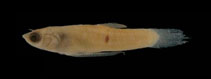 Phalloceros malabarbai
Male Immagine di Lucinda, P.H.F.
Immagini | Google image
Male Immagine di Lucinda, P.H.F.
Classificazione / Nomi Nomi Comuni | Sinonimi | Catalog of Fishes(Genere, Specie) | ITIS | CoL | WoRMS | Cloffa
> Cyprinodontiformes (Rivulines, killifishes and live bearers) > Poeciliidae (Poeciliids) > Poeciliinae
Etymology: Phalloceros: Greek, phallos = penis + Greek, keras = horn (Ref. 45335); malabarbai: The specific epithet malabarbai is a patronym for Luiz Roberto Malabarba, in recognition of his many contributions to Neotropical ichthyology.
Eponymy: Dr Luiz Roberto Malabarba is a Brazilian ichthyologist and biologist. [...] (Ref. 128868), visit book page.
Etymology: Phalloceros: Greek, phallos = penis + Greek, keras = horn (Ref. 45335); malabarbai: The specific epithet malabarbai is a patronym for Luiz Roberto Malabarba, in recognition of his many contributions to Neotropical ichthyology.
Eponymy: Dr Luiz Roberto Malabarba is a Brazilian ichthyologist and biologist. [...] (Ref. 128868), visit book page.
Ambiente: milieu / zona climatica / distribuzione batimetrica / gamma di distribuzione Ecologia
; acqua dolce benthopelagico. Tropical
Distribuzione Territories | Aree FAO | Ecosistemi | Presenze | Mappa dei ritrovamenti | Introduzioni | Faunafri
South America: known only from type locality, creek near Itapoá, São Francisco do Sul, Santa Catarina, Brazil.
Dimensione / Peso / Età
Maturità: Lm ? range ? - ? cm
Max length : 2.2 cm SL maschio/sesso non determinato; (Ref. 76852); 3.2 cm SL (female)
Max length : 2.2 cm SL maschio/sesso non determinato; (Ref. 76852); 3.2 cm SL (female)
Breve descrizione Chiavi di identificazione | Morfologia | Morfometria
Raggi dorsali molli (totale) : 8; Raggi anali molli: 9 - 11; Vertebre: 32 - 33. Distinguished autapomorphically by functional gonapophyses on vertebrae 15, 16, and 17, and also differs from congeners by the width of first pelvic-fin ray in adult males approximately constant tapering gradually to tip. Can be separated from other species of the genus Phalloceros, except Phalloceros megapolos, Phalloceros spiloura, Phalloceros anisophallos, Phalloceros alessandrae, Phalloceros buckupi, Phalloceros uai, Phalloceros lucenorum, Phalloceros pellos, and Phalloceros reisi by the female urogenital papilla curved to the right, located laterally (vs. slightly left turned and with a lateral ramus or straight located along midventral line), and border of the anal aperture in contact with the first anal-fin ray or very close to it (vs. separated from first anal-fin ray by the female urogenital papilla). Can be distinguished from Phalloceros megapolos by the gonopodial appendix normally developed
(vs. greatly expanded in wing like expansions); and from Phalloceros spiloura, Phalloceros anisophallos, Phalloceros buckupi, Phalloceros uai, Phalloceros lucenorum, Phalloceros pellos, and Phalloceros reisi by the halves of gonopodial paired appendix slender, not sickle like, and similar to each other (vs.
Sickle like and different from each other), bearing a medial corner (vs. medial corner absent); and hooks on both halves of gonopodial paired appendix (vs. right half hook absent).
Differs from Phalloceros alessandrae by gonopodial appendix strongly arched at
the distal tip (vs. straight at the distal tip); distal portion bent upward (vs. distal portion straight and oblique forming a 45°angle with the vertical axis); and left and right halves free not coalescent at the base (vs. coalescent at the base) (Ref. 76852).
Ciclo vitale e comportamento di accoppiamento Maturità | Riproduzione | Deposizione | Uova | Fecondità | Larve
Riferimento principale
Caricare le referenze | Bibliografia | Coordinatore | Collaboratori
Lucinda, P.H.F., 2008. Systematics and biogeography of the genus Phalloceros Eigenmann, 1907 (Cyprinodontiformes: Poeciliidae: Poeciliinae), with the description of twenty-one new species. Neotrop. Ichthyol. 6(2):113-158. (Ref. 76852)
Stato della Lista Rossa IUCN (Ref. 130435: Version 2025-2 (Global))
Least Concern (LC) ; Date assessed: 07 November 2018
CITES
Not Evaluated
Minaccia per l'uomo
Harmless
Usi umani
FAO - Publication: search | FishSource |
Informazioni ulteriori
Ecologia trofica
Articoli alimentari (prede)
Alimentazione
Consumo di cibo
Razioni alimentari
Predatori
Articoli alimentari (prede)
Alimentazione
Consumo di cibo
Razioni alimentari
Predatori
Ecologia
Ecologia
Ecologia
Dinamica della popolazione
Parametri di crescita
Età massima / dimensioni massime
Rapporto lunghezza-peso.
Lunghezza-lunghezza rel.
Lunghezza-frequenze
Conversione di massa
Reclutamento
Abbondanza
Parametri di crescita
Età massima / dimensioni massime
Rapporto lunghezza-peso.
Lunghezza-lunghezza rel.
Lunghezza-frequenze
Conversione di massa
Reclutamento
Abbondanza
Ciclo di vita
Riproduzione
Maturità
Maturità/Gli occhielli sono relativi.
Fecondità
Deposizione
Aggregazioni riproduttive
Uova
Sviluppo delle uova
Larve
Dinamica popolazioni larvali
Riproduzione
Maturità
Maturità/Gli occhielli sono relativi.
Fecondità
Deposizione
Aggregazioni riproduttive
Uova
Sviluppo delle uova
Larve
Dinamica popolazioni larvali
Anatomia
Area branchiale
Cervello
Otolite
Area branchiale
Cervello
Otolite
Fisiologia
Composizione corporea
Nutrienti
Consumo di ossigeno
Tipo di nuoto
Velocità di nuoto
Pigmenti visivi
Suono del pesce
Malattie e parassiti
Tossicità (LC50)
Composizione corporea
Nutrienti
Consumo di ossigeno
Tipo di nuoto
Velocità di nuoto
Pigmenti visivi
Suono del pesce
Malattie e parassiti
Tossicità (LC50)
Genetica
Genome
Genetica
Eterozigosi
Ereditarietà
Diversità genetica
Genome
Genetica
Eterozigosi
Ereditarietà
Diversità genetica
Legato all'uomo
Sistemi di acquacoltura
Profili di acquacoltura
Varietà
Casi di Ciguatera
Francobolli, monete, materiale vario.
Sistemi di acquacoltura
Profili di acquacoltura
Varietà
Casi di Ciguatera
Francobolli, monete, materiale vario.
Strumenti
Libro elettronico | Giuda pratica | Generatore frequenze di lunghezza | Strumento Parametri Biologici | Mappa dei ritrovamenti |
Cattura-MSY |
Rapporti speciali
Controllo della manutenzione dell'acquario | Verificare la presenza di schede informative sulle specie | Verifica delle schede informative sull'acquacoltura
Scarica XML
Fonti Internet
AFORO (otoliths) | Aquatic Commons | BHL | Cloffa | Websites from users | Check FishWatcher | CISTI | Catalog of Fishes: Genere, Specie | DiscoverLife | ECOTOX | FAO - Publication: search | Faunafri | Fishipedia | Fishtrace | GloBI | Google Books | Google Scholar | Google | IGFA World Record | OneZoom | Open Tree of Life | Otolith Atlas of Taiwan Fishes | PubMed | Reef Life Survey | Socotra Atlas | TreeBase | Tree of Life | Wikipedia: Go, ricerca | World Records Freshwater Fishing | Zoobank | Record zoologico
Stime basate su modelli
Indice di diversità filogenetica (Fonte Biblio. 82804): PD50 = 0.5000 [Uniqueness, from 0.5 = low to 2.0 = high].
Bayesian length-weight: a=0.00851 (0.00369 - 0.01962), b=3.15 (2.96 - 3.34), in cm total length, based on LWR estimates for this (Sub)family-body shape (Ref. 93245).
Livello trofico (Fonte Biblio. 69278): 3.0 ±0.4 se; based on size and trophs of closest relatives
Resilienza (Fonte Biblio. 120179): Alto, tempo minimo di raddoppiamento della popolazione meno di 15 mesi (Preliminary K or Fecundity.).