



Phalloceros malabarbai Lucinda, 2008
Itapoá toothcarp
Hochladen Photos und videos
Bilder | Google Bild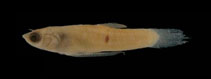 Phalloceros malabarbai
Male Photo von Lucinda, P.H.F.
Bilder | Google Bild
Male Photo von Lucinda, P.H.F.
Klassifizierung / Names Namen | Synonyme | Catalog of Fishes(Gattung, Arten) | ITIS | CoL | WoRMS | Cloffa
> Cyprinodontiformes (Rivulines, killifishes and live bearers) > Poeciliidae (Poeciliids) > Poeciliinae
Etymology: Phalloceros: Greek, phallos = penis + Greek, keras = horn (Ref. 45335); malabarbai: The specific epithet malabarbai is a patronym for Luiz Roberto Malabarba, in recognition of his many contributions to Neotropical ichthyology.
Eponymy: Dr Luiz Roberto Malabarba is a Brazilian ichthyologist and biologist. [...] (Ref. 128868), visit book page.
Etymology: Phalloceros: Greek, phallos = penis + Greek, keras = horn (Ref. 45335); malabarbai: The specific epithet malabarbai is a patronym for Luiz Roberto Malabarba, in recognition of his many contributions to Neotropical ichthyology.
Eponymy: Dr Luiz Roberto Malabarba is a Brazilian ichthyologist and biologist. [...] (Ref. 128868), visit book page.
Umwelt: Milieu / Klimazone / Tiefenbereich / Verbreitungsgebiet Ökologie
; süßwasser benthopelagisch. Tropical
Verbreitung Territorien | FAO Gebiete | Ökosysteme | Vorkommen | Punkt Karte | Einführungen | Faunafri
South America: known only from type locality, creek near Itapoá, São Francisco do Sul, Santa Catarina, Brazil.
Größe / Gewicht / Alter
Geschlechtsreife: Lm ? range ? - ? cm
Max length : 2.2 cm SL Männchen/unbestimmt; (Ref. 76852); 3.2 cm SL (female)
Max length : 2.2 cm SL Männchen/unbestimmt; (Ref. 76852); 3.2 cm SL (female)
Kurzbeschreibung Bestimmungsschlüssel | Morphologie | Morphometrie
Rückenflossenweichstrahlen (insgesamt) : 8; Afterflossenweichstrahlen: 9 - 11; Wirbelzahl: 32 - 33. Distinguished autapomorphically by functional gonapophyses on vertebrae 15, 16, and 17, and also differs from congeners by the width of first pelvic-fin ray in adult males approximately constant tapering gradually to tip. Can be separated from other species of the genus Phalloceros, except Phalloceros megapolos, Phalloceros spiloura, Phalloceros anisophallos, Phalloceros alessandrae, Phalloceros buckupi, Phalloceros uai, Phalloceros lucenorum, Phalloceros pellos, and Phalloceros reisi by the female urogenital papilla curved to the right, located laterally (vs. slightly left turned and with a lateral ramus or straight located along midventral line), and border of the anal aperture in contact with the first anal-fin ray or very close to it (vs. separated from first anal-fin ray by the female urogenital papilla). Can be distinguished from Phalloceros megapolos by the gonopodial appendix normally developed
(vs. greatly expanded in wing like expansions); and from Phalloceros spiloura, Phalloceros anisophallos, Phalloceros buckupi, Phalloceros uai, Phalloceros lucenorum, Phalloceros pellos, and Phalloceros reisi by the halves of gonopodial paired appendix slender, not sickle like, and similar to each other (vs.
Sickle like and different from each other), bearing a medial corner (vs. medial corner absent); and hooks on both halves of gonopodial paired appendix (vs. right half hook absent).
Differs from Phalloceros alessandrae by gonopodial appendix strongly arched at
the distal tip (vs. straight at the distal tip); distal portion bent upward (vs. distal portion straight and oblique forming a 45°angle with the vertical axis); and left and right halves free not coalescent at the base (vs. coalescent at the base) (Ref. 76852).
Lebenszyklus und Paarungsverhalten Geschlechtsreife | Fortpflanzung | Ablaichen | Eier | Fruchtbarkeit | Larven
Hauptreferenz
Laden Sie Ihre Referenzen hoch | Referenzen | Koordinator | Partner
Lucinda, P.H.F., 2008. Systematics and biogeography of the genus Phalloceros Eigenmann, 1907 (Cyprinodontiformes: Poeciliidae: Poeciliinae), with the description of twenty-one new species. Neotrop. Ichthyol. 6(2):113-158. (Ref. 76852)
IUCN Rote Liste Status (Ref. 130435: Version 2025-2 (Global))
nicht bedroht (LC) ; Date assessed: 07 November 2018
CITES
Not Evaluated
Bedrohung für Menschen
Harmless
Nutzung durch Menschen
FAO - Publication: search | FishSource |
Mehr Information
Trophische Ökologie
Lebensmittel (Beutetiere)
Nahrungszusammensetzung
Nahrungsaufnahme
Lebensmittelrationen
Räuber
Lebensmittel (Beutetiere)
Nahrungszusammensetzung
Nahrungsaufnahme
Lebensmittelrationen
Räuber
Ökologie
Ökologie
Ökologie
Populationsdynamik
Wachstumsparameter
Max. Alter/Größen
Länge-Gewicht-Rel.
Länge-Länge-Verhältnis.
Längenhäufigkeiten
Massenkonvertierung
Rekrutierung
Dichte
Wachstumsparameter
Max. Alter/Größen
Länge-Gewicht-Rel.
Länge-Länge-Verhältnis.
Längenhäufigkeiten
Massenkonvertierung
Rekrutierung
Dichte
Lebenszyklus
Fortpflanzung
Geschlechtsreife
Reifung/Kiemen rel.
Fruchtbarkeit
Ablaichen
Laichaggregationen
Eier
Eientwicklung
Larven
Larven Pop.Dyn.
Fortpflanzung
Geschlechtsreife
Reifung/Kiemen rel.
Fruchtbarkeit
Ablaichen
Laichaggregationen
Eier
Eientwicklung
Larven
Larven Pop.Dyn.
Anatomie
Kiemenoberfläche
Gehirn
Otolith
Kiemenoberfläche
Gehirn
Otolith
Physiologie
Körperliche Zusammensetzung
Nährstoffe
Sauerstoffverbrauch
Schwimmart
Schwimmgeschwindigkeit
Visuelle Pigmente
Fischgeräusche
Krankheiten und Parasiten
Toxizität (LC50s)
Körperliche Zusammensetzung
Nährstoffe
Sauerstoffverbrauch
Schwimmart
Schwimmgeschwindigkeit
Visuelle Pigmente
Fischgeräusche
Krankheiten und Parasiten
Toxizität (LC50s)
Genetik
Genom
Genetik
Heterozygotie
Vererbbarkeit
Genetische Vielfalt
Genom
Genetik
Heterozygotie
Vererbbarkeit
Genetische Vielfalt
Menschenbezogen
Aquakultur-Systeme
Aquakultur Profile
Zuchtlinien
Ciguatera-Fälle
Briefmarken, Münzen, Verschiedenes.
Aquakultur-Systeme
Aquakultur Profile
Zuchtlinien
Ciguatera-Fälle
Briefmarken, Münzen, Verschiedenes.
Tools
Zusatzinformationen
Download XML
Zusammenfassung | Punktdaten | Namen | Photos
Internet Quellen
AFORO (otoliths) | Aquatic Commons | BHL | Cloffa | Websites from users | FishWatcher Einträge suchen | CISTI | Catalog of Fishes: Gattung, Arten | DiscoverLife | ECOTOX | FAO - Publication: search | Faunafri | Fishipedia | Fishtrace | GloBI | Google Books | Google Scholar | Google | IGFA World Record | OneZoom | Open Tree of Life | Otolith Atlas of Taiwan Fishes | PubMed | Reef Life Survey | Socotra Atlas | TreeBase | Tree of Life | Wikipedia: Gehe zu, Suchen | World Records Freshwater Fishing | Zoobank | Zoologischer Rekord
Schätzungen auf der Grundlage von Modellen
Phylogenetischer Diversitätsindex (Ref. 82804): PD50 = 0.5000 [Uniqueness, from 0.5 = low to 2.0 = high].
Bayesian length-weight: a=0.00851 (0.00369 - 0.01962), b=3.15 (2.96 - 3.34), in cm total length, based on LWR estimates for this (Sub)family-body shape (Ref. 93245).
Trophische Ebene (Ref. 69278): 3.0 ±0.4 se; based on size and trophs of closest relatives
Widerstandsfähigkeit (Ref. 120179): hoch, Verdopplung der Population dauert weniger als 15 Monate. (Preliminary K or Fecundity.).