This website uses cookies to enhance your browsing experience and ensure the functionality of our site. For more detailed information about the types of cookies we use and how we protect your privacy, please visit our Privacy Information page.
×
Cookie Settings
This website uses different types of cookies to enhance your experience. Please select your preferences below:
> Eupercaria/misc (Various families in series Eupercaria) > Labridae (Wrasses) > Cheilininae
Etymology: Epibulus:Greek, epi = over, in front + Greek, boleo = to throw (Ref. 45335); brevis:Name from Latin meaning short, refers to its distinctly smaller size. More on authors: Carlson, Randall & Dawson.
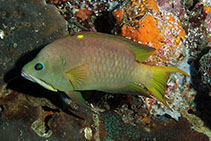
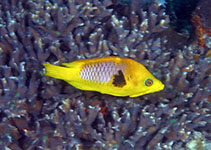
Ραχιαίες άκανθες (συνολικά) : 9; Μαλακές ραχιαίες ακτίνες (συνολικά) : 10; Εδρικές άκανθες: 3; Μαλακές εδρικές ακτίνες: 8. This species is distinguished from its only congener Epibulus insidiator by the relatively drab coloration of the male; a prominent black pigment on the pectoral fins of most females (vs. absent); smaller size with slightly longer pectoral fins, 23.1-26.2% SL (vs. 20.5-23.3% SL); genetically as determined by mitochondrial DNA analysis; jaw structure very long, its posterior end nearly reaching origin of pelvic fins, and it is extremely protrusible; D IX, 10; A III, 9; pectoral rays 12; lateral line interrupted, 14-15 + 7-9 scales; gill rakers 16-19 (modally 17); females varying from dark to light brown, gray, yellow, to nearly white, with narrow black bar on scales of body except ventrally and posteriorly; males dark brown to gray or dark greenish on body, the head at least partly green with no black stripe through eye; yellow band in lobes of caudal fin; no black on pectoral fins (Ref. 75789). Cross section: compressed.
This species inhabits protected inshore waters and is a protogynous hermaphrodite. It has been observed to spawn on several occasions in Palau at Ngerikuul (Nikko Bay) and Cemetery Reef (W side of Ngeruktabel) in the late afternoon, generally about 1600 when sunset is around 1800, and not correlated with high tide. Courtship and spawning were found to be variable; distinct from that of E. insidiator. The males do not display in such an obvious manner as E. insidiator, but they do swim conspicuously around a putative territory, often a short distance above the bottom, but sometimes higher in the water column, presumably to be more visible to the females. The male’s courtship posture is distinctly different from that of its congener, with caudal fin folded, and the dorsal and anal fins held closely to the body. The males swim around prospective females, displaying in a very subtle manner. The spawning rush varies, ranging from a low arch to a short and relatively slow upward movement. At the time of spawning the median fins of the male are more widely spread. Stomach contents contain remains of crabs and shrimps, and other unidentified crustaceans (Ref. 75789). A solitary species (Ref. 90102).
Κύκλος ζωής και συμπεριφορά ζευγαρώματος Γεννητική Ωρίμανση | Αναπαραγωγή | Γεννοβολία | Αβγά | Γονιμότητα | Προνύμφες
Oviparous, with distinct pairing during breeding (Ref. 205).
Carlson, B.A., J.E. Randall and M.N. Dawson, 2008. A new species of Epibulus (Perciformes: Labridae) from the West Pacific. Copeia 2008(2):476-483. (Ref. 75789)
Κατάσταση Κόκκινου Καταλόγου IUCN (Ref. 130435: Version 2025-2 (Global))
Προτιμώμενη θερμοκρασία (Αναφ. 123201): 28.6 - 29.4, mean 28.9 °C (based on 600 cells).
Δείκτης φυλογενετικής ποικιλότητας (Αναφ. 82804): PD50 = 0.7500 [Uniqueness, from 0.5 = low to 2.0 = high].
Bayesian length-weight: a=0.00389 (0.00180 - 0.00842), b=3.12 (2.94 - 3.30), in cm total length, based on all LWR estimates for this body shape (Ref. 93245).
Τροφικό Επίπεδο (Αναφ. 69278): 3.7 ±0.4 se; based on size and trophs of closest relatives
Ελαστικότητα (Αναφ. 120179): Υψηλό, ελάχιστος χρόνος για διπλασιασμό πληθυσμού < 15 μήνες (Preliminary K or Fecundity.).
Ευπάθεια στην αλιεία (Ref. 59153): Low vulnerability (13 of 100). 🛈