



把你的觀察加入 Fish Watcher
| Native range | All suitable habitat | Point map | Year 2050 |

|
| This map was computer-generated and has not yet been reviewed. |
| Epibulus brevis AquaMaps Data sources: GBIF OBIS |

分類 / 名稱 俗名 | 同種異名 | Catalog of Fishes(屬, 種) | ITIS | CoL | WoRMS | Cloffa
Teleostei > Eupercaria/misc (Various families in series Eupercaria) 鱸形目 (Various families in series Eupercaria) > Labridae (Wrasses) 隆頭魚科 (Wrasses) > Cheilininae
Etymology: Epibulus: Greek, epi = over, in front + Greek, boleo = to throw (Ref. 45335); brevis: Name from Latin meaning short, refers to its distinctly smaller size.
More on authors: Carlson, Randall & Dawson.
Etymology: Epibulus: Greek, epi = over, in front + Greek, boleo = to throw (Ref. 45335); brevis: Name from Latin meaning short, refers to its distinctly smaller size.
More on authors: Carlson, Randall & Dawson.
環境: 環境 / 氣候帶 / 深度上下限 / 配送範圍 生態學
海洋 礁區魚類; 深度上下限 3 - 18 m (Ref. 75789).
分布 領土 | FAO區域 | 生態系 | 發現紀錄 | 分布圖 | 簡介 | Faunafri
Western Pacific: Palau, Philippines, Papua New Guinea and Indonesia.
大小 / 重量 / 年齡
簡短描述 檢索表 | 型態特徵 | 形態測量圖
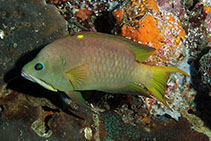
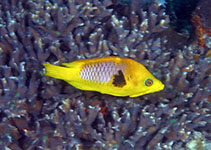
背棘 (總數) : 9; 背的軟條 (總數) : 10; 臀棘: 3; 臀鰭軟條: 8. This species is distinguished from its only congener Epibulus insidiator by the relatively drab coloration of the male; a prominent black pigment on the pectoral fins of most females (vs. absent); smaller size with slightly longer pectoral fins, 23.1-26.2% SL (vs. 20.5-23.3% SL); genetically as determined by mitochondrial DNA analysis; jaw structure very long, its posterior end nearly reaching origin of pelvic fins, and it is extremely protrusible; D IX, 10; A III, 9; pectoral rays 12; lateral line interrupted, 14-15 + 7-9 scales; gill rakers 16-19 (modally 17); females varying from dark to light brown, gray, yellow, to nearly white, with narrow black bar on scales of body except ventrally and posteriorly; males dark brown to gray or dark greenish on body, the head at least partly green with no black stripe through eye; yellow band in lobes of caudal fin; no black on pectoral fins (Ref. 75789).
Cross section: compressed.
Cross section: compressed.
This species inhabits protected inshore waters and is a protogynous hermaphrodite. It has been observed to spawn on several occasions in Palau at Ngerikuul (Nikko Bay) and Cemetery Reef (W side of Ngeruktabel) in the late afternoon, generally about 1600 when sunset is around 1800, and not correlated with high tide. Courtship and spawning were found to be variable; distinct from that of E. insidiator. The males do not display in such an obvious manner as E. insidiator, but they do swim conspicuously around a putative territory, often a short distance above the bottom, but sometimes higher in the water column, presumably to be more visible to the females. The male’s courtship posture is distinctly different from that of its congener, with caudal fin folded, and the dorsal and anal fins held closely to the body. The males swim around prospective females, displaying in a very subtle manner. The spawning rush varies, ranging from a low arch to a short and relatively slow upward movement. At the time of spawning the median fins of the male are more widely spread. Stomach contents contain remains of crabs and shrimps, and other unidentified crustaceans (Ref. 75789). A solitary species (Ref. 90102).
生命週期和交配行為 成熟度 | 繁殖 | 產卵場 | 卵 | 孕卵數 | 仔魚
Oviparous, with distinct pairing during breeding (Ref. 205).
主要參考資料
上傳您的推薦信 | 參考文獻 | 合作者 : Westneat, Mark | 合作者
Carlson, B.A., J.E. Randall and M.N. Dawson, 2008. A new species of Epibulus (Perciformes: Labridae) from the West Pacific. Copeia 2008(2):476-483. (Ref. 75789)
CITES
Not Evaluated
對人類具威脅
人類使用
FAO - Publication: search | FishSource |
更多資訊
解剖學
鰓區
腦部
耳石
鰓區
腦部
耳石
生理學
身體成分
營養素
耗氧量
游泳類型
游泳速度
視覺色素
魚聲
疾病與寄生蟲
毒性 (LC50s)
身體成分
營養素
耗氧量
游泳類型
游泳速度
視覺色素
魚聲
疾病與寄生蟲
毒性 (LC50s)
遺傳學
基因組
遺傳學
異種性
遺傳率
遺傳多樣性
基因組
遺傳學
異種性
遺傳率
遺傳多樣性
工具
特別的報告
下載 XML
網路資源
AFORO (otoliths) | Aquatic Commons | BHL | Cloffa | Websites from users | 檢查 FishWatcher | CISTI | Catalog of Fishes: 屬, 種 | DiscoverLife | ECOTOX | FAO - Publication: search | Faunafri | Fishipedia | Fishtrace | GloBI | Google Books | Google Scholar | Google | IGFA World Record | OneZoom | Open Tree of Life | Otolith Atlas of Taiwan Fishes | PubMed | Reef Life Survey | Socotra Atlas | TreeBase | 樹狀分類階層 | Wikipedia: 去, 搜尋 | World Records Freshwater Fishing | Zoobank | 動物學的記錄
基於模型的估計
首選溫度 (參考文獻 123201): 28.6 - 29.4, mean 28.9 °C (based on 600 cells).
系統發育多樣性指數 (參考文獻 82804): PD50 = 0.7500 [Uniqueness, from 0.5 = low to 2.0 = high].
Bayesian length-weight: a=0.00389 (0.00180 - 0.00842), b=3.12 (2.94 - 3.30), in cm total length, based on all LWR estimates for this body shape (Ref. 93245).
營養階層 (參考文獻 69278): 3.7 ±0.4 se; based on size and trophs of closest relatives
回復力 (參考文獻 120179): 高度, 族群倍增時間少於 15個月 (Preliminary K or Fecundity.).
營養素 (Ref. 124155): Calcium = 97.3 [29.2, 299.4] mg/100g; Iron = 0.684 [0.253, 1.771] mg/100g; Protein = 18 [15, 20] %; Omega3 = 0.117 [0.051, 0.262] g/100g; Selenium = 24.3 [7.1, 71.3] μg/100g; VitaminA = 145 [41, 584] μg/100g; Zinc = 3.35 [1.05, 6.56] mg/100g (wet weight);