This website uses cookies to enhance your browsing experience and ensure the functionality of our site. For more detailed information about the types of cookies we use and how we protect your privacy, please visit our Privacy Information page.
×
Cookie Settings
This website uses different types of cookies to enhance your experience. Please select your preferences below:
> Gobiiformes (Gobies) > Gobiidae (Gobies) > Gobiinae
Etymology: Grallenia:Named for Gerald R. Allen, (G+R+Allen+suffix '-ia'), in honor of his great contribution to our knowledge of the diversity of coral-reef fishes; lipi:Named for the Lembaga Ilmu Pengetahuan Indonesia (or Indonesian Institute of Science), abbreviation of the institute. Eponymy: Dr Gerald Ray Allen (d: 1942) The genus was named to honour “…his great contribution to our knowledge of the diversity of coral-reef fishes.” (See Allen, GR) This is an acronym of Lembaga Ilmu Pengetahuan Indonesia (Indonesian Institute of Science), referring to the fact that all examined specimens were captured during the JSPS (Japan Society for the Promotion of Science)-LIPI cooperative research on [...] (Ref. 128868), visit book page.
Meio ambiente: milieu / Zona climática / intervalo de profundidade / faixa de distribuição Ecologia
marinhas demersal; intervalo de profundidade 8 - 20 m (Ref. 90102). Tropical
Maturidade: Lm? range ? - ? cm Max length : 1.6 cm SL macho/indeterminado; (Ref. 75132); 1.9 cm SL (female)
Descrição suscinta Chaves de identificação | Morfologia | Morfometria
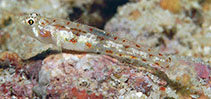
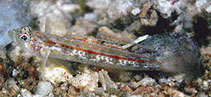
Espinhos dorsais (total) : 7 - 8; Raios dorsais (total) : 9 - 10; Espinhos anais: 1; Raios anais : 9. This species is distinguished by the following characters: second dorsal-fin rays I, 9-10; anal-fin rays I, 9; vertebrae 10+17-18= 27-28, usually 10+18=28); first spine of first dorsal-fin greatly elongated or filamentous in males; second dorsal fin usually reaching to, or beyond, caudal-fin base when adpressed in adult, length of longest ray 17.5-21.8% of SL; length of longest ray of anal fin 12.6-18.1% of SL); scales on body restricted on posterior half of body, except for isolated patch of scales just behind pectoral-fin base; no pelvic frenum; length of pectoral fin 23.2-30.6% of SL); caudal-peduncle length 20.3-23.6% of SL; cephalic sensory canals and associated pores absent; an orange line present at the middle of dorsal fin in life (Ref. 75132). Body shape (shape guide): elongated.
Collected around an isolated, relatively large coral patch on flat, clean and fine sandy bottom
at a depth of 15 m; the area is typical for other sandy-bottom dwellers (e.g., Fusigobius inframaculatus, Limnichthys nitidus). Similar to its congener G. arenicola, as observed, this species did not display symbiotic association with any other organisms. Found to be widespread in Indonesia, and often found on light coloured sand or rubble to
about 15 m depth (Ref. 75132).
Ciclo de vida ou comportamento de acasalamento Maturidade | Reprodução | Desova | Ovos | Fecundidade | Larvas
Shibukawa, K. and A. Iwata, 2007. Grallenia, a new goby genus from the western Pacific, with descriptions of two new species (Perciformes: Gobiidae: Gobiinae). Bull. Natl. Mus. Nat. Sci., Ser. A, Suppl. 1:123-136. (Ref. 75132)
Status na Lista Vermelha da UICN (Ref. 130435: Version 2025-2 (Global))
Ecologia Trófica Itens alimentares (presas) Composição da dieta Consumo alimentar Rações alimentares Predadores
Ecologia Ecologia
Dinâmica populacional Parâmetros de crescimento Idade máxima / tamanhos Relação comprimento-peso. Relação comprimento-comprimento. Frequências de comprimento Conversão de massa Recrutamento Abundância
Ciclo de vida Reprodução Maturidade Maturidade/Rel. das guelras Fecundidade Desova Agregações de desova Ovos Desenvolvimento dos ovos Larvas Dinâmica larval
Fisiologia Composição corporal Nutrientes Consumo de oxigênio Tipo de natação Velocidade de natação Pigmentos visuais Som de peixe Doenças e Parasitas Toxicidade (LC50s)
Temperatura preferida (Ref. 123201): 28.5 - 29.2, mean 28.8 °C (based on 284 cells).
Índice de diversidade filogenética (Ref. 82804): PD50 = 0.5020 [Uniqueness, from 0.5 = low to 2.0 = high].
Bayesian length-weight: a=0.00741 (0.00347 - 0.01582), b=3.09 (2.91 - 3.27), in cm total length, based on LWR estimates for this (Sub)family-body shape (Ref. 93245).
Nível Trófico (Ref. 69278): 3.0 ±0.3 se; based on size and trophs of closest relatives
Resiliência (Ref. 120179): Elevada, tempo mínimo de duplicação da população menor que 15 meses (Preliminary K or Fecundity.).
Vulnerabilidade da pesca (Ref. 59153): Low vulnerability (10 of 100). 🛈