



Tripterygion tartessicum Carreras-Carbonell, Pascual & Macpherson, 2007
Beobachtung melden im Fish Watcher
| Native range | All suitable habitat | Point map | Year 2050 |

|
| This map was computer-generated and has not yet been reviewed. |
| Tripterygion tartessicum AquaMaps Data sources: GBIF OBIS |
Hochladen Photos und videos
Bilder | Google Bild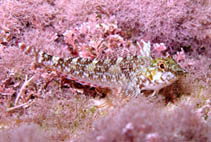 Tripterygion tartessicum
Photo von Pillon, R.
Bilder | Google Bild
Photo von Pillon, R.
Klassifizierung / Names Namen | Synonyme | Catalog of Fishes(Gattung, Arten) | ITIS | CoL | WoRMS | Cloffa
> Blenniiformes (Blennies) > Tripterygiidae (Triplefin blennies) > Tripterygiinae
Etymology: Tripterygion: Greek, tres tria = three + Greek, pteron = wing, fin; diminutive (Ref. 45335); tartessicum: Named for the old Spanish culture (Tartessos, at least dating from 1000 BC), located on the south coast of the Iberian peninsula (in modern Andalusia, Spain), where the new species is partially distributed.
Etymology: Tripterygion: Greek, tres tria = three + Greek, pteron = wing, fin; diminutive (Ref. 45335); tartessicum: Named for the old Spanish culture (Tartessos, at least dating from 1000 BC), located on the south coast of the Iberian peninsula (in modern Andalusia, Spain), where the new species is partially distributed.
Umwelt: Milieu / Klimazone / Tiefenbereich / Verbreitungsgebiet Ökologie
Verbreitung Territorien | FAO Gebiete | Ökosysteme | Vorkommen | Punkt Karte | Einführungen | Faunafri
Mediterranean and Eastern Central Atlantic: along the southern coast of Spain, from Plage David (Morocco) to Tunisia.
Größe / Gewicht / Alter
Kurzbeschreibung Bestimmungsschlüssel | Morphologie | Morphometrie
Rückenflossenstacheln (insgesamt) : 19 - 21; Rückenflossenweichstrahlen (insgesamt) : 12 - 13; Afterflossenstacheln: 2; Afterflossenweichstrahlen: 22 - 24. This species has an elongated and compressed body, greatest height at base of anal fin, being about one-sixth total length. Entire body with ctenoid scales except base of pectoral fin and ventral abdominal region back to vent. Lateral line with an anterior section with 20 (19-22) pored scales, and a posterior section with 22 (21-24) notched scales, total of 42 (40-46). Upper, anterior, section commencing at upper angle of opercular opening, slightly curving up over the pectoral fin base and running parallel to the dorsal profile to a point below last 1-3 rays of second dorsal fin; canal running across exposed width of each scale. Lower,
posterior, section commencing below, and in front of last scale or two of upper section, running along the mid-line of tail to caudal fin base; each scale with shallow notch in free-edge tip (Ref. 58124).
Adults inhabit similar habitats to Tripterygion tripteronotus, shallow rocky shores to 6 m,
preferably between 0 and 3 m; in light-exposed and shady biotopes dominated by algal communities (e.g. Corallina elongata, Cladophora spp., Litophyllum spp., Enteromorpha spp.). Nests are usually situated in sciaphyl habitats dominated by
steep rocky zones, without arborescent algae (Ref. 58124). Eggs are hemispherical and covered with numerous sticky threads that anchor them in the algae on the nesting sites (Ref. 240). Larvae are planktonic which occur primarily in shallow, nearshore waters (Ref. 94114).
Lebenszyklus und Paarungsverhalten Geschlechtsreife | Fortpflanzung | Ablaichen | Eier | Fruchtbarkeit | Larven
Hauptreferenz
Laden Sie Ihre Referenzen hoch | Referenzen | Koordinator : Fricke, Ronald | Partner
Carreras-Carbonell, J., M. Pascual and E. Macpherson, 2007. A review of the Tripterygion tripteronotus (Risso, 1810) complex, with a description of a new species from the Mediterranean Sea (Teleostei: Tripterygiidae). Scientia Marina 71(1):75-86. (Ref. 58124)
IUCN Rote Liste Status (Ref. 130435: Version 2025-2 (Global))
nicht bedroht (LC) ; Date assessed: 07 May 2010
CITES
Not Evaluated
Bedrohung für Menschen
Harmless
Nutzung durch Menschen
FAO - Publication: search | FishSource |
Mehr Information
Trophische Ökologie
Lebensmittel (Beutetiere)
Nahrungszusammensetzung
Nahrungsaufnahme
Lebensmittelrationen
Räuber
Lebensmittel (Beutetiere)
Nahrungszusammensetzung
Nahrungsaufnahme
Lebensmittelrationen
Räuber
Populationsdynamik
Wachstumsparameter
Max. Alter/Größen
Länge-Gewicht-Rel.
Länge-Länge-Verhältnis.
Längenhäufigkeiten
Massenkonvertierung
Rekrutierung
Dichte
Wachstumsparameter
Max. Alter/Größen
Länge-Gewicht-Rel.
Länge-Länge-Verhältnis.
Längenhäufigkeiten
Massenkonvertierung
Rekrutierung
Dichte
Anatomie
Kiemenoberfläche
Gehirn
Otolith
Kiemenoberfläche
Gehirn
Otolith
Physiologie
Körperliche Zusammensetzung
Nährstoffe
Sauerstoffverbrauch
Schwimmart
Schwimmgeschwindigkeit
Visuelle Pigmente
Fischgeräusche
Krankheiten und Parasiten
Toxizität (LC50s)
Körperliche Zusammensetzung
Nährstoffe
Sauerstoffverbrauch
Schwimmart
Schwimmgeschwindigkeit
Visuelle Pigmente
Fischgeräusche
Krankheiten und Parasiten
Toxizität (LC50s)
Genetik
Genom
Genetik
Heterozygotie
Vererbbarkeit
Genetische Vielfalt
Genom
Genetik
Heterozygotie
Vererbbarkeit
Genetische Vielfalt
Menschenbezogen
Aquakultur-Systeme
Aquakultur Profile
Zuchtlinien
Ciguatera-Fälle
Briefmarken, Münzen, Verschiedenes.
Aquakultur-Systeme
Aquakultur Profile
Zuchtlinien
Ciguatera-Fälle
Briefmarken, Münzen, Verschiedenes.
Tools
Zusatzinformationen
Download XML
Zusammenfassung | Punktdaten | Namen | Photos
Internet Quellen
AFORO (otoliths) | Aquatic Commons | BHL | Cloffa | Websites from users | FishWatcher Einträge suchen | CISTI | Catalog of Fishes: Gattung, Arten | DiscoverLife | ECOTOX | FAO - Publication: search | Faunafri | Fishipedia | Fishtrace | GloBI | Google Books | Google Scholar | Google | IGFA World Record | Nationale Datenbanken | OneZoom | Open Tree of Life | Otolith Atlas of Taiwan Fishes | PubMed | Reef Life Survey | Socotra Atlas | TreeBase | Tree of Life | Wikipedia: Gehe zu, Suchen | World Records Freshwater Fishing | Zoobank | Zoologischer Rekord
Schätzungen auf der Grundlage von Modellen
Bevorzugte Temperatur (Ref. 123201): 17.6 - 20.1, mean 18.9 °C (based on 213 cells).
Phylogenetischer Diversitätsindex (Ref. 82804): PD50 = 0.5625 [Uniqueness, from 0.5 = low to 2.0 = high].
Bayesian length-weight: a=0.00794 (0.00442 - 0.01428), b=3.07 (2.91 - 3.23), in cm total length, based on LWR estimates for this species & (Sub)family-body (Ref. 93245).
Trophische Ebene (Ref. 69278): 3.4 ±0.4 se; based on size and trophs of closest relatives
Widerstandsfähigkeit (Ref. 120179): hoch, Verdopplung der Population dauert weniger als 15 Monate. (Preliminary K or Fecundity.).