



Enneapterygius elaine Holleman, 2005
Carregue seu(sua) Fotos e vídeos
Imagem do Google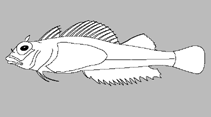 No image available for this species;
drawing shows typical species in Tripterygiidae.
Imagem do Google
drawing shows typical species in Tripterygiidae.
Classificação / Nomes Nomes comuns | Sinônimos | Catalog of Fishes(Gênero, Espécies) | ITIS | CoL | WoRMS | Cloffa
> Blenniiformes (Blennies) > Tripterygiidae (Triplefin blennies) > Tripterygiinae
Etymology: Enneapterygius: Greek, ennea = nine times + Greek, pterygion = little fin (Ref. 45335); elaine: Named for Elaine Heemstra, in recognition of her considerable and excellent contribution to the illustration of Indo-Pacific fishes, including several in this paper; a noun in apposition (Ref. 57774).
Eponymy: Elaine Margaret Heemstra née Lawrence formerly Grant is Scientific Illustrator Emeritus at the South Africa Institute for Aquatic Biodiversity. [...] (Ref. 128868), visit book page.
Etymology: Enneapterygius: Greek, ennea = nine times + Greek, pterygion = little fin (Ref. 45335); elaine: Named for Elaine Heemstra, in recognition of her considerable and excellent contribution to the illustration of Indo-Pacific fishes, including several in this paper; a noun in apposition (Ref. 57774).
Eponymy: Elaine Margaret Heemstra née Lawrence formerly Grant is Scientific Illustrator Emeritus at the South Africa Institute for Aquatic Biodiversity. [...] (Ref. 128868), visit book page.
Meio ambiente: milieu / Zona climática / intervalo de profundidade / faixa de distribuição Ecologia
marinhas demersal. Tropical
Distribuição Territórios | Áreas da FAO | Ecossistemas | Ocorrências | Mapa de pontos | Introduções | Faunafri
Western Indian Ocean: currently known only from Rodriguez Island.
Tamanho / Peso / Idade
Descrição suscinta Chaves de identificação | Morfologia | Morfometria
Espinhos dorsais (total) : 12 - 16; Raios dorsais (total) : 9 - 11; Espinhos anais: 0; Raios anais : 17 - 19; Vértebras: 35. Dorsal fins III + XIII + 10 (rarely with 12 spines and 9-11 rays); anal fin I,17-19; pectoral fins 15: 3+5+7 (rarely 4+4+7); lateral line with 14-15 (usually 14) pored scales and 21-22 notched scales (rarely 20-23), starting second scale row below end of pored segment. Total lateral scales 33; transverse scales 2/5. Vertebrae: 10 precaudal, 25 caudal. Mandibular pores: 3+1+3. Head 3.2-4.0 in SL; eye 2.4-3.0 in head length. Small fish, seldom longer than 20 mm SL. Body slender, scales large, nape scaled, abdomen naked. Pelvic fin rays slender, united by membrane for half the length of the longer ray. First dorsal fin about half height of second. Pectoral fin large, longest ray reaching to penultimate spine of second dorsal fin. Mouth oblique, small and pointed, maxilla reaching vertical through anterior margin of orbit. Orbital cirrus small and pointed (Ref. 57774).
Known only from the lagoon around the island of Rodrigues (Ref. 57774). Eggs are hemispherical and covered with numerous sticky threads that anchor them in the algae on the nesting sites (Ref. 240). Larvae are planktonic which occur primarily in shallow, nearshore waters (Ref. 94114).
Ciclo de vida ou comportamento de acasalamento Maturidade | Reprodução | Desova | Ovos | Fecundidade | Larvas
Referência principal
Carregar suas referências | Referências | Coordenador : Fricke, Ronald | Colaboradores
Holleman, W., 2005. A review of the triplefin fish genus Enneapterygius (Blennioidei: Tripterygidae) in the western Indian Ocean, with descriptions of four new species. Smithiana, Bull. 5:1-25. (Ref. 57774)
Status na Lista Vermelha da UICN (Ref. 130435: Version 2025-2 (Global))
Segura ou pouco preocupante (LC) ; Date assessed: 03 May 2010
CITES
Not Evaluated
Ameaça para os humanos
Harmless
Uso pelos humanos
Pescarias: sem interesse
FAO - Publication: search | FishSource |
Mais informação
Ecologia Trófica
Itens alimentares (presas)
Composição da dieta
Consumo alimentar
Rações alimentares
Predadores
Itens alimentares (presas)
Composição da dieta
Consumo alimentar
Rações alimentares
Predadores
Dinâmica populacional
Parâmetros de crescimento
Idade máxima / tamanhos
Relação comprimento-peso.
Relação comprimento-comprimento.
Frequências de comprimento
Conversão de massa
Recrutamento
Abundância
Parâmetros de crescimento
Idade máxima / tamanhos
Relação comprimento-peso.
Relação comprimento-comprimento.
Frequências de comprimento
Conversão de massa
Recrutamento
Abundância
Anatomia
Área branquial
Cérebro
Otólito
Área branquial
Cérebro
Otólito
Fisiologia
Composição corporal
Nutrientes
Consumo de oxigênio
Tipo de natação
Velocidade de natação
Pigmentos visuais
Som de peixe
Doenças e Parasitas
Toxicidade (LC50s)
Composição corporal
Nutrientes
Consumo de oxigênio
Tipo de natação
Velocidade de natação
Pigmentos visuais
Som de peixe
Doenças e Parasitas
Toxicidade (LC50s)
Genética
genoma
Genética
Heterozigosidade
Hereditariedade
Diversidade genética
genoma
Genética
Heterozigosidade
Hereditariedade
Diversidade genética
Relacionado a humanos
Sistemas de aquicultura
Perfis para aquacultura
Estirpes
Casos de Ciguatera
Selos, moedas, diversos.
Sistemas de aquicultura
Perfis para aquacultura
Estirpes
Casos de Ciguatera
Selos, moedas, diversos.
Ferramentas
Livro eletrônico | Guia de campo | Ferramenta auxiliar de frequências de comprimento | Ferramenta sobre a história de vida | Mapa de pontos |
Catch-MSY |
Relatórios especiais
Checar Manutenção em Aquário | Checar Planilhas de Fatos sobre as Espécies | Checar Planilhas de Fatos sobre Aquicultura
Baixar XML
Fontes da internet
AFORO (otoliths) | Aquatic Commons | BHL | Cloffa | Websites from users | Checar Observador de Peixes (FishWatcher) | CISTI | Catalog of Fishes: Gênero, Espécies | DiscoverLife | ECOTOX | FAO - Publication: search | Faunafri | Fishipedia | Fishtrace | GloBI | Google Books | Google Scholar | Google | IGFA World Record | OneZoom | Open Tree of Life | Otolith Atlas of Taiwan Fishes | PubMed | Reef Life Survey | Socotra Atlas | TreeBase | Árvore da vida | Wikipedia: Ir para, procura | World Records Freshwater Fishing | Zoobank | Registro zoológico
Estimativas baseadas em modelos
Índice de diversidade filogenética (Ref. 82804): PD50 = 0.5000 [Uniqueness, from 0.5 = low to 2.0 = high].
Bayesian length-weight: a=0.00617 (0.00290 - 0.01310), b=3.04 (2.86 - 3.22), in cm total length, based on LWR estimates for this (Sub)family-body shape (Ref. 93245).
Nível Trófico (Ref. 69278): 3.1 ±0.3 se; based on size and trophs of closest relatives
Resiliência (Ref. 120179): Elevada, tempo mínimo de duplicação da população menor que 15 meses (Preliminary K or Fecundity.).