



Enneapterygius elaine Holleman, 2005
Envoyez vos Photos et vidéos
Images Google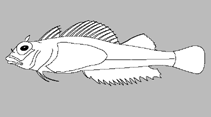 No image available for this species;
drawing shows typical species in Tripterygiidae.
Images Google
drawing shows typical species in Tripterygiidae.
Classification / Noms Noms communs | Synonymes | Catalog of Fishes(Genre, Espèce) | ITIS | CoL | WoRMS | Cloffa
> Blenniiformes (Blennies) > Tripterygiidae (Triplefin blennies) > Tripterygiinae
Etymology: Enneapterygius: Greek, ennea = nine times + Greek, pterygion = little fin (Ref. 45335); elaine: Named for Elaine Heemstra, in recognition of her considerable and excellent contribution to the illustration of Indo-Pacific fishes, including several in this paper; a noun in apposition (Ref. 57774).
Eponymy: Elaine Margaret Heemstra née Lawrence formerly Grant is Scientific Illustrator Emeritus at the South Africa Institute for Aquatic Biodiversity. [...] (Ref. 128868), visit book page.
Etymology: Enneapterygius: Greek, ennea = nine times + Greek, pterygion = little fin (Ref. 45335); elaine: Named for Elaine Heemstra, in recognition of her considerable and excellent contribution to the illustration of Indo-Pacific fishes, including several in this paper; a noun in apposition (Ref. 57774).
Eponymy: Elaine Margaret Heemstra née Lawrence formerly Grant is Scientific Illustrator Emeritus at the South Africa Institute for Aquatic Biodiversity. [...] (Ref. 128868), visit book page.
Environnement : milieu / zone climatique / profondeur / gamme de distribution Écologie
marin démersal. Tropical
Distribution Territoires | Zones FAO | Écosystèmes | Occurrences | Carte par point | Introductions | Faunafri
Western Indian Ocean: currently known only from Rodriguez Island.
Taille / Poids / Âge
Description synthétique Clés d'identification | Morphologie | Morphométrie
Épines dorsales (Total) : 12 - 16; Rayons mous dorsaux (Total) : 9 - 11; Épines anales: 0; Rayons mous anaux: 17 - 19; Vertèbres: 35. Dorsal fins III + XIII + 10 (rarely with 12 spines and 9-11 rays); anal fin I,17-19; pectoral fins 15: 3+5+7 (rarely 4+4+7); lateral line with 14-15 (usually 14) pored scales and 21-22 notched scales (rarely 20-23), starting second scale row below end of pored segment. Total lateral scales 33; transverse scales 2/5. Vertebrae: 10 precaudal, 25 caudal. Mandibular pores: 3+1+3. Head 3.2-4.0 in SL; eye 2.4-3.0 in head length. Small fish, seldom longer than 20 mm SL. Body slender, scales large, nape scaled, abdomen naked. Pelvic fin rays slender, united by membrane for half the length of the longer ray. First dorsal fin about half height of second. Pectoral fin large, longest ray reaching to penultimate spine of second dorsal fin. Mouth oblique, small and pointed, maxilla reaching vertical through anterior margin of orbit. Orbital cirrus small and pointed (Ref. 57774).
Known only from the lagoon around the island of Rodrigues (Ref. 57774). Eggs are hemispherical and covered with numerous sticky threads that anchor them in the algae on the nesting sites (Ref. 240). Larvae are planktonic which occur primarily in shallow, nearshore waters (Ref. 94114).
Cycle de vie et comportement reproducteur Maturité | Reproduction | Frai | Œufs | Fécondité | Larves
Référence principale
Téléchargez vos références | Références | Coordinateur : Fricke, Ronald | Collaborateurs
Holleman, W., 2005. A review of the triplefin fish genus Enneapterygius (Blennioidei: Tripterygidae) in the western Indian Ocean, with descriptions of four new species. Smithiana, Bull. 5:1-25. (Ref. 57774)
Statut dans la liste rouge de l'IUCN (Ref. 130435: Version 2025-2 (Global))
Préoccupation mineure (LC) ; Date assessed: 03 May 2010
CITES
Not Evaluated
Menace pour l'homme
Harmless
Utilisations par l'homme
Pêcheries: sans intérêt
FAO - Publication: search | FishSource |
Plus d'informations
Écologie trophique
Aliments (proies)
Composition du régime alimentaire
Consommation alimentaire
Rations alimentaires
Prédateurs
Aliments (proies)
Composition du régime alimentaire
Consommation alimentaire
Rations alimentaires
Prédateurs
Dynamique des populations
Paramètres de croissance
Âges / tailles maximales
Longueur-poids rel.
Rel. longueur-longueur.
Fréquences de longueurs
Conversion de masse
Recrutement
Abondance
Paramètres de croissance
Âges / tailles maximales
Longueur-poids rel.
Rel. longueur-longueur.
Fréquences de longueurs
Conversion de masse
Recrutement
Abondance
Anatomie
Surface branchiale
Cerveau
Otolithe
Surface branchiale
Cerveau
Otolithe
Physiologie
Composition corporelle
Nutriments
Consommation d'oxygène
Type de natation
Vitesse de nage
Pigments visuels
Son de poisson
Maladies et parasites
Toxicité (CL50)
Composition corporelle
Nutriments
Consommation d'oxygène
Type de natation
Vitesse de nage
Pigments visuels
Son de poisson
Maladies et parasites
Toxicité (CL50)
Génétique
génôme
Génétique
Hétérozygotie
Héritabilité
Diversité génétique
génôme
Génétique
Hétérozygotie
Héritabilité
Diversité génétique
Liées à l'homme
Systèmes d'aquaculture
Profils d'aquaculture
Souches
Cas de ciguatera
Timbres, pièces de monnaie, divers
Systèmes d'aquaculture
Profils d'aquaculture
Souches
Cas de ciguatera
Timbres, pièces de monnaie, divers
Outils
E-book | Guide de terrain | Générateur de fréquences de longueur | Outil de dynamique de population | Carte par point |
Capture-MSY |
Articles particuliers
Télécharger en XML
Sources Internet
AFORO (otoliths) | Aquatic Commons | BHL | Cloffa | Websites from users | FishWatcher | CISTI | Catalog of Fishes: Genre, Espèce | DiscoverLife | ECOTOX | FAO - Publication: search | Faunafri | Fishipedia | Fishtrace | GloBI | Google Books | Google Scholar | Google | IGFA World Record | OneZoom | Open Tree of Life | Otolith Atlas of Taiwan Fishes | PubMed | Reef Life Survey | Socotra Atlas | TreeBase | Arbre de Vie | Wikipedia: aller à, chercher | World Records Freshwater Fishing | Zoobank | Zoological Record
Estimations basées sur des modèles
Indice de diversité phylogénétique (Réf. 82804): PD50 = 0.5000 [Uniqueness, from 0.5 = low to 2.0 = high].
Bayesian length-weight: a=0.00617 (0.00290 - 0.01310), b=3.04 (2.86 - 3.22), in cm total length, based on LWR estimates for this (Sub)family-body shape (Ref. 93245).
Niveau trophique (Réf. 69278): 3.1 ±0.3 se; based on size and trophs of closest relatives
Résilience (Réf. 120179): Haut, temps minimum de doublement de population inférieur à 15 mois (Preliminary K or Fecundity.).