



Rhabdolichops nigrimans Correa, Crampton & Albert, 2006
Adicionar o seu Fotografias e vídeos
Imagem do Google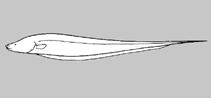 No image available for this species;
drawing shows typical species in Sternopygidae.
Imagem do Google
drawing shows typical species in Sternopygidae.
Classificação / Nomes Nomes comuns | Sinónimos | Catalog of Fishes(Género, Espécies) | ITIS | CoL | WoRMS | Cloffa
> Gymnotiformes (Knifefishes) > Sternopygidae (Glass knifefishes) > Eigenmanninae
Etymology: Rhabdolichops: Greek, rhabdos = stick + Greek, dolichos = long (Ref. 45335); nigrimans: Name from the Latin noun 'manus', meaning hand, and 'nigrum' for black, referring to the diagnostic black pectoral fin.
Etymology: Rhabdolichops: Greek, rhabdos = stick + Greek, dolichos = long (Ref. 45335); nigrimans: Name from the Latin noun 'manus', meaning hand, and 'nigrum' for black, referring to the diagnostic black pectoral fin.
Ambiente: milieu / zona climática / intervalo de profundidade / gama de distribuição Ecologia
; Água doce bentopelágico; intervalo de profundidade 5 - 15 m (Ref. 55969). Tropical
Distribuição Territórios | Áreas FAO | Ecossistemas | Ocorrências | Mapa dos pontos | Introduções | Faunafri
South America: Brazil.
Tamanho / Peso / Idade
Maturidade: Lm ? range ? - ? cm
Max length : 43.1 cm TL macho/indeterminado; (Ref. 55969); 30.5 cm TL (female)
Max length : 43.1 cm TL macho/indeterminado; (Ref. 55969); 30.5 cm TL (female)
Descrição breve Chaves de identificação | Morfologia | Morfometria
Diagnosis: Distinguished from its congeners by the following characters: presence of black pectoral and anal fins, with dark chromatophores extending to the distal tips of the fin rays, and from all congeners (except R. lundbergi) by long pectoral fins (P1/HL = 127.7 ±13.4 vs. 60-100); except with R. lundbergi, the anterodorsal margin of the opercle forms a sharp right (vs. sloping obtuse) angle; except R. lundbergi, it has a sickleshaped maxilla with concave dorsal margin (vs. broad maxilla with straight dorsal margin); infraorbital canal bones five and six ossified as complete slender tubes (vs. broad partial cylinders with bony arches); sphenotic spine ventral to infraorbital portion on frontal (vs. posterior to infraorbital portion on frontal); posttemporal fossa absent (vs. present); opercle with anterodorsal facet; cleithral process narrow (vs. broad); cleithrum with a semi-lunar margin against the base of the pectoral-fin radials, a long pectoral-fin (longer than head length vs. shorter); displaced hemal spines 3-4 (vs. 2); and pectoral-fin with black chromatophores on rays (vs. hyaline rays). Rhabdolichops nigrimans can further be distinguished from
R. lundbergi by having: a longer body (maximum total length 419 vs. 233 mm TL; n = 15 for each species); an exaggeratedly scaly appearance of anterior epaxial body surface due to chromatophores concentrated along outer scale margins; larger teeth on premaxilla, mesopterygoid and dentary; and more numerous teeth on premaxilla (20-25 vs. 18-20), mesopterygoid (11-13 vs. 8), and dentary (25-34 vs. 12-13; n = 2 adults for each species); and sexual dimorphism of the caudal appendage (tail) length in which mature males possess a longer caudal appendage than mature females (mean CA 44 ± 2.9% vs. 38 ± 3.2%; n = 5 each) (Ref. 55969).
Ciclo de vida e comportamento de acasalamento Maturidade | Reprodução | Desova | Ovos | Fecundidade | Larvas
Referência principal
Carregar as suas referências | Referências | Coordenador : Albert, James S. | Colaboradores
Correa, S.B., W.G.R. Crampton and J.S. Albert, 2006. Three new species of the neotropical electric fish Rhabdolichops (Gymnotiformes: Sternopygidae) from the central Amazon, with a new diagnosis of the genus. Copeia 2006(1):27-42. (Ref. 55969)
Categoria na Lista Vermelha da IUCN (Ref. 130435: Version 2025-2 (Global))
Preocupação menor (LC) ; Date assessed: 03 December 2020
CITES
Not Evaluated
Ameaça para o homem
Harmless
Utilização humana
FAO - Publication: search | FishSource |
Mais informação
Ecologia Trófica
Produtos alimentares (presas)
Composição da dieta
Consumo alimentar
Rações alimentares
Predadores
Produtos alimentares (presas)
Composição da dieta
Consumo alimentar
Rações alimentares
Predadores
Ecologia
Ecologia
Ecologia
Dinâmica das populações
Parâmetros de crescimento
Idades / tamanhos máximos
Comprimento-peso rel.
Comprimento-comprimento rel.
Frequência de comprimento
Conversão de massa
Recrutamento
Abundância
Parâmetros de crescimento
Idades / tamanhos máximos
Comprimento-peso rel.
Comprimento-comprimento rel.
Frequência de comprimento
Conversão de massa
Recrutamento
Abundância
Ciclo de vida
Reprodução
Maturidade
Maturidade/Rel. das guelras
Fecundidade
Desova
Agregações de desova
Ovos
Desenvolvimento dos ovos
Larvas
Dinâmica larvar
Reprodução
Maturidade
Maturidade/Rel. das guelras
Fecundidade
Desova
Agregações de desova
Ovos
Desenvolvimento dos ovos
Larvas
Dinâmica larvar
Anatomia
Área branquial
Cérebro
Otólitos
Área branquial
Cérebro
Otólitos
Fisiologia
Composição corporal
Nutrientes
Consumo de oxigénio
Tipo de natação
Velocidade de natação
Pigmentos visuais
Som de peixe
Doenças e Parasitas
Toxicidade (LC50s)
Composição corporal
Nutrientes
Consumo de oxigénio
Tipo de natação
Velocidade de natação
Pigmentos visuais
Som de peixe
Doenças e Parasitas
Toxicidade (LC50s)
Genética
genoma
Genética
Heterozigotia
Hereditariedade
Diversidade genética
genoma
Genética
Heterozigotia
Hereditariedade
Diversidade genética
Relacionado com o ser humano
Sistemas de aquacultura
Perfis para aquacultura
Estirpes
Casos de Ciguatera
Selos, moedas, diversos.
Sistemas de aquacultura
Perfis para aquacultura
Estirpes
Casos de Ciguatera
Selos, moedas, diversos.
Ferramentas
E-book | Guia de campo | Ferramenta auxiliar de frequências de comprimento | Ferramenta sobre a história de vida | Mapa dos pontos |
Captura-MSY |
Relatórios especiais
Descarregue XML
Fontes da internet
AFORO (otoliths) | Aquatic Commons | BHL | Cloffa | Websites from users | Consultar FishWatcher | CISTI | Catalog of Fishes: Género, Espécies | DiscoverLife | ECOTOX | FAO - Publication: search | Faunafri | Fishipedia | Fishtrace | GloBI | Google Books | Google Scholar | Google | IGFA World Record | OneZoom | Open Tree of Life | Otolith Atlas of Taiwan Fishes | PubMed | Reef Life Survey | Socotra Atlas | TreeBase | Árvore da vida | Wikipedia: ir para, procurar | World Records Freshwater Fishing | Zoobank | Registo zoológico
Estimativas baseadas em modelos
Índice de diversidade filogenética (Ref. 82804): PD50 = 0.5010 [Uniqueness, from 0.5 = low to 2.0 = high].
Bayesian length-weight: a=0.00355 (0.00161 - 0.00782), b=2.97 (2.78 - 3.16), in cm total length, based on LWR estimates for this (Sub)family-body shape (Ref. 93245).
Nível Trófico (Ref. 69278): 3.2 ±0.3 se; based on size and trophs of closest relatives