



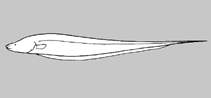
Rhabdolichops nigrimans Correa, Crampton & Albert, 2006
分類 / 名稱 俗名 | 同種異名 | Catalog of Fishes(屬, 種) | ITIS | CoL | WoRMS | Cloffa
Teleostei > Gymnotiformes (Knifefishes) 電鰻目 (Knifefishes) > Sternopygidae (Glass knifefishes) 胸肛魚科 (Glass knifefishes) > Eigenmanninae
Etymology: Rhabdolichops: Greek, rhabdos = stick + Greek, dolichos = long (Ref. 45335); nigrimans: Name from the Latin noun 'manus', meaning hand, and 'nigrum' for black, referring to the diagnostic black pectoral fin.
Etymology: Rhabdolichops: Greek, rhabdos = stick + Greek, dolichos = long (Ref. 45335); nigrimans: Name from the Latin noun 'manus', meaning hand, and 'nigrum' for black, referring to the diagnostic black pectoral fin.
環境: 環境 / 氣候帶 / 深度上下限 / 配送範圍 生態學
; 淡水 底中水層性; 深度上下限 5 - 15 m (Ref. 55969).
分布 領土 | FAO區域 | 生態系 | 發現紀錄 | 分布圖 | 簡介 | Faunafri
South America: Brazil.
大小 / 重量 / 年齡
簡短描述 檢索表 | 型態特徵 | 形態測量圖
Diagnosis: Distinguished from its congeners by the following characters: presence of black pectoral and anal fins, with dark chromatophores extending to the distal tips of the fin rays, and from all congeners (except R. lundbergi) by long pectoral fins (P1/HL = 127.7 ±13.4 vs. 60-100); except with R. lundbergi, the anterodorsal margin of the opercle forms a sharp right (vs. sloping obtuse) angle; except R. lundbergi, it has a sickleshaped maxilla with concave dorsal margin (vs. broad maxilla with straight dorsal margin); infraorbital canal bones five and six ossified as complete slender tubes (vs. broad partial cylinders with bony arches); sphenotic spine ventral to infraorbital portion on frontal (vs. posterior to infraorbital portion on frontal); posttemporal fossa absent (vs. present); opercle with anterodorsal facet; cleithral process narrow (vs. broad); cleithrum with a semi-lunar margin against the base of the pectoral-fin radials, a long pectoral-fin (longer than head length vs. shorter); displaced hemal spines 3-4 (vs. 2); and pectoral-fin with black chromatophores on rays (vs. hyaline rays). Rhabdolichops nigrimans can further be distinguished from
R. lundbergi by having: a longer body (maximum total length 419 vs. 233 mm TL; n = 15 for each species); an exaggeratedly scaly appearance of anterior epaxial body surface due to chromatophores concentrated along outer scale margins; larger teeth on premaxilla, mesopterygoid and dentary; and more numerous teeth on premaxilla (20-25 vs. 18-20), mesopterygoid (11-13 vs. 8), and dentary (25-34 vs. 12-13; n = 2 adults for each species); and sexual dimorphism of the caudal appendage (tail) length in which mature males possess a longer caudal appendage than mature females (mean CA 44 ± 2.9% vs. 38 ± 3.2%; n = 5 each) (Ref. 55969).
鑑別: 與它的同類區分了藉由跟隨特徵: 有黑色的胸鰭與臀鰭, 有深色的延伸至鰭條的末端的色素胞, 與從長胸鰭的所有同類 (除了 R. lundbergi 以外);(P1/HL=127.7 ±13.4 vs.60-100) 除了 R. lundbergi 以外,鰓蓋的前背部邊緣形成一個銳利的權利 (vs. 傾斜的圓頭) 角; 除了 R. lundbergi 以外, 它有一個 sickleshaped 顎骨有凹的上緣;(vs. 寬的顎骨有直的上緣) 眶下管硬骨五與六鈣化成完全的細長管;(vs. 寬的部分圓筒以骨弓) 對眶下的部分蝶骨棘腹面前的之上;(vs. 在額骨上在眶下的部分後面) 後顳窩不存在;(vs. 存在的) 鰓蓋有前背部刻面; 匙骨突起狹窄的;(vs. 寬的) 匙骨具有一個半-對抗胸鰭動脈的基底的陰曆邊緣一個長的胸鰭;(長度超過頭長 vs. 比較短的) 移置了血液的棘 3-4;(vs.2) 而且在鰭條上胸鰭有黑色的色素胞.(vs. 透明的鰭條) Rhabdolichops nigrimans 能進一步被區分 R. lundbergi 藉著具有: 一個較長的身體 (最大的全長 419 和 233 mm TL 比較; 為每個種的 n=15); 前面軸上的身體表面的誇大有鱗外表由於被集中的色素胞沿著外部的鱗片邊緣; 比較大的牙齒在前頜骨,中翼骨與齒骨; 而且眾多的牙齒在前頜骨 (20-25 vs.18-20) ,中翼骨 (11-13 vs.8) 與齒骨 (25-34 和 12-13 比較; 為每個種的 n=2個成魚); 而且尾鰭附肢 (尾部) 長度的性同種二形在那一個成熟雄性超過成熟的雌性持有一個比較長的尾部附肢 (意謂加州 44 ± 2.9% 和 38 ± 3.2% 比較; n=5 每個).(參考文獻 55969)
鑑別: 與它的同類區分了藉由跟隨特徵: 有黑色的胸鰭與臀鰭, 有深色的延伸至鰭條的末端的色素胞, 與從長胸鰭的所有同類 (除了 R. lundbergi 以外);(P1/HL=127.7 ±13.4 vs.60-100) 除了 R. lundbergi 以外,鰓蓋的前背部邊緣形成一個銳利的權利 (vs. 傾斜的圓頭) 角; 除了 R. lundbergi 以外, 它有一個 sickleshaped 顎骨有凹的上緣;(vs. 寬的顎骨有直的上緣) 眶下管硬骨五與六鈣化成完全的細長管;(vs. 寬的部分圓筒以骨弓) 對眶下的部分蝶骨棘腹面前的之上;(vs. 在額骨上在眶下的部分後面) 後顳窩不存在;(vs. 存在的) 鰓蓋有前背部刻面; 匙骨突起狹窄的;(vs. 寬的) 匙骨具有一個半-對抗胸鰭動脈的基底的陰曆邊緣一個長的胸鰭;(長度超過頭長 vs. 比較短的) 移置了血液的棘 3-4;(vs.2) 而且在鰭條上胸鰭有黑色的色素胞.(vs. 透明的鰭條) Rhabdolichops nigrimans 能進一步被區分 R. lundbergi 藉著具有: 一個較長的身體 (最大的全長 419 和 233 mm TL 比較; 為每個種的 n=15); 前面軸上的身體表面的誇大有鱗外表由於被集中的色素胞沿著外部的鱗片邊緣; 比較大的牙齒在前頜骨,中翼骨與齒骨; 而且眾多的牙齒在前頜骨 (20-25 vs.18-20) ,中翼骨 (11-13 vs.8) 與齒骨 (25-34 和 12-13 比較; 為每個種的 n=2個成魚); 而且尾鰭附肢 (尾部) 長度的性同種二形在那一個成熟雄性超過成熟的雌性持有一個比較長的尾部附肢 (意謂加州 44 ± 2.9% 和 38 ± 3.2% 比較; n=5 每個).(參考文獻 55969)
生命週期和交配行為 成熟度 | 繁殖 | 產卵場 | 卵 | 孕卵數 | 仔魚
主要參考資料
上傳您的推薦信 | 參考文獻 | 合作者 : Albert, James S. | 合作者
Correa, S.B., W.G.R. Crampton and J.S. Albert, 2006. Three new species of the neotropical electric fish Rhabdolichops (Gymnotiformes: Sternopygidae) from the central Amazon, with a new diagnosis of the genus. Copeia 2006(1):27-42. (Ref. 55969)
CITES
Not Evaluated
對人類具威脅
人類使用
FAO - Publication: search | FishSource |
更多資訊
營養生態學
食物項目(獵物)
食性組成
食物消耗量
食物配給
捕食者
食物項目(獵物)
食性組成
食物消耗量
食物配給
捕食者
生態學
生態學
生態學
人口動態
成長參數
最大年齡/尺寸
長度重量比
長度關係
長度-頻率
質量轉換
入添量
豐度
成長參數
最大年齡/尺寸
長度重量比
長度關係
長度-頻率
質量轉換
入添量
豐度
解剖學
鰓區
腦部
耳石
鰓區
腦部
耳石
生理學
身體成分
營養素
耗氧量
游泳類型
游泳速度
視覺色素
魚聲
疾病與寄生蟲
毒性 (LC50s)
身體成分
營養素
耗氧量
游泳類型
游泳速度
視覺色素
魚聲
疾病與寄生蟲
毒性 (LC50s)
遺傳學
基因組
遺傳學
異種性
遺傳率
遺傳多樣性
基因組
遺傳學
異種性
遺傳率
遺傳多樣性
工具
特別的報告
下載 XML
網路資源
AFORO (otoliths) | Aquatic Commons | BHL | Cloffa | Websites from users | 檢查 FishWatcher | CISTI | Catalog of Fishes: 屬, 種 | DiscoverLife | ECOTOX | FAO - Publication: search | Faunafri | Fishipedia | Fishtrace | GloBI | Google Books | Google Scholar | Google | IGFA World Record | OneZoom | Open Tree of Life | Otolith Atlas of Taiwan Fishes | PubMed | Reef Life Survey | Socotra Atlas | TreeBase | 樹狀分類階層 | Wikipedia: 去, 搜尋 | World Records Freshwater Fishing | Zoobank | 動物學的記錄
基於模型的估計
系統發育多樣性指數 (參考文獻 82804): PD50 = 0.5010 [Uniqueness, from 0.5 = low to 2.0 = high].
Bayesian length-weight: a=0.00355 (0.00161 - 0.00782), b=2.97 (2.78 - 3.16), in cm total length, based on LWR estimates for this (Sub)family-body shape (Ref. 93245).
營養階層 (參考文獻 69278): 3.2 ±0.3 se; based on size and trophs of closest relatives