



Apristurus melanoasper Iglésias, Nakaya & Stehmann, 2004
Black roughscale catshark
Aggiungete la vostra osservazione in Fish Watcher
| Native range | All suitable habitat | Point map | Year 2050 |

|
| This map was computer-generated and has not yet been reviewed. |
| Apristurus melanoasper AquaMaps Data sources: GBIF OBIS |
Carica il tuo foto e Video
Immagini | Google image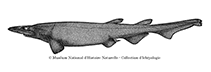 Apristurus melanoasper
Male Immagine di MNHN
Immagini | Google image
Male Immagine di MNHN
Classificazione / Nomi Nomi Comuni | Sinonimi | Catalog of Fishes(Genere, Specie) | ITIS | CoL | WoRMS | Cloffa
Elasmobranchi (squali e razze) (sharks and rays) > Carcharhiniformes (Ground sharks) > Pentanchidae (Deepwater catsharks)
Etymology: Apristurus: a-, Latin privative, i.e., without; pristis, from pristes (Gr.), sawyer (but here meaning saw); oura (Gr.), tail, referring to absence of saw-toothed crest of enlarged dermal denticles along upper edge of caudal fin as found in the closely related Pristiurus (=Galeus) (See ETYFish); melanoasper: melanos (Gr.), black; asper (L.), rough, referring to black body color and rough skin (See ETYFish).
Etymology: Apristurus: a-, Latin privative, i.e., without; pristis, from pristes (Gr.), sawyer (but here meaning saw); oura (Gr.), tail, referring to absence of saw-toothed crest of enlarged dermal denticles along upper edge of caudal fin as found in the closely related Pristiurus (=Galeus) (See ETYFish); melanoasper: melanos (Gr.), black; asper (L.), rough, referring to black body color and rough skin (See ETYFish).
Ambiente: milieu / zona climatica / distribuzione batimetrica / gamma di distribuzione Ecologia
marino batipelagico; distribuzione batimetrica 512 - 1520 m (Ref. 56212). Deep-water
Distribuzione Territories | Aree FAO | Ecosistemi | Presenze | Mappa dei ritrovamenti | Introduzioni | Faunafri
North Atlantic: Slope, off northern U.S. and off France, Ireland and British Isles.
Lunghezza alla prima maturità / Dimensione / Peso / Età
Maturità: Lm 57.0, range 55 - 59 cm
Max length : 76.1 cm TL maschio/sesso non determinato; (Ref. 56212); 73.2 cm TL (female); peso massimo pubblicato: 1.3 kg (Ref. 56212); peso massimo pubblicato: 1.3 kg
Max length : 76.1 cm TL maschio/sesso non determinato; (Ref. 56212); 73.2 cm TL (female); peso massimo pubblicato: 1.3 kg (Ref. 56212); peso massimo pubblicato: 1.3 kg
Breve descrizione Chiavi di identificazione | Morfologia | Morfometria
Diagnosis: Body uniformly black, slightly brownish in larger specimens. Dermal denticles large and giving a rough texture to the skin. Upper labial furrows longer than the lower ones. First dorsal fin only slightly smaller than the second dorsal fin, originating from above anterior third to middle of the pelvic fin base. Second dorsal fin insertion just before level of anal fin insertion. Interorbital space 1.9-3.5 times eye horizontal diameter. Abdomen between pectoral fin tip and pelvic fin origin 1.3-2.5 times pectoral fin width. Spiral valves of the intestine 19-23 (mostly 21-22). Monospondylous + precaudal diplospondylous vertebrae 36-43 + 26-32 (often 38-40 + 28-30). Dermal denticles on tongue and palate absent (Ref. 56212).
Body shape (shape guide): elongated.
Body shape (shape guide): elongated.
Found generally at depths of more than 1000 meters (Ref. 56212).
Ciclo vitale e comportamento di accoppiamento Maturità | Riproduzione | Deposizione | Uova | Fecondità | Larve
Riferimento principale
Caricare le referenze | Bibliografia | Coordinatore | Collaboratori
Iglésias, S.P., K. Nakaya and M. Stehmann, 2004. Apristurus melanoasper, a new species of deep-water catshark from the North Atlantic (Chondrichthyes: Carcharhiniformes: Scyliorhinidae). Cybium 28(4):345-356. (Ref. 56212)
Stato della Lista Rossa IUCN (Ref. 130435: Version 2025-2 (Global))
Least Concern (LC) ; Date assessed: 07 July 2023
CITES
Not Evaluated
Minaccia per l'uomo
Harmless
Usi umani
FAO - Publication: search | FishSource |
Informazioni ulteriori
Ecologia trofica
Articoli alimentari (prede)
Alimentazione
Consumo di cibo
Razioni alimentari
Predatori
Articoli alimentari (prede)
Alimentazione
Consumo di cibo
Razioni alimentari
Predatori
Ecologia
Ecologia
Ecologia
Dinamica della popolazione
Parametri di crescita
Età massima / dimensioni massime
Rapporto lunghezza-peso.
Lunghezza-lunghezza rel.
Lunghezza-frequenze
Conversione di massa
Reclutamento
Abbondanza
Parametri di crescita
Età massima / dimensioni massime
Rapporto lunghezza-peso.
Lunghezza-lunghezza rel.
Lunghezza-frequenze
Conversione di massa
Reclutamento
Abbondanza
Anatomia
Area branchiale
Cervello
Otolite
Area branchiale
Cervello
Otolite
Fisiologia
Composizione corporea
Nutrienti
Consumo di ossigeno
Tipo di nuoto
Velocità di nuoto
Pigmenti visivi
Suono del pesce
Malattie e parassiti
Tossicità (LC50)
Composizione corporea
Nutrienti
Consumo di ossigeno
Tipo di nuoto
Velocità di nuoto
Pigmenti visivi
Suono del pesce
Malattie e parassiti
Tossicità (LC50)
Legato all'uomo
Sistemi di acquacoltura
Profili di acquacoltura
Varietà
Casi di Ciguatera
Francobolli, monete, materiale vario.
Sistemi di acquacoltura
Profili di acquacoltura
Varietà
Casi di Ciguatera
Francobolli, monete, materiale vario.
Strumenti
Libro elettronico | Giuda pratica | Generatore frequenze di lunghezza | Strumento Parametri Biologici | Mappa dei ritrovamenti |
Cattura-MSY |
Rapporti speciali
Controllo della manutenzione dell'acquario | Verificare la presenza di schede informative sulle specie | Verifica delle schede informative sull'acquacoltura
Scarica XML
Fonti Internet
AFORO (otoliths) | Aquatic Commons | BHL | Cloffa | Websites from users | Check FishWatcher | CISTI | Catalog of Fishes: Genere, Specie | DiscoverLife | ECOTOX | FAO - Publication: search | Faunafri | Fishipedia | Fishtrace | GloBI | Google Books | Google Scholar | Google | IGFA World Record | OneZoom | Open Tree of Life | Otolith Atlas of Taiwan Fishes | PubMed | Reef Life Survey | Socotra Atlas | TreeBase | Tree of Life | Wikipedia: Go, ricerca | World Records Freshwater Fishing | Zoobank | Record zoologico
Stime basate su modelli
Temperatura preferita (Fonte Biblio. 123201): 3.5 - 9.9, mean 7.2 °C (based on 79 cells).
Indice di diversità filogenetica (Fonte Biblio. 82804): PD50 = 0.5000 [Uniqueness, from 0.5 = low to 2.0 = high].
Bayesian length-weight: a=0.00347 (0.00172 - 0.00698), b=3.08 (2.90 - 3.26), in cm total length, based on LWR estimates for this (Sub)family-body shape (Ref. 93245).
Livello trofico (Fonte Biblio. 69278): 4.0 ±0.6 se; based on size and trophs of closest relatives
Resilienza (Fonte Biblio. 120179): Molto basso, tempo minimo di raddoppiamento della popolazione più di 14 anni (Fec assumed to be <10).
Nutrienti (Ref. 124155): Calcium = 8.66 [1.82, 62.13] mg/100g; Iron = 0.255 [0.057, 1.009] mg/100g; Protein = 19.6 [17.3, 21.9] %; Omega3 = 0.115 [0.035, 0.351] g/100g; Selenium = 13.7 [3.4, 53.5] μg/100g; VitaminA = 13.5 [1.6, 98.3] μg/100g; Zinc = 0.388 [0.159, 0.952] mg/100g (wet weight);