



Beobachtung melden im Fish Watcher
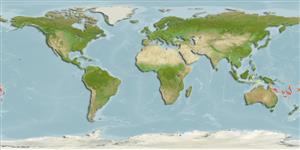
| Native range | All suitable habitat | Point map | Year 2050 |
|
| This map was computer-generated and has not yet been reviewed. |
| Urolophus deforgesi AquaMaps Data sources: GBIF OBIS |
Hochladen Photos und videos
Google Bild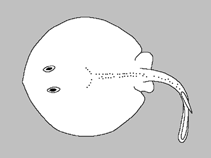 No image available for this species;
drawing shows typical species in Urolophidae.
Google Bild
drawing shows typical species in Urolophidae.
Klassifizierung / Names Namen | Synonyme | Catalog of Fishes(Gattung, Arten) | ITIS | CoL | WoRMS | Cloffa
Elasmobranchii (Haie und Rochen) (sharks and rays) > Myliobatiformes (Stingrays) > Urolophidae (Round rays)
Etymology: Urolophus: Greek, oura = tail + Greek, lophos = crest (Ref. 45335); deforgesi: Named for Bertrand Richer de Forges of the Institute de Recherche pour le Développemen, for promoting the recent exploration of the bathyal fauna off New Caledonia and for collecting valuable fish specimens from cruise surveys (Ref. 51067).
Eponymy: Dr Bertrand Richer-de-Forges (d: 1948) is a French carcinologist and marine biologist who (since 1984) has been based at ORSTOM, Noumea, New Caledonia. [...] (Ref. 128868), visit book page.
More on authors: Séret & Last.
Etymology: Urolophus: Greek, oura = tail + Greek, lophos = crest (Ref. 45335); deforgesi: Named for Bertrand Richer de Forges of the Institute de Recherche pour le Développemen, for promoting the recent exploration of the bathyal fauna off New Caledonia and for collecting valuable fish specimens from cruise surveys (Ref. 51067).
Eponymy: Dr Bertrand Richer-de-Forges (d: 1948) is a French carcinologist and marine biologist who (since 1984) has been based at ORSTOM, Noumea, New Caledonia. [...] (Ref. 128868), visit book page.
More on authors: Séret & Last.
Umwelt: Milieu / Klimazone / Tiefenbereich / Verbreitungsgebiet Ökologie
seewasser bathydemersal; tiefenbereich 203 - 330 m (Ref. 51067). Deep-water
Verbreitung Territorien | FAO Gebiete | Ökosysteme | Vorkommen | Punkt Karte | Einführungen | Faunafri
Western Central Pacific: Chesterfield Islands.
Größe / Gewicht / Alter
Kurzbeschreibung Bestimmungsschlüssel | Morphologie | Morphometrie
Rückenflossenstacheln (insgesamt) : 0; Wirbelzahl: 151 - 157. Weakly rhomboidal disc, width less than 70% total length; rather long tail, postcoacal length more than 75% of disc length; short head (ventral length mostly less than 30% total length) and snout (length to eye less than 15% total length); narrow, cartilaginous interorbit less than 4% total length; internasal flap greatly expanded posteriorly; no broad lobes on posterolateral border of nostrils; inner margin of spiracle oblique; no lateral tail folds; no dorsal fin; apices of pelvic fins rounded; 7-8 oral papillae arranged along a 'W' line on mouth floor; 96-102 pectoral fin radials; total vertebrae more than 150; dorsal surface uniform yellowish brown (Ref. 51067).
Body shape (shape guide): other.
Body shape (shape guide): other.
Inhabits the continental slope (Ref. 51067).
Lebenszyklus und Paarungsverhalten Geschlechtsreife | Fortpflanzung | Ablaichen | Eier | Fruchtbarkeit | Larven
Hauptreferenz
Laden Sie Ihre Referenzen hoch | Referenzen | Koordinator | Partner
Séret, B. and P. Last, 2003. Description of four new stingarees of the genus Urolophus (Batoidea: Urolophidae) from the Coral Sea, South-West Pacific. Cybium 27(4):307-320. (Ref. 51067)
IUCN Rote Liste Status (Ref. 130435: Version 2025-2 (Global))
nicht bedroht (LC) ; Date assessed: 20 June 2017
CITES
Not Evaluated
Bedrohung für Menschen
Harmless
Nutzung durch Menschen
FAO - Publication: search | FishSource |
Mehr Information
Trophische Ökologie
Lebensmittel (Beutetiere)
Nahrungszusammensetzung
Nahrungsaufnahme
Lebensmittelrationen
Räuber
Lebensmittel (Beutetiere)
Nahrungszusammensetzung
Nahrungsaufnahme
Lebensmittelrationen
Räuber
Populationsdynamik
Wachstumsparameter
Max. Alter/Größen
Länge-Gewicht-Rel.
Länge-Länge-Verhältnis.
Längenhäufigkeiten
Massenkonvertierung
Rekrutierung
Dichte
Wachstumsparameter
Max. Alter/Größen
Länge-Gewicht-Rel.
Länge-Länge-Verhältnis.
Längenhäufigkeiten
Massenkonvertierung
Rekrutierung
Dichte
Lebenszyklus
Fortpflanzung
Geschlechtsreife
Reifung/Kiemen rel.
Fruchtbarkeit
Ablaichen
Laichaggregationen
Eier
Eientwicklung
Larven
Larven Pop.Dyn.
Fortpflanzung
Geschlechtsreife
Reifung/Kiemen rel.
Fruchtbarkeit
Ablaichen
Laichaggregationen
Eier
Eientwicklung
Larven
Larven Pop.Dyn.
Anatomie
Kiemenoberfläche
Gehirn
Otolith
Kiemenoberfläche
Gehirn
Otolith
Physiologie
Körperliche Zusammensetzung
Nährstoffe
Sauerstoffverbrauch
Schwimmart
Schwimmgeschwindigkeit
Visuelle Pigmente
Fischgeräusche
Krankheiten und Parasiten
Toxizität (LC50s)
Körperliche Zusammensetzung
Nährstoffe
Sauerstoffverbrauch
Schwimmart
Schwimmgeschwindigkeit
Visuelle Pigmente
Fischgeräusche
Krankheiten und Parasiten
Toxizität (LC50s)
Genetik
Genom
Genetik
Heterozygotie
Vererbbarkeit
Genetische Vielfalt
Genom
Genetik
Heterozygotie
Vererbbarkeit
Genetische Vielfalt
Menschenbezogen
Aquakultur-Systeme
Aquakultur Profile
Zuchtlinien
Ciguatera-Fälle
Briefmarken, Münzen, Verschiedenes.
Aquakultur-Systeme
Aquakultur Profile
Zuchtlinien
Ciguatera-Fälle
Briefmarken, Münzen, Verschiedenes.
Tools
Zusatzinformationen
Download XML
Zusammenfassung | Punktdaten | Namen | Photos
Internet Quellen
AFORO (otoliths) | Aquatic Commons | BHL | Cloffa | Websites from users | FishWatcher Einträge suchen | CISTI | Catalog of Fishes: Gattung, Arten | DiscoverLife | ECOTOX | FAO - Publication: search | Faunafri | Fishipedia | Fishtrace | GloBI | Google Books | Google Scholar | Google | IGFA World Record | OneZoom | Open Tree of Life | Otolith Atlas of Taiwan Fishes | PubMed | Reef Life Survey | Socotra Atlas | TreeBase | Tree of Life | Wikipedia: Gehe zu, Suchen | World Records Freshwater Fishing | Zoobank | Zoologischer Rekord
Schätzungen auf der Grundlage von Modellen
Bevorzugte Temperatur (Ref. 123201): 4.2 - 5.6, mean 4.8 °C (based on 48 cells).
Phylogenetischer Diversitätsindex (Ref. 82804): PD50 = 0.5000 [Uniqueness, from 0.5 = low to 2.0 = high].
Bayesian length-weight: a=0.00813 (0.00371 - 0.01783), b=3.08 (2.87 - 3.29), in cm total length, based on LWR estimates for this (Sub)family-body shape (Ref. 93245).
Trophische Ebene (Ref. 69278): 3.5 ±0.4 se; based on size and trophs of closest relatives
Widerstandsfähigkeit (Ref. 120179): niedrig, Verdopplung der Population dauert 4,5 - 14 Jahre. (Assuming fecundity<100).