



Caecobarbus geertsii Boulenger, 1921
Congo blind barb
Envoyez vos Photos et vidéos
Images Google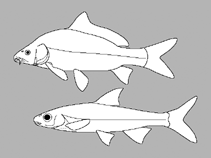 No image available for this species;
drawing shows typical species in Cyprinidae.
Images Google
drawing shows typical species in Cyprinidae.
Classification / Noms Noms communs | Synonymes | Catalog of Fishes(Genre, Espèce) | ITIS | CoL | WoRMS | Cloffa
> Cypriniformes (Carps) > Cyprinidae (Minnows or carps) > Smiliogastrinae
Etymology: Caecobarbus: Latin, caecus = blind + Latin, barbus = barbel (Ref. 45335).
Eponymy: G Geerts was an engineer and railway director in the Belgian Congo. [...] (Ref. 128868), visit book page.
More on author: Boulenger.
Etymology: Caecobarbus: Latin, caecus = blind + Latin, barbus = barbel (Ref. 45335).
Eponymy: G Geerts was an engineer and railway director in the Belgian Congo. [...] (Ref. 128868), visit book page.
More on author: Boulenger.
Environnement : milieu / zone climatique / profondeur / gamme de distribution Écologie
; eau douce benthopélagique. Tropical; 0°S - 5°S
Distribution Territoires | Zones FAO | Écosystèmes | Occurrences | Carte par point | Introductions | Faunafri
Africa: known only from some caves near Mbanza-Ngungu (lower Congo River basin), Democratic Republic of the Congo (Ref. 86866).
Taille / Poids / Âge
Description synthétique Clés d'identification | Morphologie | Morphométrie
Blind fish which lives in caves (Ref. 86866), about (700)750-850 m above sea-level (Ref. 2801, 86866). Feeds on small crustaceans living in the caves and also on animals washed into the caves (Ref. 557), although this needs confirmation (Ref. 86866). Estimated longevity 9-14 years, but may exceed 15 years (Ref. 86866). Not closely related to any extant epigean species of the Congo region. Classified as `textbook and popular press fish' in Ref. 4537.
Cycle de vie et comportement reproducteur Maturité | Reproduction | Frai | Œufs | Fécondité | Larves
Expels eggs in a more or less haphazard fashion, the substrate on which the species spawns must have crevices and pores into which the adhesive eggs can roll and be hidden so to prevent predation by its parents or other cave inhabitants.
Référence principale
Téléchargez vos références | Références | Coordinateur | Collaborateurs
Vreven, E., A. Kimbembi ma Ibaka and S. Wamuini Lunkayilakio, 2011. The Congo blind barb: Mbanza-Ngungu’s albino cave fish. p.74-75. In W.R.T. Darwall, K.G. Smith, D.J. Allen, R.A. Holland, I.J. Harrison and E.G.E. Brooks (eds.). The diversity of life in African freshwaters: under water, under threat. An analysis of the status and distribution of freshwater species throughout mainland Africa. IUCN, Cambridge, United Kingdom and Gland, Switzerland, 348p. (Ref. 86866)
Statut dans la liste rouge de l'IUCN (Ref. 130435: Version 2025-2 (Global))
Vulnérable (VU) (B1ab(i,ii,iii,iv)+2ab(i,ii,iii,iv)); Date assessed: 16 February 2009
Menace pour l'homme
Harmless
Utilisations par l'homme
Pêcheries: sans intérêt; Aquarium: Commercial
FAO - Publication: search | FishSource |
Plus d'informations
Écologie trophique
Aliments (proies)
Composition du régime alimentaire
Consommation alimentaire
Rations alimentaires
Prédateurs
Aliments (proies)
Composition du régime alimentaire
Consommation alimentaire
Rations alimentaires
Prédateurs
Dynamique des populations
Paramètres de croissance
Âges / tailles maximales
Longueur-poids rel.
Rel. longueur-longueur.
Fréquences de longueurs
Conversion de masse
Recrutement
Abondance
Paramètres de croissance
Âges / tailles maximales
Longueur-poids rel.
Rel. longueur-longueur.
Fréquences de longueurs
Conversion de masse
Recrutement
Abondance
Cycle de vie
Reproduction
Maturité
Maturité/épines rel.
Fécondité
Frai
Agrégats de frai
Œufs
Développement de l'œuf
Larves
Dynamique des populations larvaires
Reproduction
Maturité
Maturité/épines rel.
Fécondité
Frai
Agrégats de frai
Œufs
Développement de l'œuf
Larves
Dynamique des populations larvaires
Anatomie
Surface branchiale
Cerveau
Otolithe
Surface branchiale
Cerveau
Otolithe
Physiologie
Composition corporelle
Nutriments
Consommation d'oxygène
Type de natation
Vitesse de nage
Pigments visuels
Son de poisson
Maladies et parasites
Toxicité (CL50)
Composition corporelle
Nutriments
Consommation d'oxygène
Type de natation
Vitesse de nage
Pigments visuels
Son de poisson
Maladies et parasites
Toxicité (CL50)
Liées à l'homme
Systèmes d'aquaculture
Profils d'aquaculture
Souches
Cas de ciguatera
Timbres, pièces de monnaie, divers
Systèmes d'aquaculture
Profils d'aquaculture
Souches
Cas de ciguatera
Timbres, pièces de monnaie, divers
Outils
E-book | Guide de terrain | Générateur de fréquences de longueur | Outil de dynamique de population | Carte par point |
Capture-MSY |
Articles particuliers
Télécharger en XML
Sources Internet
AFORO (otoliths) | Aquatic Commons | BHL | Cloffa | Websites from users | FishWatcher | CISTI | Catalog of Fishes: Genre, Espèce | DiscoverLife | ECOTOX | FAO - Publication: search | Faunafri | Fishipedia | Fishtrace | GloBI | Google Books | Google Scholar | Google | IGFA World Record | OneZoom | Open Tree of Life | Otolith Atlas of Taiwan Fishes | PubMed | Reef Life Survey | Socotra Atlas | TreeBase | Arbre de Vie | Wikipedia: aller à, chercher | World Records Freshwater Fishing | Zoobank | Zoological Record
Estimations basées sur des modèles
Indice de diversité phylogénétique (Réf. 82804): PD50 = 1.0000 [Uniqueness, from 0.5 = low to 2.0 = high].
Bayesian length-weight: a=0.00603 (0.00282 - 0.01286), b=3.06 (2.87 - 3.25), in cm total length, based on LWR estimates for this (Sub)family-body shape (Ref. 93245).
Niveau trophique (Réf. 69278): 3.5 ±0.45 se; based on food items.
Résilience (Réf. 120179): Haut, temps minimum de doublement de population inférieur à 15 mois (Preliminary K or Fecundity.).