This website uses cookies to enhance your browsing experience and ensure the functionality of our site. For more detailed information about the types of cookies we use and how we protect your privacy, please visit our Privacy Information page.
×
Cookie Settings
This website uses different types of cookies to enhance your experience. Please select your preferences below:
> Anabantiformes (Gouramies, snakeheads) > Osphronemidae (Gouramies) > Macropodusinae
Etymology: Macropodus:Greek, makros = great + Greek, pous, podos = foot (Ref. 45335). Eponymy: P Specht was a German aquarist based in the French port of Le Havre, who received the first known specimens and donated examples to the author and to the BMNH. (Ref. 128868), visit book page.
Environnement : milieu / zone climatique / profondeur / gamme de distribution Écologie
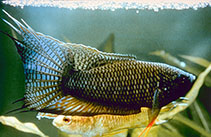
Épines dorsales (Total) : 11 - 15; Rayons mous dorsaux (Total) : 4 - 9; Épines anales: 17; Rayons mous anaux: 11 - 14; Vertèbres: 28 - 30. Differs from its congeners by the following combination of characters: caudal fin forked; opercular spot pale or missing; body without dark bars or with 4-12 faint and inconspicuous dark bars on pale brown to dark greyish background in preserved and live specimens; top of head and predorsal body without dark spots or saddle-like blotches; posterior tip or margin of scales on head and body conspicuously darker than scales; distal part of first soft pelvic-fin ray red in life; spots and bars on dorsal and caudal-fin membranes black; posterior dorsal-fin membranes and caudal-fin membranes blue in life; filamentous caudal-fin rays with white or black posterior extremity (Ref. 42924). Body shape (shape guide): short and / or deep.
Obligate air-breathing (Ref. 126274); Found in all kinds of hill stream habitats and along diverse structured margins or backwaters of large rivers, as well as in small streams and irrigation channels on farmland (Ref. 42924).
Cycle de vie et comportement reproducteur Maturité | Reproduction | Frai | Œufs | Fécondité | Larves
Freyhof, J. and F. Herder, 2002. Review of the paradise fishes of the genus Macropodus in Vietnam, with description of two species from Vietnam and southern China (Perciformes: Osphronemidae). Ichthyol. Explor. Freshwat. 13(2):147-167. (Ref. 42924)
Statut dans la liste rouge de l'IUCN (Ref. 130435: Version 2025-2 (Global))
Dynamique des populations Paramètres de croissance Âges / tailles maximales Longueur-poids rel. Rel. longueur-longueur. Fréquences de longueurs Conversion de masse Recrutement Abondance
Cycle de vie Reproduction Maturité Maturité/épines rel. Fécondité Frai Agrégats de frai Œufs Développement de l'œuf Larves Dynamique des populations larvaires
Physiologie Composition corporelle Nutriments Consommation d'oxygène Type de natation Vitesse de nage Pigments visuels Son de poisson Maladies et parasites Toxicité (CL50)
Indice de diversité phylogénétique (Réf. 82804): PD50 = 0.5020 [Uniqueness, from 0.5 = low to 2.0 = high].
Bayesian length-weight: a=0.01622 (0.00652 - 0.04036), b=2.97 (2.75 - 3.19), in cm total length, based on LWR estimates for this (Sub)family-body shape (Ref. 93245).
Niveau trophique (Réf. 69278): 3.4 ±0.4 se; based on size and trophs of closest relatives
Résilience (Réf. 120179): Haut, temps minimum de doublement de population inférieur à 15 mois (Preliminary K or Fecundity.).
Vulnérabilité de la pêche (Ref. 59153): Low vulnerability (10 of 100). 🛈