



Hemipristis elongata (Klunzinger, 1871)
Snaggletooth shark
Aggiungete la vostra osservazione in Fish Watcher
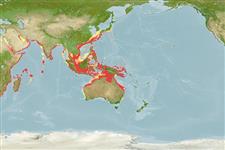
| Native range | All suitable habitat | Point map | Year 2050 |
|
| This map was computer-generated and has not yet been reviewed. |
| Hemipristis elongata AquaMaps Data sources: GBIF OBIS |
Carica il tuo foto e Video
Immagini | Google image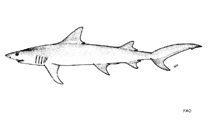 Hemipristis elongata
Immagine di FAO
Immagini | Google image
Immagine di FAO
Classificazione / Nomi Nomi Comuni | Sinonimi | Catalog of Fishes(Genere, Specie) | ITIS | CoL | WoRMS | Cloffa
Elasmobranchi (squali e razze) (sharks and rays) > Carcharhiniformes (Ground sharks) > Hemigaleidae (Weasel sharks)
Etymology: Hemipristis: hemi-, from hemisys (Gr.), half; pristis, from pristes (Gr.), sawyer (but here meaning saw), allusion not explained, possibly referring to how marginal serrations of teeth of H. serra (type species, a fossil) do not extend over the entire length of each tooth (See ETYFish); elongata: Latin for prolonged, referring to its long and slim body (See ETYFish).
More on author: Klunzinger.
Etymology: Hemipristis: hemi-, from hemisys (Gr.), half; pristis, from pristes (Gr.), sawyer (but here meaning saw), allusion not explained, possibly referring to how marginal serrations of teeth of H. serra (type species, a fossil) do not extend over the entire length of each tooth (See ETYFish); elongata: Latin for prolonged, referring to its long and slim body (See ETYFish).
More on author: Klunzinger.
Ambiente: milieu / zona climatica / distribuzione batimetrica / gamma di distribuzione Ecologia
marino demersale; distribuzione batimetrica 1 - 130 m (Ref. 6871). Tropical; 41°N - 34°S, 12°E - 156°E (Ref. 6871)
Distribuzione Territories | Aree FAO | Ecosistemi | Presenze | Mappa dei ritrovamenti | Introduzioni | Faunafri
Indo-West Pacific: Red Sea and southeast Africa, including Persian Gulf (Ref. 68964) to Philippines, north to China, south to Australia.
Lunghezza alla prima maturità / Dimensione / Peso / Età
Maturità: Lm ?, range 120 - ? cm
Max length : 259 cm TL maschio/sesso non determinato; (Ref. 130455); common length : 200 cm TL maschio/sesso non determinato; (Ref. 13567); peso massimo pubblicato: 63.0 kg (Ref. 130455)
Max length : 259 cm TL maschio/sesso non determinato; (Ref. 130455); common length : 200 cm TL maschio/sesso non determinato; (Ref. 13567); peso massimo pubblicato: 63.0 kg (Ref. 130455)
Breve descrizione Chiavi di identificazione | Morfologia | Morfometria
Spine dorsali (totale) : 0; Spine anali: 0. A slender weasel shark with a long, broadly rounded snout, large curved, saw-edged teeth in the upper jaw, and hooked lower teeth protruding from mouth; gill slits long; fins strongly curved (Ref. 5578). Light grey or bronzy with no prominent markings (Ref. 5578).
Body shape (shape guide): elongated.
Body shape (shape guide): elongated.
A coastal species, found inshore and offshore on the continental and insular shelves (Ref. 244). Feeds on sharks, rays and bony fishes (Ref. 244); also cephalopods (Ref. 13567). Viviparous (Ref. 50449). Thought to be potentially dangerous because of its large, fearsome teeth and shallow-water habitat, but has not been recorded in an attack on people (Ref. 244). Caught regularly by inshore gillnet, bottom trawl (occasionally) and longline fisheries (Ref.58048). Regularly taken in artisanal fisheries (Ref. 13567). Utilized fresh for human consumption, liver processed for vitamins, fins used in the oriental shark fin trade, and by-products processed into fishmeal (Ref. 244). Most adults below 200 cm (Ref. 30573).
Ciclo vitale e comportamento di accoppiamento Maturità | Riproduzione | Deposizione | Uova | Fecondità | Larve
Viviparous, with 2 to 11 young in a litter (Ref. 6871) after a gestation period of 7-8 months; possibly reproduces in alternate years (Ref.58048). Size at birth about 45-52 cm TL (Ref. 13567, Ref.58048). Distinct pairing with embrace (Ref. 205).
Riferimento principale
Caricare le referenze | Bibliografia | Coordinatore | Collaboratori
Compagno, L.J.V., 1984. FAO Species Catalogue. Vol. 4. Sharks of the world. An annotated and illustrated catalogue of shark species known to date. Part 2 - Carcharhiniformes. FAO Fish. Synop. 125(4/2):251-655. Rome: FAO. (Ref. 244)
Stato della Lista Rossa IUCN (Ref. 130435: Version 2025-2 (Global))
Endangered (EN) (A2d); Date assessed: 08 June 2023
CITES
Not Evaluated
Minaccia per l'uomo
Traumatogenic (Ref. 5213)
Usi umani
Pesca: commerciale
FAO - Publication: search | FishSource |
Informazioni ulteriori
Ecologia trofica
Articoli alimentari (prede)
Alimentazione
Consumo di cibo
Razioni alimentari
Predatori
Articoli alimentari (prede)
Alimentazione
Consumo di cibo
Razioni alimentari
Predatori
Dinamica della popolazione
Parametri di crescita
Età massima / dimensioni massime
Rapporto lunghezza-peso.
Lunghezza-lunghezza rel.
Lunghezza-frequenze
Conversione di massa
Reclutamento
Abbondanza
Parametri di crescita
Età massima / dimensioni massime
Rapporto lunghezza-peso.
Lunghezza-lunghezza rel.
Lunghezza-frequenze
Conversione di massa
Reclutamento
Abbondanza
Ciclo di vita
Riproduzione
Maturità
Maturità/Gli occhielli sono relativi.
Fecondità
Deposizione
Aggregazioni riproduttive
Uova
Sviluppo delle uova
Larve
Dinamica popolazioni larvali
Riproduzione
Maturità
Maturità/Gli occhielli sono relativi.
Fecondità
Deposizione
Aggregazioni riproduttive
Uova
Sviluppo delle uova
Larve
Dinamica popolazioni larvali
Anatomia
Area branchiale
Cervello
Otolite
Area branchiale
Cervello
Otolite
Fisiologia
Composizione corporea
Nutrienti
Consumo di ossigeno
Tipo di nuoto
Velocità di nuoto
Pigmenti visivi
Suono del pesce
Malattie e parassiti
Tossicità (LC50)
Composizione corporea
Nutrienti
Consumo di ossigeno
Tipo di nuoto
Velocità di nuoto
Pigmenti visivi
Suono del pesce
Malattie e parassiti
Tossicità (LC50)
Legato all'uomo
Sistemi di acquacoltura
Profili di acquacoltura
Varietà
Casi di Ciguatera
Francobolli, monete, materiale vario.
Sistemi di acquacoltura
Profili di acquacoltura
Varietà
Casi di Ciguatera
Francobolli, monete, materiale vario.
Strumenti
Libro elettronico | Giuda pratica | Chiavi di identificazione | Generatore frequenze di lunghezza | Strumento Parametri Biologici | Mappa dei ritrovamenti |
Cattura-MSY |
Rapporti speciali
Controllo della manutenzione dell'acquario | Verificare la presenza di schede informative sulle specie | Verifica delle schede informative sull'acquacoltura
Scarica XML
Fonti Internet
AFORO (otoliths) | Aquatic Commons | BHL | Cloffa | Websites from users | Check FishWatcher | CISTI | Catalog of Fishes: Genere, Specie | DiscoverLife | ECOTOX | FAO - Publication: search | Faunafri | Fishipedia | Fishtrace | GloBI | Google Books | Google Scholar | Google | IGFA World Record | Database Nazionali | OneZoom | Open Tree of Life | Otolith Atlas of Taiwan Fishes | PubMed | Reef Life Survey | Socotra Atlas | TreeBase | Tree of Life | Wikipedia: Go, ricerca | World Records Freshwater Fishing | Record zoologico
Stime basate su modelli
Temperatura preferita (Fonte Biblio. 123201): 23.8 - 29, mean 27.9 °C (based on 2110 cells).
Indice di diversità filogenetica (Fonte Biblio. 82804): PD50 = 1.0039 [Uniqueness, from 0.5 = low to 2.0 = high].
Bayesian length-weight: a=0.00355 (0.00172 - 0.00734), b=3.06 (2.88 - 3.24), in cm total length, based on LWR estimates for this species & (Sub)family-body (Ref. 93245).
Livello trofico (Fonte Biblio. 69278): 4.3 ±0.3 se; based on diet studies.
Resilienza (Fonte Biblio. 120179): Molto basso, tempo minimo di raddoppiamento della popolazione più di 14 anni (Fec=2).
Nutrienti (Ref. 124155): Calcium = 19.4 [3.2, 106.9] mg/100g; Iron = 0.636 [0.166, 1.913] mg/100g; Protein = 19.3 [17.2, 21.4] %; Omega3 = 0.101 [0.042, 0.245] g/100g; Selenium = 64.4 [18.5, 200.7] μg/100g; VitaminA = 13.4 [4.4, 42.6] μg/100g; Zinc = 0.614 [0.292, 1.120] mg/100g (wet weight);