



Hemipristis elongata (Klunzinger, 1871)
Snaggletooth shark
अपना अवलोकन जोड़ें Fish Watcher
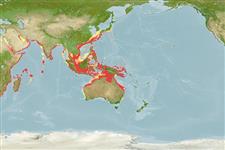
| Native range | All suitable habitat | Point map | Year 2050 |
|
| This map was computer-generated and has not yet been reviewed. |
| Hemipristis elongata AquaMaps Data sources: GBIF OBIS |
अपना अपलोड करें तस्वीरें और वीडियो
तस्वीरे | Google image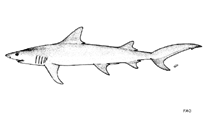 Hemipristis elongata
चित्र स्रोत: AP FAO
तस्वीरे | Google image
चित्र स्रोत: AP FAO
वर्गीकरण / नाम आम नाम | उपशब्द | Catalog of Fishes(वर्ग, प्रजाति) | ITIS | CoL | WoRMS | Cloffa
इलाज़मौबरांकी (शारक और रेज़) (sharks and rays) > Carcharhiniformes (Ground sharks) > Hemigaleidae (Weasel sharks)
Etymology: Hemipristis: hemi-, from hemisys (Gr.), half; pristis, from pristes (Gr.), sawyer (but here meaning saw), allusion not explained, possibly referring to how marginal serrations of teeth of H. serra (type species, a fossil) do not extend over the entire length of each tooth (See ETYFish); elongata: Latin for prolonged, referring to its long and slim body (See ETYFish).
More on author: Klunzinger.
Etymology: Hemipristis: hemi-, from hemisys (Gr.), half; pristis, from pristes (Gr.), sawyer (but here meaning saw), allusion not explained, possibly referring to how marginal serrations of teeth of H. serra (type species, a fossil) do not extend over the entire length of each tooth (See ETYFish); elongata: Latin for prolonged, referring to its long and slim body (See ETYFish).
More on author: Klunzinger.
पर्यावरण: पर्यावरण / जलवायु क्षेत्र / गहराई सीमा / वितरण सीमा पारिस्थितिकी
वितरण प्रदेशों | ऐफ ऐ ओ क्षेत्र | पारिस्थितिकी प्रणालियों | संयोग | बिन्दु नक्शा | भूमिका | Faunafri
Indo-West Pacific: Red Sea and southeast Africa, including Persian Gulf (Ref. 68964) to Philippines, north to China, south to Australia.
प्रथम परिपक्वता पर लंबाई / आकार / वज़न / आयु
परिपक्व अवधि: Lm ?, range 120 - ? cm
Max length : 259 cm TL पुल्लिंग / अलिंग; (Ref. 130455); common length : 200 cm TL पुल्लिंग / अलिंग; (Ref. 13567); अधिकतम प्रकाशित वज़न: 63.0 kg (Ref. 130455)
Max length : 259 cm TL पुल्लिंग / अलिंग; (Ref. 130455); common length : 200 cm TL पुल्लिंग / अलिंग; (Ref. 13567); अधिकतम प्रकाशित वज़न: 63.0 kg (Ref. 130455)
संक्षिप्त वर्णन पहचान कुंजी | आकृति विज्ञान | मौरफोमैटरिक्स
पृष्ठीय रीढ़ (सम्पूर्ण) : 0; गुदा कांटा: 0. A slender weasel shark with a long, broadly rounded snout, large curved, saw-edged teeth in the upper jaw, and hooked lower teeth protruding from mouth; gill slits long; fins strongly curved (Ref. 5578). Light grey or bronzy with no prominent markings (Ref. 5578).
Body shape (shape guide): elongated.
Body shape (shape guide): elongated.
A coastal species, found inshore and offshore on the continental and insular shelves (Ref. 244). Feeds on sharks, rays and bony fishes (Ref. 244); also cephalopods (Ref. 13567). Viviparous (Ref. 50449). Thought to be potentially dangerous because of its large, fearsome teeth and shallow-water habitat, but has not been recorded in an attack on people (Ref. 244). Caught regularly by inshore gillnet, bottom trawl (occasionally) and longline fisheries (Ref.58048). Regularly taken in artisanal fisheries (Ref. 13567). Utilized fresh for human consumption, liver processed for vitamins, fins used in the oriental shark fin trade, and by-products processed into fishmeal (Ref. 244). Most adults below 200 cm (Ref. 30573).
जीवन चक्र और संभोग व्यवहार परिपक्व अवधि | पुनरुत्पत्ति | मछलीऔ का अंडे देना | अंडे | उपजाऊपन | लार्वा
Viviparous, with 2 to 11 young in a litter (Ref. 6871) after a gestation period of 7-8 months; possibly reproduces in alternate years (Ref.58048). Size at birth about 45-52 cm TL (Ref. 13567, Ref.58048). Distinct pairing with embrace (Ref. 205).
मुख्य संदर्भ
अपने संदर्भ अपलोड करें | संदर्भ | संयोजक | सहयोगीयो
Compagno, L.J.V., 1984. FAO Species Catalogue. Vol. 4. Sharks of the world. An annotated and illustrated catalogue of shark species known to date. Part 2 - Carcharhiniformes. FAO Fish. Synop. 125(4/2):251-655. Rome: FAO. (Ref. 244)
आईयूसीएन रेड लिस्ट स्थिति (Ref. 130435: Version 2025-2 (Global))
Endangered (EN) (A2d); Date assessed: 08 June 2023
CITES
Not Evaluated
मनुष्यों के लिए ख़तरा
Traumatogenic (Ref. 5213)
मानव उपयोग
मात्स्यिकी: व्यापारिक
FAO - Publication: search | FishSource |
अधिक जानकारी
जनसंख्या गतिशीलता
विकास मापदंड
अधिकतम आयु/आकार
लंबाई-वजन संबंध
लंबाई-लंबाई संबंध
लंबाई-आवृत्तियाँ
सामूहिक रूपांतरण
भर्ती
बहुतायत
विकास मापदंड
अधिकतम आयु/आकार
लंबाई-वजन संबंध
लंबाई-लंबाई संबंध
लंबाई-आवृत्तियाँ
सामूहिक रूपांतरण
भर्ती
बहुतायत
जीवन चक्र
पुनरुत्पत्ति
परिपक्व अवधि
परिपक्वता/गिल्स संबंध
उपजाऊपन
मछलीऔ का अंडे देना
स्पॉनिंग एकत्रीकरण
अंडे
अंडे का विकास
लार्वा
लारवल गतिकी
पुनरुत्पत्ति
परिपक्व अवधि
परिपक्वता/गिल्स संबंध
उपजाऊपन
मछलीऔ का अंडे देना
स्पॉनिंग एकत्रीकरण
अंडे
अंडे का विकास
लार्वा
लारवल गतिकी
शरीर रचना
गिल क्षेत्र
दिमाग
ओटोलिथ
गिल क्षेत्र
दिमाग
ओटोलिथ
फिजियोलॉजी
शारीरिक संरचना
पोषक तत्व
प्राणवायु की खपत
तैराकी का प्रकार
तैराकी की गति
दृश्य वर्णक
मछली की आवाज
रोग एवं परजीवी
विषाक्तता (LC50s)
शारीरिक संरचना
पोषक तत्व
प्राणवायु की खपत
तैराकी का प्रकार
तैराकी की गति
दृश्य वर्णक
मछली की आवाज
रोग एवं परजीवी
विषाक्तता (LC50s)
मानव संबंधी
जलकृषि प्रणालियाँ
जलीयकृषि रूपरेखाऐ
खींच
सिगुएटेरा के मामले
टिकट, सिक्के, विविध.
जलकृषि प्रणालियाँ
जलीयकृषि रूपरेखाऐ
खींच
सिगुएटेरा के मामले
टिकट, सिक्के, विविध.
साधन
ई-पुस्तक | कार्यक्षेत्र पथप्रदर्शक | पहचान कुंजी | लंबाई आवृति इंद्रजालिक | जीवन-इतिहास उपकरण | बिन्दु नक्शा |
कैच-एमएसवाई |
विशेष रिपोर्ट
एक्वेरियम के रखरखाव की जांच करें | प्रजातियों के तथ्य पत्रक की जाँच करें | जलीय कृषि तथ्य पत्रक की जाँच करें
XML डाउनलोड करें
सारांश पृष्ठ | बिंदु डेटा | आम नाम | तस्वीरें
इंटरनेट स्रोत
AFORO (otoliths) | Aquatic Commons | BHL | Cloffa | Websites from users | Check FishWatcher | CISTI | Catalog of Fishes: वर्ग, प्रजाति | DiscoverLife | ECOTOX | FAO - Publication: search | Faunafri | Fishipedia | Fishtrace | GloBI | Google Books | Google Scholar | Google | IGFA World Record | राष्ट्रीय आंकड़ासंचय | OneZoom | Open Tree of Life | Otolith Atlas of Taiwan Fishes | PubMed | Reef Life Survey | Socotra Atlas | TreeBase | Tree of Life | Wikipedia: Go, खोज | World Records Freshwater Fishing | प्राणीशास्त्रीय अभिलेख
मॉडल पर आधारित अनुमान
पसंदीदा तापमान (संदर्भ 123201): 23.8 - 29, mean 27.9 °C (based on 2110 cells).
जातिवृति विविधता सूचकांक (संदर्भ 82804): PD50 = 1.0039 [Uniqueness, from 0.5 = low to 2.0 = high].
Bayesian length-weight: a=0.00355 (0.00172 - 0.00734), b=3.06 (2.88 - 3.24), in cm total length, based on LWR estimates for this species & (Sub)family-body (Ref. 93245).
ट्रॉफिक स्तर (संदर्भ 69278): 4.3 ±0.3 se; based on diet studies.
लौटाव (संदर्भ 120179): बहुत नीचे, न्यूनतम जनसंख्या दुगनी समय अवलागत 14 महीने। (Fec=2).
पोषक तत्व (Ref. 124155): Calcium = 19.4 [3.2, 106.9] mg/100g; Iron = 0.636 [0.166, 1.913] mg/100g; Protein = 19.3 [17.2, 21.4] %; Omega3 = 0.101 [0.042, 0.245] g/100g; Selenium = 64.4 [18.5, 200.7] μg/100g; VitaminA = 13.4 [4.4, 42.6] μg/100g; Zinc = 0.614 [0.292, 1.120] mg/100g (wet weight);