



Scolopsis taenioptera (Cuvier, 1830)
Lattice monocle bream
Adicionar as suas observações no Fish Watcher
| Native range | All suitable habitat | Point map | Year 2050 |

|
| This map was computer-generated and has not yet been reviewed. |
| Scolopsis taenioptera AquaMaps Data sources: GBIF OBIS |
Adicionar o seu Fotografias e vídeos
Fotografias | Imagem do Google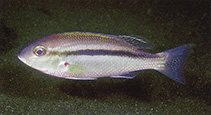 Scolopsis taenioptera
Fotografia de Kuiter, R.H.
Fotografias | Imagem do Google
Fotografia de Kuiter, R.H.
Classificação / Nomes Nomes comuns | Sinónimos | Catalog of Fishes(Género, Espécies) | ITIS | CoL | WoRMS | Cloffa
> Eupercaria/misc (Various families in series Eupercaria) > Nemipteridae (Threadfin breams, Whiptail breams)
Etymology: Scolopsis: Name from the Greek masculine noun 'skolos' meaning 'thorn' and suffix '-opsis' (from Greek feminine n. 'opsis' meaning 'aspect', 'appearance') meaning ‘thorny appearance’ presumably referring to 'les dentelures de la préopercule, en ont aussi, et même d'épineuses, aux sous-orbitaires' mentioned by Cuvier (1814) in his designation of the genus. Name ending in -'opsis' are treated as feminine according to ICZN 1999: Article 30.1.2 (Ref. 130620).
More on author: Cuvier.
Etymology: Scolopsis: Name from the Greek masculine noun 'skolos' meaning 'thorn' and suffix '-opsis' (from Greek feminine n. 'opsis' meaning 'aspect', 'appearance') meaning ‘thorny appearance’ presumably referring to 'les dentelures de la préopercule, en ont aussi, et même d'épineuses, aux sous-orbitaires' mentioned by Cuvier (1814) in his designation of the genus. Name ending in -'opsis' are treated as feminine according to ICZN 1999: Article 30.1.2 (Ref. 130620).
More on author: Cuvier.
Ambiente: milieu / zona climática / intervalo de profundidade / gama de distribuição Ecologia
marinhas demersal; intervalo de profundidade 2 - 50 m (Ref. 9785). Tropical; 26°N - 11°S, 93°E - 130°E (Ref. 120866)
Distribuição Territórios | Áreas FAO | Ecossistemas | Ocorrências | Mapa dos pontos | Introduções | Faunafri
Western Pacific: Southeast Asia (Taiwan Myanmar, Vietnam, Thailand, Malaysia, Indonesia and the Philippines); with two geographic populations: Philippines and the other countries in the region.
Tamanho / Peso / Idade
Maturidade: Lm ? range ? - ? cm
Max length : 25.0 cm SL macho/indeterminado; (Ref. 90102); common length : 15.0 cm SL macho/indeterminado; (Ref. 3810)
Max length : 25.0 cm SL macho/indeterminado; (Ref. 90102); common length : 15.0 cm SL macho/indeterminado; (Ref. 3810)
Descrição breve Chaves de identificação | Morfologia | Morfometria
Espinhos dorsais (total) : 10; Raios dorsais moles (total) : 9; Espinhos anais: 3; Raios anais moles: 7. This species is distinguished by the following characters: head scales reaching forward to between level of anterior margin of eyes and posterior nostrils; no scales on the bony opercular ridge and lower limb of the preopercle; antrorse spine below the eye absent; pectoral-fin rays 16-18; lateral-line scales 46-49. Colour of upper body greyish-yellow, whitish below; sides of body with faint oblique blue and yellow lines, horizontal on the caudal peduncle; a narrow blue stripe joining eyes just behind nostrils; a blue stripe from middle of upper lip to lower edge of eye; upper part of pectoral-fin base with a reddish orange spot; fins are yellowish; dorsal fin with a blue stripe along its middle area; upper tip of caudal fin bright yellow; upper base of caudal fin with a blue spot (Ref. 9785, 118977).
Body shape (shape guide): fusiform / normal; Cross section: oval.
Body shape (shape guide): fusiform / normal; Cross section: oval.
Occurs inshore on sand or mud bottoms (Ref. 118677). Swims in small groups. Feeds on small crustaceans, mollusks and fishes. Most abundant species of Scolopsis seen in Singapore, Malaysia and Thailand. Trawled in moderate numbers along with other species in the South China Sea and Gulf of Thailand. Highly rated as a food fish, although it sells for a low price and no major fishery exists. Sold fresh and prepared steamed or used for fish balls; sometimes salted or dried (Ref. 9785).
Ciclo de vida e comportamento de acasalamento Maturidade | Reprodução | Desova | Ovos | Fecundidade | Larvas
Also Ref. 103751.
Referência principal
Carregar as suas referências | Referências | Coordenador | Colaboradores
Russell, B.C., 1990. FAO Species Catalogue. Vol. 12. Nemipterid fishes of the world. (Threadfin breams, whiptail breams, monocle breams, dwarf monocle breams, and coral breams). Family Nemipteridae. An annotated and illustrated catalogue of nemipterid species known to date. FAO Fish. Synop. 125(12):149p. Rome: FAO. (Ref. 3810)
Categoria na Lista Vermelha da IUCN (Ref. 130435: Version 2025-2 (Global))
Preocupação menor (LC) ; Date assessed: 12 July 2020
CITES
Not Evaluated
Ameaça para o homem
Harmless
Utilização humana
Pescarias: espécies comerciais
FAO - Publication: search | FishSource |
Mais informação
Ecologia Trófica
Produtos alimentares (presas)
Composição da dieta
Consumo alimentar
Rações alimentares
Predadores
Produtos alimentares (presas)
Composição da dieta
Consumo alimentar
Rações alimentares
Predadores
Dinâmica das populações
Parâmetros de crescimento
Idades / tamanhos máximos
Comprimento-peso rel.
Comprimento-comprimento rel.
Frequência de comprimento
Conversão de massa
Recrutamento
Abundância
Parâmetros de crescimento
Idades / tamanhos máximos
Comprimento-peso rel.
Comprimento-comprimento rel.
Frequência de comprimento
Conversão de massa
Recrutamento
Abundância
Ciclo de vida
Reprodução
Maturidade
Maturidade/Rel. das guelras
Fecundidade
Desova
Agregações de desova
Ovos
Desenvolvimento dos ovos
Larvas
Dinâmica larvar
Reprodução
Maturidade
Maturidade/Rel. das guelras
Fecundidade
Desova
Agregações de desova
Ovos
Desenvolvimento dos ovos
Larvas
Dinâmica larvar
Anatomia
Área branquial
Cérebro
Otólitos
Área branquial
Cérebro
Otólitos
Fisiologia
Composição corporal
Nutrientes
Consumo de oxigénio
Tipo de natação
Velocidade de natação
Pigmentos visuais
Som de peixe
Doenças e Parasitas
Toxicidade (LC50s)
Composição corporal
Nutrientes
Consumo de oxigénio
Tipo de natação
Velocidade de natação
Pigmentos visuais
Som de peixe
Doenças e Parasitas
Toxicidade (LC50s)
Relacionado com o ser humano
Sistemas de aquacultura
Perfis para aquacultura
Estirpes
Casos de Ciguatera
Selos, moedas, diversos.
Sistemas de aquacultura
Perfis para aquacultura
Estirpes
Casos de Ciguatera
Selos, moedas, diversos.
Ferramentas
E-book | Guia de campo | Chaves de identificação | Ferramenta auxiliar de frequências de comprimento | Ferramenta sobre a história de vida | Mapa dos pontos |
Captura-MSY |
Relatórios especiais
Descarregue XML
Fontes da internet
AFORO (otoliths) | Aquatic Commons | BHL | Cloffa | Websites from users | Consultar FishWatcher | CISTI | Catalog of Fishes: Género, Espécies | DiscoverLife | ECOTOX | FAO - Publication: search | Faunafri | Fishipedia | Fishtrace | GloBI | Google Books | Google Scholar | Google | IGFA World Record | Bases de dados nacionais | OneZoom | Open Tree of Life | Otolith Atlas of Taiwan Fishes | PubMed | Reef Life Survey | Socotra Atlas | TreeBase | Árvore da vida | Wikipedia: ir para, procurar | | Registo zoológico
Estimativas baseadas em modelos
|
Índice de diversidade filogenética (Ref. 82804) |
PD50 = 0.5000 [Uniqueness, from 0.5 = low to 2.0 = high]. |
| Bayesian length-weight | a=0.01259 (0.00803 - 0.01973), b=3.00 (2.88 - 3.12), in cm total length, based on LWR estimates for this species & Genus-body shape (Ref. 93245). |
|
Nível Trófico (Ref. 69278) |
3.9 ±0.61 se; based on food items. |
| Generation time | 2.3 ( na - na) years. Estimated as median ln(3)/K based on 1 growth studies. |
|
Resiliência (Ref. 120179) |
Elevada, tempo mínimo de duplicação da população menor que 15 meses (K=0.4-1). |
|
Vulnerabilidade da pesca (Ref. 59153) |
Low to moderate vulnerability (27 of 100). 🛈 |
|
Categoria de preço (Ref. 80766) |
Low. |
|
Nutrientes (Ref. 124155) |
Calcium = 241 [94, 522] mg/100g; Iron = 1.58 [0.76, 2.88] mg/100g; Protein = 18.5 [16.6, 20.2] %; Omega3 = 0.269 [0.149, 0.485] g/100g; Selenium = 55.4 [27.8, 113.1] μg/100g; VitaminA = 14.7 [4.0, 44.2] μg/100g; Zinc = 1.26 [0.85, 1.89] mg/100g (wet weight); |