



Scolopsis taenioptera (Cuvier, 1830)
Lattice monocle bream
Ajouter votre observation dans Fish Watcher
| Native range | All suitable habitat | Point map | Year 2050 |

|
| This map was computer-generated and has not yet been reviewed. |
| Scolopsis taenioptera AquaMaps Data sources: GBIF OBIS |
Envoyez vos Photos et vidéos
Images | Images Google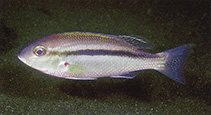 Scolopsis taenioptera
Photo de Kuiter, R.H.
Images | Images Google
Photo de Kuiter, R.H.
Classification / Noms Noms communs | Synonymes | Catalog of Fishes(Genre, Espèce) | ITIS | CoL | WoRMS | Cloffa
> Eupercaria/misc (Various families in series Eupercaria) > Nemipteridae (Threadfin breams, Whiptail breams)
Etymology: Scolopsis: Name from the Greek masculine noun 'skolos' meaning 'thorn' and suffix '-opsis' (from Greek feminine n. 'opsis' meaning 'aspect', 'appearance') meaning ‘thorny appearance’ presumably referring to 'les dentelures de la préopercule, en ont aussi, et même d'épineuses, aux sous-orbitaires' mentioned by Cuvier (1814) in his designation of the genus. Name ending in -'opsis' are treated as feminine according to ICZN 1999: Article 30.1.2 (Ref. 130620).
More on author: Cuvier.
Etymology: Scolopsis: Name from the Greek masculine noun 'skolos' meaning 'thorn' and suffix '-opsis' (from Greek feminine n. 'opsis' meaning 'aspect', 'appearance') meaning ‘thorny appearance’ presumably referring to 'les dentelures de la préopercule, en ont aussi, et même d'épineuses, aux sous-orbitaires' mentioned by Cuvier (1814) in his designation of the genus. Name ending in -'opsis' are treated as feminine according to ICZN 1999: Article 30.1.2 (Ref. 130620).
More on author: Cuvier.
Environnement : milieu / zone climatique / profondeur / gamme de distribution Écologie
Distribution Territoires | Zones FAO | Écosystèmes | Occurrences | Carte par point | Introductions | Faunafri
Western Pacific: Southeast Asia (Taiwan Myanmar, Vietnam, Thailand, Malaysia, Indonesia and the Philippines); with two geographic populations: Philippines and the other countries in the region.
Taille / Poids / Âge
Maturité: Lm ? range ? - ? cm
Max length : 25.0 cm SL mâle / non sexé; (Ref. 90102); common length : 15.0 cm SL mâle / non sexé; (Ref. 3810)
Max length : 25.0 cm SL mâle / non sexé; (Ref. 90102); common length : 15.0 cm SL mâle / non sexé; (Ref. 3810)
Description synthétique Clés d'identification | Morphologie | Morphométrie
Épines dorsales (Total) : 10; Rayons mous dorsaux (Total) : 9; Épines anales: 3; Rayons mous anaux: 7. This species is distinguished by the following characters: head scales reaching forward to between level of anterior margin of eyes and posterior nostrils; no scales on the bony opercular ridge and lower limb of the preopercle; antrorse spine below the eye absent; pectoral-fin rays 16-18; lateral-line scales 46-49. Colour of upper body greyish-yellow, whitish below; sides of body with faint oblique blue and yellow lines, horizontal on the caudal peduncle; a narrow blue stripe joining eyes just behind nostrils; a blue stripe from middle of upper lip to lower edge of eye; upper part of pectoral-fin base with a reddish orange spot; fins are yellowish; dorsal fin with a blue stripe along its middle area; upper tip of caudal fin bright yellow; upper base of caudal fin with a blue spot (Ref. 9785, 118977).
Body shape (shape guide): fusiform / normal; Cross section: oval.
Body shape (shape guide): fusiform / normal; Cross section: oval.
Occurs inshore on sand or mud bottoms (Ref. 118677). Swims in small groups. Feeds on small crustaceans, mollusks and fishes. Most abundant species of Scolopsis seen in Singapore, Malaysia and Thailand. Trawled in moderate numbers along with other species in the South China Sea and Gulf of Thailand. Highly rated as a food fish, although it sells for a low price and no major fishery exists. Sold fresh and prepared steamed or used for fish balls; sometimes salted or dried (Ref. 9785).
Cycle de vie et comportement reproducteur Maturité | Reproduction | Frai | Œufs | Fécondité | Larves
Also Ref. 103751.
Référence principale
Téléchargez vos références | Références | Coordinateur | Collaborateurs
Russell, B.C., 1990. FAO Species Catalogue. Vol. 12. Nemipterid fishes of the world. (Threadfin breams, whiptail breams, monocle breams, dwarf monocle breams, and coral breams). Family Nemipteridae. An annotated and illustrated catalogue of nemipterid species known to date. FAO Fish. Synop. 125(12):149p. Rome: FAO. (Ref. 3810)
Statut dans la liste rouge de l'IUCN (Ref. 130435: Version 2025-2 (Global))
Préoccupation mineure (LC) ; Date assessed: 12 July 2020
CITES
Not Evaluated
Menace pour l'homme
Harmless
Utilisations par l'homme
Pêcheries: commercial
FAO - Publication: search | FishSource |
Plus d'informations
Écologie trophique
Aliments (proies)
Composition du régime alimentaire
Consommation alimentaire
Rations alimentaires
Prédateurs
Aliments (proies)
Composition du régime alimentaire
Consommation alimentaire
Rations alimentaires
Prédateurs
Dynamique des populations
Paramètres de croissance
Âges / tailles maximales
Longueur-poids rel.
Rel. longueur-longueur.
Fréquences de longueurs
Conversion de masse
Recrutement
Abondance
Paramètres de croissance
Âges / tailles maximales
Longueur-poids rel.
Rel. longueur-longueur.
Fréquences de longueurs
Conversion de masse
Recrutement
Abondance
Cycle de vie
Reproduction
Maturité
Maturité/épines rel.
Fécondité
Frai
Agrégats de frai
Œufs
Développement de l'œuf
Larves
Dynamique des populations larvaires
Reproduction
Maturité
Maturité/épines rel.
Fécondité
Frai
Agrégats de frai
Œufs
Développement de l'œuf
Larves
Dynamique des populations larvaires
Anatomie
Surface branchiale
Cerveau
Otolithe
Surface branchiale
Cerveau
Otolithe
Physiologie
Composition corporelle
Nutriments
Consommation d'oxygène
Type de natation
Vitesse de nage
Pigments visuels
Son de poisson
Maladies et parasites
Toxicité (CL50)
Composition corporelle
Nutriments
Consommation d'oxygène
Type de natation
Vitesse de nage
Pigments visuels
Son de poisson
Maladies et parasites
Toxicité (CL50)
Liées à l'homme
Systèmes d'aquaculture
Profils d'aquaculture
Souches
Cas de ciguatera
Timbres, pièces de monnaie, divers
Systèmes d'aquaculture
Profils d'aquaculture
Souches
Cas de ciguatera
Timbres, pièces de monnaie, divers
Outils
E-book | Guide de terrain | Clés d'identification | Générateur de fréquences de longueur | Outil de dynamique de population | Carte par point |
Capture-MSY |
Articles particuliers
Télécharger en XML
Sources Internet
AFORO (otoliths) | Aquatic Commons | BHL | Cloffa | Websites from users | FishWatcher | CISTI | Catalog of Fishes: Genre, Espèce | DiscoverLife | ECOTOX | FAO - Publication: search | Faunafri | Fishipedia | Fishtrace | GloBI | Google Books | Google Scholar | Google | IGFA World Record | Bases de données nationales | OneZoom | Open Tree of Life | Otolith Atlas of Taiwan Fishes | PubMed | Reef Life Survey | Socotra Atlas | TreeBase | Arbre de Vie | Wikipedia: aller à, chercher | | Zoological Record
Estimations basées sur des modèles
|
Indice de diversité phylogénétique (Réf. 82804) |
PD50 = 0.5000 [Uniqueness, from 0.5 = low to 2.0 = high]. |
| Bayesian length-weight | a=0.01259 (0.00803 - 0.01973), b=3.00 (2.88 - 3.12), in cm total length, based on LWR estimates for this species & Genus-body shape (Ref. 93245). |
|
Niveau trophique (Réf. 69278) |
3.9 ±0.61 se; based on food items. |
| Generation time | 2.3 ( na - na) years. Estimated as median ln(3)/K based on 1 growth studies. |
|
Résilience (Réf. 120179) |
Haut, temps minimum de doublement de population inférieur à 15 mois (K=0.4-1). |
|
Vulnérabilité de la pêche (Ref. 59153) |
Low to moderate vulnerability (27 of 100). 🛈 |
|
Catégorie de prix (Ref. 80766) |
Low. |
|
Nutriments (Ref. 124155) |
Calcium = 241 [94, 522] mg/100g; Iron = 1.58 [0.76, 2.88] mg/100g; Protein = 18.5 [16.6, 20.2] %; Omega3 = 0.269 [0.149, 0.485] g/100g; Selenium = 55.4 [27.8, 113.1] μg/100g; VitaminA = 14.7 [4.0, 44.2] μg/100g; Zinc = 1.26 [0.85, 1.89] mg/100g (wet weight); |