



Kyphosus vaigiensis (Quoy & Gaimard, 1825)
Brassy chub
Waarneming toevoegen in Fish Watcher
| Native range | All suitable habitat | Point map | Year 2050 |

|
| This map was computer-generated and has not yet been reviewed. |
| Kyphosus vaigiensis AquaMaps Data sources: GBIF OBIS |
Uploaden van uw Foto's en video's
Afbeeldingen | video's | Google afbeelding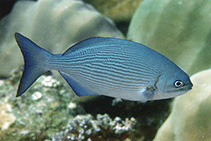 Kyphosus vaigiensis
Afbeelding van Allen, G.R.
Afbeeldingen | video's | Google afbeelding
Afbeelding van Allen, G.R.
Classificatie / Namen Lokale namen | Synoniemen | Catalog of Fishes(Genus, Soort(en)) | ITIS | CoL | WoRMS | Cloffa
> Centrarchiformes (Basses) > Kyphosidae (Sea chubs)
Etymology: Kyphosus: Greek, kyphos = bent (Ref. 45335).
More on authors: Quoy & Gaimard.
Etymology: Kyphosus: Greek, kyphos = bent (Ref. 45335).
More on authors: Quoy & Gaimard.
Taxonomic Remarks
Kyphosus species analogus (E. Pacific) and incisor (Atlantic) in Knudsen and Clements, 2013 (Ref. 95491:65) were considered as synonyms of K. vaigiensis.
Milieu: milieu / Klimaatzone / Diepte / verspreidingsgebied Ecologie
marien rifbewoner; oceanodroom (Ref. 51243); diepte 0 - 40 m (Ref. 89972). Tropical; 35°N - 38°S, 25°E - 133°W
Verspreiding Gebieden | FAO regio's | Ecosystemen | Voorkomen | Verspreidingskaart | Introducties | Faunafri
Circumtropical: from the eastern Pacific across the Pacific Ocean to the Indian
Ocean, the Red Sea and the eastern and western Atlantic and the Mediterranean.
Lengte bij maturiteit / Grootte / Gewicht / Leeftijd
Maturiteit: Lm ?, range 39 - ? cm
Max length : 70.0 cm TL mannelijk / geslacht onbekend; (Ref. 559); common length : 50.0 cm TL mannelijk / geslacht onbekend; (Ref. 5450)
Max length : 70.0 cm TL mannelijk / geslacht onbekend; (Ref. 559); common length : 50.0 cm TL mannelijk / geslacht onbekend; (Ref. 5450)
Korte beschrijving Determinatiesleutels | Morfologie | Morfometrie
Dorsale stekels (totaal) : 10 - 11; Dorsale zachte stralen (totaal) : 13 - 15; Anale stekels: 3; Anale zachte stralen: 12 - 14; Wervels: 26. This species is distinguished by the following characters: elongate and oval-shaped body; scale rows horizontally along the body appear alternately golden and bluish; metallic blue dorsally and white ventrally; caudal fin moderately emarginated; very low dorsal and anal fins; D X-XI,13-15; A III, 12-14; pectoral fin 17-20: teeth incisor-shaped; scales on interorbital region; external side of first gill arch with high number of gill rakers on lower limb 16-23, upper limb 5-10; total lateral line scale rows 63-80, 52-63 has pores; longitudinal scale rows 56-70; vertebrae: precaudal 10, caudal 16; pterygiophores, anal 13-14, dorsal 22-24. Colour of body silvery with a bluish shine, with golden horizontal lines along the body (around 23-29), dorsal lines above lateral line curved along the lateral line;; golden streak beneath eye from snout to behind anterior edge of eye; fins are grey or slightly darker grey than body colour (Ref. 95491).
Body shape (shape guide): short and / or deep; Cross section: compressed.
Body shape (shape guide): short and / or deep; Cross section: compressed.
Aggregate over hard, algal coated bottoms of exposed surf-swept outer reef flats, lagoons, and seaward reefs to a depth of at least 24 m. Found in exposed areas around rocky reefs (Ref. 559); adults usually close to the shore and the coastline, while juveniles are associated with flotsam and can be encountered in the open ocean close to the surface (Ref. 95491). Benthopelagic (Ref. 58302). Usually in groups (Ref. 90102). Young (up to 5 cm) found among floating seaweed; feeding on small crustaceans (Ref. 559). Adults are carnivorous during summer and autumn but feed on Endarachne binghamiae during winter (Ref. 559). Good food fish (Ref. 559). Minimum depth reported taken from Ref. 30573.
Levenscyclus en paargedrag Maturiteit | Voortplanting | Paaien | Eieren | Fecunditeit | Larven
Oviparous (Ref. 101771).
Hoofdreferentie
Upload uw referenties | Referenties | Coördinator | Medewerkers
Knudsen, S.W. and K.D. Clements, 2013. Revision of the fish family Kyphosidae (Teleostei: Perciformes). Zootaxa 3751(1):001-101. (Ref. 95491)
Status op de Rode Lijst van het IUCN (Ref. 130435: Version 2025-2 (Global))
Niet bedreigd (LC) ; Date assessed: 07 July 2014
CITES
Not Evaluated
Gevaar voor de mens
Harmless
Gebruik door de mens
Visserij: commercieel; sportvis: ja
FAO - Publication: search | FishSource | Sea Around Us
Meer informatie
Trofische ecologie
Voedsel (prooien)
Dieetsamenstelling
Voedselconsumptie
Voedselrantsoenen
Predatoren
Voedsel (prooien)
Dieetsamenstelling
Voedselconsumptie
Voedselrantsoenen
Predatoren
Populatiedynamica
Groeiparameters
Max. leeftijden / maten
Lengte-gewicht rel.
Lengte-lengte rel.
Lengtefrequenties
Massaconversie
Rekrutering
Abundantie
Groeiparameters
Max. leeftijden / maten
Lengte-gewicht rel.
Lengte-lengte rel.
Lengtefrequenties
Massaconversie
Rekrutering
Abundantie
Levenscyclus
Voortplanting
Maturiteit
Rijpheid/kieuwen rel.
Fecunditeit
Paaien
Paaibestanden
Eieren
Ontwikkeling van de eieren
Larven
Larvale populatiedynamiek
Voortplanting
Maturiteit
Rijpheid/kieuwen rel.
Fecunditeit
Paaien
Paaibestanden
Eieren
Ontwikkeling van de eieren
Larven
Larvale populatiedynamiek
Fysiologie
Lichaamssamenstelling
Voedingsstoffen
Zuurstofverbruik
Type zwemmen
Zwemsnelheid
Visuele pigmenten
Vis geluid
Ziekten en parasieten
Toxiciteit (LC50)
Lichaamssamenstelling
Voedingsstoffen
Zuurstofverbruik
Type zwemmen
Zwemsnelheid
Visuele pigmenten
Vis geluid
Ziekten en parasieten
Toxiciteit (LC50)
Genetica
genoom
Genetica
Heterozygositeit
Erfelijkheid
Genetische diversiteit
genoom
Genetica
Heterozygositeit
Erfelijkheid
Genetische diversiteit
Menselijk gerelateerd
Aquacultuursystemen
Aquacultuurprofielen
Kweeklijnen
Ciguatera gevallen
Postzegels, munten, diversen.
Aquacultuursystemen
Aquacultuurprofielen
Kweeklijnen
Ciguatera gevallen
Postzegels, munten, diversen.
Tools
Biologische quiz | E-boek | Veldgids | Determinatiesleutels | Lengtefrequentie Tool | Levenscyclus tool | Verspreidingskaart |
Vangst-MSY |
Speciale rapporten
Bekijk gegevens voor het houden in een aquarium | Bekijk Fact Sheets voor de soort | Bekijk Aquacultuur Fact Sheets
Download XML
Internetbronnen
AFORO (otoliths) | Aquatic Commons | BHL | Cloffa | Websites from users | Bekijk FishWatcher | CISTI | Catalog of Fishes: Genus, Soort(en) | DiscoverLife | ECOTOX | FAO - Publication: search | Faunafri | Fishipedia | Fishtrace | GloBI | Google Books | Google Scholar | Google | IGFA World Record | Nationale databanken | OneZoom | Open Tree of Life | Otolith Atlas of Taiwan Fishes | PubMed | Reef Life Survey | Socotra Atlas | TreeBase | Tree of Life | Wikipedia: ga naar, zoek | World Records Freshwater Fishing | Zoological Record
Schattingen op basis van modellen
Gewenste temperatuur (Ref. 123201): 24.7 - 29, mean 27.8 °C (based on 896 cells).
Fylogenetische diversiteitsindex (Ref. 82804): PD50 = 0.5000 [Uniqueness, from 0.5 = low to 2.0 = high].
Bayesian length-weight: a=0.01820 (0.01138 - 0.02910), b=3.00 (2.86 - 3.14), in cm total length, based on LWR estimates for this species & (Sub)family-body (Ref. 93245).
Trofisch niveau (Ref. 69278): 2.0 ±0.0 se; based on diet studies.
Weerstandsvermogen (Ref. 120179): laag, minimale populatieverdubbelingstijd 4,5-14 jaar (Preliminary K or Fecundity.).
Voedingsstoffen (Ref. 124155): Calcium = 34 [16, 63] mg/100g; Iron = 0.517 [0.303, 0.890] mg/100g; Protein = 18.2 [16.8, 19.5] %; Omega3 = 0.0772 [, ] g/100g; Selenium = 42 [21, 89] μg/100g; VitaminA = 32.6 [6.9, 140.7] μg/100g; Zinc = 1.24 [0.84, 1.85] mg/100g (wet weight);